Introduction to the Rearing Methods and Nutritional Value of the Black Guinea Pig
The black guinea pig is small in size (1-1.5 kg). It is gentle in temperament, likes to live in groups, is timid, easily startled, averse to disturbance, and has keen hearing. Its whole body is covered in black fur, with black eyes, a black mouth, black feet, and no tail; its ears and limbs are short, it is not good at jumping, and it generally does not bite or scratch people. As early as ancient China, there was a custom of eating black guinea pig meat, and it was selected into the Chinese famous dish cookbook as a high-grade wild dish. Su Dongpo, a poet and gourmet of the Song Dynasty, regretted all his life that he had never tasted guinea pig meat, and wrote a poem saying: “Caught in the pen, ashamed and unable to eat.” The deliciousness of the black guinea pig is well matched by the saying, “turtledoves in the sky, guinea pigs on the ground.”
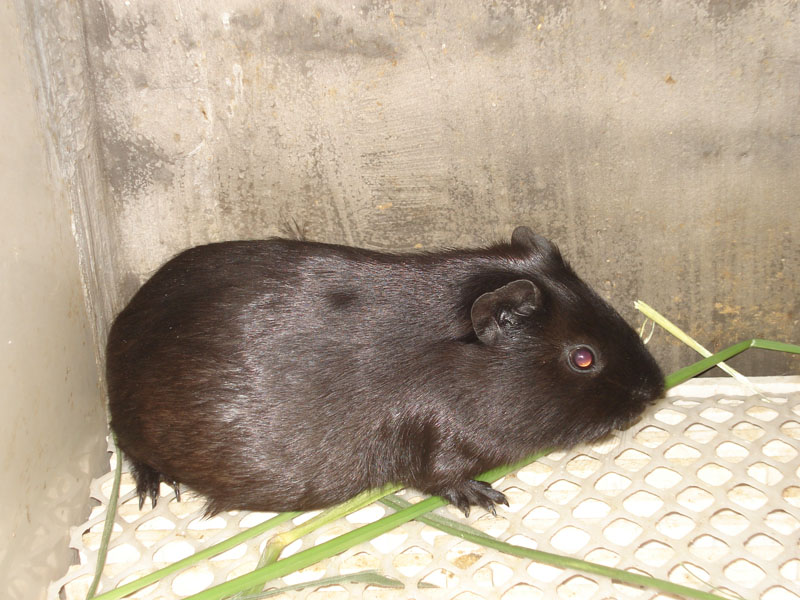
Aliases
[Aliases] Guinea pig, Dutch pig, cavy, because its whole body is black
black guinea pig
so it is called the black guinea pig
Origin
[Origin] The black guinea pig originated in the Peru region of South America
Category
[Category] It is a herbivorous mammal
Rearing Methods
I. Rearing facilities: There are many ways to raise black guinea pigs, adapted to local conditions. The methods commonly used are: cage rearing, pool-style pen rearing, and three-dimensional large-scale factory farming. (1) Cage rearing. This rearing method can be used for small-scale raising. Its advantages are that it can control breeding and feeding and maintain cleanliness and hygiene. The cage can be made of wooden strips, bamboo strips, or wire, and a size of 60 cm × 50 cm × 40 cm is suitable. (2) Pool-style pen rearing. It is suitable when there is a single-story house and sufficient width. Inside the room, bricks, wooden boards, and the like are used to partition off pools with an area of 0.5-1 sq m. It is best to spread some wood shavings or dry grass in the pool, which helps keep it warm and absorb moisture. At present, this method is mostly used for rearing. (3) Three-dimensional factory rearing: Its scale is relatively large and relatively concentrated, making it easy to manage and operate, and a large number can be raised. Bricks, wood, or iron bars are used to make 3-5 layers, with the bottom slightly slanted so that manure flows out, making management convenient. There are small doors in the pools and cages. For various rearing methods, generally the density is 8-10 animals per sq m for small ones and 10-20 animals for large ones.
II. Feed supply: The black guinea pig has a very miscellaneous diet, and normal growth, development, and reproduction all require sufficient nutrition. Because the black guinea pig is a herbivorous animal, it has a relatively high digestion rate for crude fiber. If it is not supplied with green feed or dried grass and other plants for a long time, skin peeling will occur, so the feed supply should have a proper combination of concentrate and green feed. (1) Concentrate: The concentrate is mainly cornmeal, wheat bran, rice bran, and the like, and piglet pellet feed can also be fed; (2) Green feed: fresh tender grass, such as ryegrass, corn leaves, sugarcane leaves, tree leaves, green vegetables, fruit peels, carrots, sweet potatoes, and the like.
III. Rearing management: Rearing management is the key to black guinea pig breeding, with the focus on preventing feed from becoming moldy and deteriorating. Compound feed is best mixed and fed immediately; when pellet feed is fed directly, clean water should be provided for drinking, or it can be mixed with feed and fed, with small meals and frequent feeding. The daily ration for each adult is about 40 grams, fed twice a day, and the feeding trough should be kept clean and hygienic. After feeding concentrate, fresh green feed should be put in at the same time. Green feed is best cut and fed the same day. The daily green feed intake for each adult is about 250 grams, and feeding green feed contaminated by pesticides and the like should be prevented.
The rearing room should be kept quiet, manure should be cleaned every day, and the utensils should be frequently scrubbed clean. The room temperature is best kept at 18-25°C, with a relative humidity of 45-55%, and good warmth retention work should be done in winter. Prevent rodents and snakes from entering the rearing room, and create a comfortable environment for the black guinea pigs.
IV. Breeding: According to preliminary observations, females show sexual characteristics at about 45 days after birth, and males at about 70 days, but the initial mating period for females should be after 70 days to ensure the reproduction rate.
1. Sex identification. 2. Selection and mating. The estrus period of the female lasts 1-18 hours. After mating, there is a rubber-like plug and secreted mixture at the vaginal opening. Based on the presence or absence of this plug, it can be judged whether the black guinea pig has mated successfully. In large-group rearing, it is common to use 2-3 females and put in one male for mating. Do not put in more than 2 males at the same time for breeding, otherwise it will cause fighting and affect mating. During rearing, if same-generation inbred variant breeds appear, replace the male and female with distant-related robust animals to increase the degree of pure breeding; if used for original stock breeding, a one-male-one-female distant-related mating method can be used. The female can be mated immediately after giving birth and weaning, or within half a day after giving birth, a male can be put in for mating. If successful, this can increase the reproduction rate.
The gestation period of the black guinea pig is 56-68 days, and the litter size is 1-6 young, with 3-15 in larger litters. The young guinea pigs begin to eat 3-5 days after birth, are weaned at about 15-20 days, and are then raised separately.
Nutritional Value
Dual use as medicine and food. Black guinea pig meat is fresh, tender, and delicious, and easy to digest and absorb. It is regarded by the people as a “precious product for strengthening the body.” Its fur can be processed and utilized.