Detailed Explanation of Key Techniques for Greenhouse Strawberry Cultivation
1. Choose suitable varieties or mix different varieties. Choose varieties such as Toyonoka and Meihou that produce many flowers under low-temperature conditions, have abundant pollen, large and uniform fruit, good coloration, mild acidity and few deformed fruits. Varieties such as Qiuxiang, Hokowase and All Star have less pollen and produce more deformed fruits, so pollinator varieties such as Chunxiang and Dana should be planted alongside them to facilitate pollination and fertilization, reduce deformed fruits and increase the proportion of large fruits.
2. Choose disease-free strong seedlings. Disease-free strong seedlings have well-developed root systems and strong disease resistance, and the strawberries they produce are large, high-yielding and of excellent quality.
3. Apply sufficient high-quality base fertilizer. Applying more high-quality decomposed farmyard manure can provide ample nutrients for strawberry growth, flower bud differentiation, flowering and fruit setting, and fruit development, increase fruit size, and raise the sugar content and coloration of the fruit. Apply 2000 kg of decomposed chicken manure per mu as base fertilizer, combining trench application with broadcast application.
4. Practice crop rotation and avoid continuous cropping. Crop rotation can improve the disease resistance of strawberries and reduce the number of deformed and diseased fruits. The open space between greenhouses can be fully used for cyclical rotation.
5. Increase light. Insufficient light from 2 weeks before flowering to the flowering period will affect pollination and fertilization and produce deformed fruits. Insufficient light during the fruit coloring period will lead to bland-tasting fruit and poor color. On the premise of ensuring the temperature inside the greenhouse, the straw mats should be uncovered as early as possible and covered as late as possible. Hang reflective film on the north side inside the greenhouse to increase light using reflected light. On cloudy or snowy days, incandescent lamps can be used for supplementary lighting.
6. Ridging cultivation and plastic film mulching. Ridging cultivation can reduce contact between the fruit and water dripping from the greenhouse film, enhance sunlight exposure to the fruit, reduce the occurrence of gray mold, and promote fruit coloring. Plastic film mulching can raise soil temperature, lower air humidity, prevent the fruit from directly contacting the soil, and help keep the fruit surface clean.
7. Strictly control temperature. The suitable greenhouse temperature is 22-25°C during the day and 8-10°C at night during the flowering period, and 20-24°C during the day and 6-10°C at night during the fruit enlargement period. Too high a temperature inside the greenhouse will shorten the fruit development period and make the fruit smaller.
8. Water and fertilize appropriately. Water appropriately during the flowering and fruiting period, and drip irrigation is preferable. Insufficient water during the flowering period will lead to poor pollination and fertilization and produce deformed fruits. Insufficient water during the fruit enlargement period will affect fruit enlargement. During the flowering and fruiting period, spray a 0.3% potassium dihydrogen phosphate solution 3-4 times in succession.
9. Assisted pollination. Poor pollination and fertilization is the root cause of deformed fruits, and using bees for assisted pollination can effectively reduce the occurrence of deformed fruits. Generally, during the flowering period, 1 box of bees is placed in each greenhouse for pollination.
10. Timely prevention and control of pests and diseases. Spraying pesticides during the strawberry flowering period can easily induce deformed fruits. If pests and diseases occur during the flowering period, spray should be done during a period with fewer flowers; move the beehive out of the greenhouse before spraying and move it back 1 week after application.
The Japanese strawberry company in Fujieda City: its cultivation area is equivalent to the area of 3 football fields. Moreover, a single strawberry greenhouse is 1.7 hectares in size, making it arguably the largest-scale strawberry farm in Japan!
This strawberry farm is located in Fujieda City.
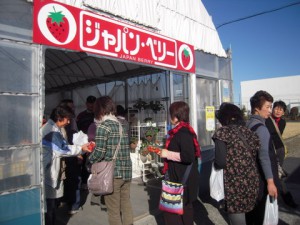
The agricultural production corporation "Japan Strawberry" is a strawberry production group jointly established in Heisei 15 by 3 farming households in the Shida · Haibara area.
I interviewed its representative manager, Mr. Masaru Ueyama.
※Ueyama currently also serves as chief director of the prefectural agricultural management association.
He said, “The 3 of us are tea farmers engaged in growing tea and lettuce; tea and strawberries; and tea and mushrooms, respectively. Of course, we still continue to grow tea now. Our main goal in operating this large-scale strawberry production is to achieve 'sustainable agriculture,' build an integrated system from production to sales, expand employment opportunities and achieve profitable operation.”
One member who had previously grown strawberries is responsible for cultivation techniques, Ueyama is responsible for planning and sales, and the other is responsible for accounting. Everyone gives play to their own talents and carries out the operation of the strawberry farm in a form of division of labor and cooperation.
In recent years, regarding the establishment of large-scale management systems and cultivation techniques, even strawberry farmers from China have asked Ueyama and the others to “provide guidance.“
The strawberry varieties cultivated here include "Benihoppe"; "Akihime"; "Sagahonoka" and "Kaorino", all using elevated cultivation methods.
They are committed to growing strawberries that are “ripened as thoroughly as possible on the strawberry plant” and have a “rich flavor.”
At the direct sales shop here, you can buy freshly picked strawberries and processed strawberry jam.
In addition, they also ship directly to Japanese-style confectionery shops and cake shops. The strawberries in the photo on the right are provided to the Japanese-style confectionery shop "Kashiharu" for use in strawberry daifuku sweets.
This place also serves as a tourist farm where visitors can pick strawberries. On weekends, many tour buses can be seen.
Ueyama said, “Because it is elevated cultivation, it is barrier-free, so even guests in wheelchairs can enjoy picking strawberries!
Everyone is welcome to come to this spacious strawberry greenhouse and taste fresh, delicious strawberries!”
The strawberry greenhouse is so spacious, it's really amazing!
Because it is elevated cultivation, the strawberry farm is very clean, and you can pick strawberries easily while standing. The freshly picked strawberries are delicious!!