Detailed Explanation of Key Technical Points for Strawberry Pipe Cultivation
Strawberry pipe cultivation uses pipes as the carrier for growing strawberries, and uses micro-control computers to achieve intelligent regulation of environmental factors such as nutrient solution, temperature, light, air and heat, allowing strawberries to grow, flower and fruit normally and rapidly under pipe hydroponic conditions. This method can reduce pests and diseases brought by soil, is safer and more hygienic, and can be used for three-dimensional cultivation in greenhouses, household balconies, indoors and other places, greatly increasing yield per unit area, and can also be developed as an agritourism project. The Intelligent Rapid Propagation Center of the Lishui City Agricultural Science Institute in Zhejiang Province achieved success through two years of experiments, and the main technical steps are introduced below.
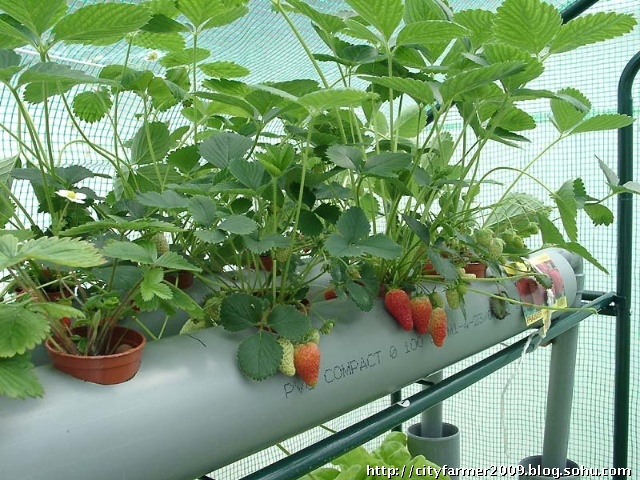
Pipe Strawberry Planting Technology
1. Construction of cultivation facilities
(1) Site selection. Large-area pipe cultivation is generally required to be carried out in greenhouse sheds to facilitate the control of temperature, light, air and heat, while small-area cultivation can be carried out on rooftops and balconies.
(2) Making the cultivation rack. Buy PVC pipes from the market, drill a hole every 20 cm, with a hole diameter of 6—10 cm, and a pipe length of 8—10 m is preferable; if too long, it is easy to cause oxygen deficiency in the plants at the end. Place the drilled PVC pipes on a leveled wooden frame, with the frame height at about 1.5 m for ease of manual operation; the wooden frame has a slope of 60 degrees, and each layer of pipes is 30 cm apart. If the spacing is too large, the planting quantity per unit area will be small; if too small, it will affect ventilation and light.
(3) Construction of nutrient solution tanks. The nutrient solution tanks are divided into mother solution tanks and storage tanks. The storage tank is mainly used for storing the circulating return of the pipe nutrient solution, so that the nutrient solution can be recycled. The mother solution tank is mainly used to store the mother solution for replenishing the nutrient solution. After the nutrient solution is absorbed by the plants, its nutrient content decreases. The micro-control computer can detect its conductivity value, and if it is lower than the set value, it will automatically replenish the mother solution. The nutrient solution tank and mother solution tank are best built underground; warm in winter and cool in summer, this is beneficial to the rapid growth of strawberries.
2. Cultivation techniques
(1) Selection of strawberry varieties. For pipe cultivation, strawberries generally choose varieties with a short dormancy period, few days from flower bud to flowering, and high fruit-setting rate, and with strong cold resistance, shade tolerance and disease resistance, such as Chunxiang, Mingbao, Fengxiang and other varieties, aiming for listing on the market at Spring Festival.
(2) Seedling preparation and planting. For greenhouse pipe cultivation of strawberries, the main purpose is to supply the off-season spring market, so the seedlings are required to have completed flower bud differentiation before freezing. One week before planting, use carbendazim, thiophanate-methyl, etc. for preventive disinfection and sterilization. Before planting, cut off old leaves, diseased leaves, stolons and some rotten roots, and remove small and weak seedlings. Planting is generally carried out in early October. When planting, wrap the root crown with sponge, insert it into the prepared pipe hole and fix it in place.
(3) Nutrient solution preparation. The nutrient solution used for strawberry cultivation can be a complete nutrient solution, such as the Japanese Enshi formula; a formula specifically for Yamazaki strawberries can also be used. To prevent precipitation during preparation, the calcium source and phosphorus source are generally separated. It can be divided into three categories: A, B and c (such as the Yamazaki strawberry formula). Group calcium nitrate and potassium nitrate, which do not produce precipitation, into one category; group monoammonium phosphate and magnesium sulfate into another category; and group the others into one category. During preparation, generally add water to 1/3 first, completely dissolve the category A substances, and stir evenly; then dissolve and dilute the category B substances to a certain degree and slowly inject them at the water inlet, adding water while injecting and stirring continuously; after stirring evenly, add liquid C in the same way. For the Yamazaki strawberry formula, prepare each ton according to the following amounts: Category A substances, calcium nitrate tetrahydrate 236 g, potassium nitrate 303 g; Category B substances, monoammonium phosphate 57 g, magnesium sulfate heptahydrate 123 g; Liquid C, chelated iron 20—40 g, boron 2.86 g, manganese sulfate tetrahydrate 2.13 g, zinc sulfate heptahydrate 0.22 g, copper sulfate 0.08 g, ammonium molybdate 0.02 g.
(4) Adjustment of the pH value of the nutrient solution. The pH value of the nutrient solution for strawberry cultivation is ideally maintained at a weakly acidic 5.5—6.5, and can be tested with a portable pH meter. If the pH is too high, that is, tending alkaline, an appropriate amount of phosphoric acid or sulfuric acid should be added for neutralization; in hard water areas, a mixture of phosphoric acid and sulfuric acid can be used for neutralization; if the pH is too low, that is, tending acidic, sodium hydroxide or potassium hydroxide can be added for neutralization. The pH adjustment cycle is preferably 1—2 weeks; if the pH value is found to be unsuitable, adjust it immediately in the storage tank.
3. Management after planting
(1) Management of the conductivity of the nutrient solution. Seedling stage after planting: 1.0—1.5 millisiemens; flowering and fruiting stage: 1.5—1.8 millisiemens; harvest stage: 1.8—2.0 millisiemens.