Detailed Explanation of Key Points on Peafowl Rearing and Breeding Techniques
I. Peafowl Rearing and Management
1 Brooding. It is best to brood in cages. At 1 to 3 days of age, the house temperature should reach 30°C to 31°C; at 1 week of age, the house temperature should reach above 28°C. For stocking density, keep 10 peafowl per brooding cage at 1 to 2 weeks of age, 6 to 8 at 3 to 4 weeks of age, and 5 at 5 to 8 weeks of age. First give the chicks a starter drink of multivitamin water or 0.02% potassium permanganate water, then feed them chick starter mash and yellow mealworms. If yellow mealworms are unavailable, 3% to 5% fishmeal can be mixed into the chick starter mash, or chopped cooked eggs can be fed. Supply sufficient drinking water, with an appropriate amount of compound vitamin B solution added to the water.
2 Rearing of growing peafowl. At 60 days of age, peafowl are transferred from brooding cages to growing pens, with a density of 10 to 12 birds per 30 sq m. For feed, two feed troughs can be used, one filled with grower chicken feed and the other with pigeon feed made from a mixture of corn, peas and the like. Add 3% fishmeal to the grower chicken feed, and at the same time place a basin of health grit in the pen. Supply a small amount of fresh green feed every day.
3 Breeding peafowl. Each pen houses one laying group, with 6 birds per laying group and a male-to-female ratio of 1:5. Two males must not be placed in the same pen at the same time; otherwise, the males will fight, affecting the laying rate and fertilization rate. For the breeding flock feed, use breeder chicken feed with 5% fishmeal added, plus pigeon feed, and health grit must also be supplied. It is best to supplement with yellow mealworms, 50 grams per bird per day, and keep a small amount of fresh green feed available. The breeder chicken feed should contain 18% to 20% crude protein and 11.70 to 12.54 megajoules/kg of energy. A reference pigeon feed formula is: corn 50%, bamboo beans 8%, hemp seed 5%, wheat 10%, peas 18%, mung beans 5%, brown rice 4%. A reference health grit formula is: red clay 40%, bone meal 10%, oyster shell 30%, salt 3%, medium sand 10%, Andrographis paniculata 2%, oxytetracycline 1%, multivitamins 1%, red iron oxide 2%, growth hormone 1%. Supply sufficient clean drinking water every day.
II. Peafowl Breeding
1 Peafowl breeding is strongly seasonal, with the annual laying season from March to August. Peafowl reach sexual maturity at 22 to 24 months of age, have a useful life of 5 years, and lay about 30 eggs per bird per year. Eggs are laid between 5:00 pm and 9:00 pm, with one egg laid every other day, and sometimes one egg laid only after several days; they do not lay an egg every day in succession.
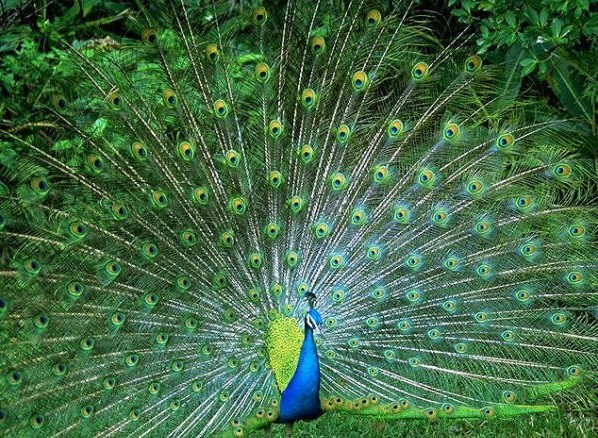
2 Before peafowl enter the breeding season, make up the breeding groups. When selecting breeding birds, choose healthy birds with good feather color, strong legs, and straight toes, and also take care to avoid inbreeding. The male-to-female ratio should be 1:5; do not use a 1:1 ratio, otherwise the females will be injured or disabled from excessive mating, and the use of pens and males will not be economical. However, the ratio must not exceed 1:5 either, otherwise the fertilization rate will decrease. Each group is one laying group, and each laying group can only be housed in one pen. When the laying season begins, peafowl start to come into heat, and the males send out courtship signals, generally before 10:00 am and after 5:00 pm. When courting, the male first fans his tail, approaches the female head-first, and circles around her. If the female is in heat, she crouches down and lets the male mount. If the female is not in heat, she shows no response, ignoring him or avoiding the male. If peafowl are disturbed or stimulated by the outside environment, they will also fan their tails and call out; this is a defensive reaction caused by external disturbance or stimulation. About half a month after courtship and mating, the female begins to lay. As laying approaches, the female keeps walking around and makes a “clucking” call, appearing restless and irritable, scratches the ground with both claws to make a nest, and then lays the egg in the nest.
3 A peafowl egg weighs about 108 grams. The incubation period is 26 to 28 days. Peafowl eggs must be collected promptly and stored in a cold room, and set for incubation once every 5 days. The incubation temperature is 37.5°C and the humidity is 65% to 70%. At 25 days of incubation, the hatching eggs are transferred to the hatcher, with a temperature of 37°C and a humidity of 75%. A newly hatched chick weighs 80 grams.
III. Disease Prevention and Control
Disease must be prevented first and foremost. Cleaning and hygiene work must be strengthened in routine rearing and management. Before peafowl are placed in a pen each time, the pen and utensils must be disinfected. Deworming should be carried out once every quarter. At 7 days of age, vaccinate against Newcastle disease with strain II vaccine by eye drop; at 30 days and 60 days of age, inject Newcastle disease strain I vaccine intramuscularly. Before laying begins each year, inject inactivated Newcastle disease vaccine intramuscularly once.