How do you keep guppies so they thrive? Keeping methods and tips
Guppies and swordtails are the easiest tropical fish to keep; even if you go on a business trip for 10 days to half a month, they won't easily die. Of course, this only means they tolerate hunger. If you keep tormenting them like that, they won't survive either.
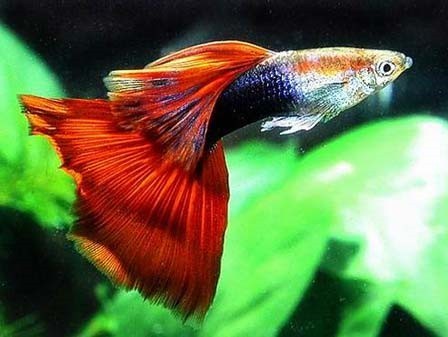
1. About changing the water
You only need to change the water once a week (1. Prepare special water, 2. Draw 2/3 of the tank's tap water in advance, put it on the balcony to sun for three days, 3. Draw 2/3 tap water, add a small amount of hot boiled water until it feels slightly warm to the touch). When it's very hot, do it twice.
2. About feeding
Feed once every morning, and never feed too much each time. If you observe after feeding and see the fish's belly is round and full, or even feces still trailing below the belly, that means you fed too much, and you should reduce the portion next time.
What specific equipment is needed for keeping guppies? Here is an introduction one by one:
1. Fish tank
2. Filtration equipment (water conditioner) = keeping water
3. Insulation equipment
4. Feed (live food, artificial feed)
5. Healthy guppies
1. Fish tank
The correct way to keep guppies is that one system should use at least 3 fish tanks.
Tank for keeping and spawning 1
Tanks for keeping males and females separately 2
Based on the general living situation in Taiwan, China (the same as in Japan), a small fish tank with a water volume of 12 liters to 18 liters is more suitable. For medium tanks over 40 liters, the maintenance cycle or method is different from small tanks, and a water-change keeping method must be chosen. Based on the author's experience, tanks with more than 40 liters of water have a higher rate of fish illness and physical deterioration than small tanks.
From practical experience, the author believes the most appropriate way to use fish tanks is as follows:
Tank for mating (holding 3pr) about 18 liters
Tank for spawning (fry) about 12 liters
Tank for fry from just born to 30 days old (about 12 liters) holding about 60
Tank for young fish from 30 days to 75 days old (about 18 liters), males and females separated, about 16 each
Tank for adult fish over 75 days old (about 18 liters), males and females separated, about 10 each
Tank for adult fish over 75 days old (about 36 liters), males and females separated, about 20 each
Tank for keeping and mating candidate breeding stock about 18 liters
Tank for keeping adult fish other than breeding stock about 36 liters to 90 liters
Using a tank with more than 50 liters of water to raise young fish has both advantages and disadvantages for ordinary hobbyists. Maintaining a tank of this size takes considerable time, so it is mostly based on the water-change maintenance method.
People generally think that a tank with more water has more stable water quality. Basically there is no doubt about this, but for refined fish like Taiwan, China guppies, it is not suitable.
Guppy specialty stores spend most of their time observing fish tanks, and as soon as the guppies show any problem, they can quickly take countermeasures. Although this kind of tank can raise a large number of fish, if one is slightly careless, it can easily cause problems such as infectious diseases, so it is not very suitable to recommend to ordinary hobbyists.
A fish tank is not good simply because it is large. Choosing different sizes for different uses is the simplest way to keep guppies. Especially when keeping breeding stock, it is best to keep them in the tank that is easiest for you to maintain.
In summary, the author believes that an 18-liter fish tank is the easiest to use and the easiest to maintain, so this size of tank is also most commonly used by hobbyists in Japan.
2. Filtration equipment (water conditioner) = keeping water
A filter is an item that creates and maintains keeping water. Therefore, it would not be an exaggeration to say that different filtration methods will determine different water quality.
Filtration methods can be roughly divided into the following four types:
(1) Filtration method with an undergravel filter plate plus substrate
(2) Filtration method using only sponge
(3) Filtration method using sponge and substrate together
(4) Top filtration method
Hobbyists in Taiwan, China seem to use methods (2) and (3) more. The advantage of method (2) is that when feeding artificial feed or tubifex worms, leftovers are easier to clean up, and changing water is also easier. Moreover, if the fish tank is placed in a location where weight must be considered, it is also more advantageous. The disadvantage is that water quality tends to change rapidly, and it is very difficult to do any aquascaping to highlight the beauty of guppies.