Detailed Introduction to Monopterus albus (Swamp Eel) Farming Technology in Plastic Film Ponds
China Monopterus albus (Swamp Eel) Research Network
The soil-free, still-water Monopterus albus (swamp eel) farming technology in plastic film ponds invented by Dr. Zhou Wenzong:
1. Low pond construction cost: the cost per sq m is less than 25 yuan (including piping facilities, labor costs and plastic film, etc.), with a service life of 8 years and fast construction speed, overcoming the shortcomings of high cost and slow construction of cement ponds, at roughly 1/3 to 1/2 of the cost of cement ponds. It is also easy to maintain: once a crack or hole appears in the film, it can be welded with a plastic hot-air welding gun;
2. It does not affect the nature of agricultural land; if Monopterus albus is not farmed, the original land characteristics can easily be restored, making it suitable for developmental use of collective construction land after land transfer;
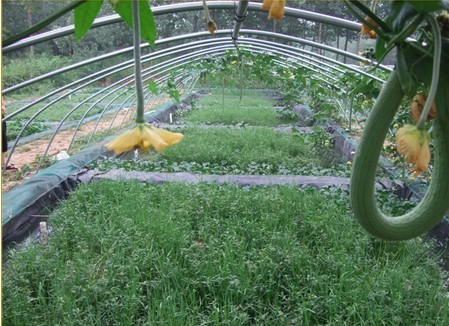
3. Farming is possible in all four seasons, avoiding the shortcomings of cage farming with its concentrated season (June to September) and high fry prices, reducing the cost by 10 to 20 yuan per kg of fry; overwintering is relatively easy and the water temperature is relatively high, so the eels can be sold around the Spring Festival when the price of commercial eels is highest, fetching about 10 to 20 yuan more per kg;
4. Low water use and wide adaptability: it can be used for courtyard farming or large-scale farming; for indoor farming (including balconies and rooftops) or outdoor farming; for freshwater farming or farming on saline-alkali land;
5. Labor-saving: for the same farming area, the labor required is only 1/3 of that for cage farming, and the operation is safe;
6. When pests and diseases occur, they are easy to observe and measures can be taken in advance; spraying liquid medicine leaves no dead corners, disease control is effective, and drug costs are low; the pond walls are very smooth and will not damage the mucus layer on the body surface of Monopterus albus, which can prevent fish diseases, with a survival rate 10% higher than that of cages; 7. In low-temperature seasons the water temperature is often higher than in cement ponds, which helps extend the feeding period of Monopterus albus; the quality of the farmed eels is easy to control, water changes and sludge removal are thorough, the water body remains usable for a long time, ecological farming causes no pollution to the water body, and the income from by-products such as loach and small miscellaneous fish is 20 yuan per sq m.
Plastic film pond farming uses specially made fish nests instead of soil and uses aquatic plants and water quality improvers to improve water quality. Although the pond is relatively small, the water quality can be maintained in a stable state. By growing vegetables on the water surface, such as water dropwort and water spinach, the goal is ultimately achieved that no further water changes are needed for eel farming and no further fertilization is needed for vegetable growing. Generally, we require a water change every 30 days in spring and autumn, while in summer a water change every half month is sufficient; at ordinary times, it is only necessary to add part of the water lost to evaporation.
In 2005 we began using HDPE anti-seepage film with a smooth surface and a rough surface and a thickness of 0.35 mm for farming. The main components of this film are 97.5% high-density polyethylene and about 2.5% auxiliary materials such as carbon black, anti-aging agents, antioxidants, ultraviolet absorbers and stabilizers. It has good heat resistance and cold resistance, good chemical stability, and resistance to corrosion by acids, alkalis and organic solvents; it has relatively high rigidity and toughness, good mechanical strength, and good resistance to environmental stress cracking and tearing; it has excellent puncture resistance, can resist most plant root systems, and is environmentally friendly and non-toxic. After several years of demonstration and promotion, we have continuously optimized and improved the construction process and farming technology, gradually standardizing and proceduralizing them, producing good results, receiving an enthusiastic welcome from the vast number of farmers, and showing broad development prospects.
Many people will ask: "With black film, the water temperature of the fish pond rises extremely fast when the summer sun is overhead; even with the best shading treatment, the water temperature can easily reach or exceed the high-temperature limit of the swamp eel and cause fish death." In fact, Monopterus albus in soil-free still-water ecological farming in plastic film ponds inhabit the lowest layer of the pond. Although the outside air temperature reaches above 37°C, we use three-dimensional ecological farming, planting luffa, grapes and so on beside the pond for shade, and then grow vegetables on the water surface and transplant aquatic plants, which not only purifies the water quality but also provides shade. Therefore, generally the water temperature 15 cm below the surface is only about 33°C, and in the summer months of June, July and August the water level is generally about 30 cm, so the water temperature at the bottom of the pond generally will not suddenly rise or fall. In addition, our experiments confirm that the optimal temperature for Monopterus albus feeding is 31 to 33°C, so the high-temperature resources of summer should be fully used to promote the growth of Monopterus albus.
Pomacea canaliculata (golden apple snail) has a wide diet and can eat the feed left over by Monopterus albus and the accumulated feces, thus promptly achieving a water purification effect to a certain extent. But some people will ask: "It is an intermediate host of many pathogens; using it will inevitably increase the incidence of disease in Monopterus albus." According to the practice of adding 2 jin of Pomacea canaliculata or field snails per 20 sq m pond, we suppress the occurrence of disease in Monopterus albus by controlling the quantity and strictly disinfecting, rather than arbitrarily putting Pomacea canaliculata or field snails into the Monopterus albus pond. In addition, we regulate water quality through microbial preparations, water quality regulators, animal tool species and various water treatment technologies, so there is no need to worry about water quality deterioration in small ponds. Moreover, experiments confirm that the rapid growth of Monopterus albus requires fertile water, and its requirement for water fertility is higher than that of ordinary fish.
Someone asks: "With the use of greenhouses, everyone knows that the temperature difference inside and outside the greenhouse is very large. The fish pond needs water changes, and the water temperature of the fish pond inside the greenhouse is relatively high, while the water temperature outside is relatively low; with such a large temperature difference when water goes out and comes in, Monopterus albus will catch a cold." There is a certain difference between the water temperature inside and outside the greenhouse, generally about 5°C. For water changes, we generally only need to change one third of the pond water volume. Through "seedling hardening" the ability of Monopterus albus to adapt to temperature differences can be improved. Whether Monopterus albus catches a cold depends on the quality of the fry and the handling techniques. Nowadays there are many winter swimming enthusiasts in the cold north, and they do not worry about catching cold either.