Detailed Explanation of Practical Breeding Techniques for Black Carp
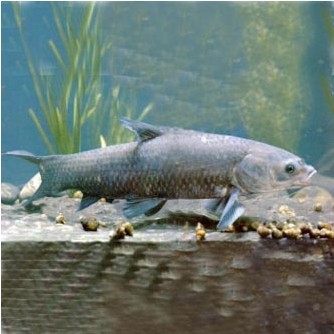
I. Ecological Habits
1. Feeding Habits
The black carp (Mylopharyngodon piceus) is a carnivorous fish. At the fry and fingerling stages, it mainly feeds on zooplankton. When the body length reaches about 15cm, its feeding habits change and it begins to feed on small snails and similar organisms. As the pharyngeal teeth develop and their crushing function strengthens, juvenile fish feed mainly on mollusks, such as mussels and river snails. In addition, they also eat shrimp, crabs and insect larvae.
2. Growth
The black carp has a large body size and grows rapidly, with a maximum weight of up to 70kg. One-year-old fish can reach 500g, two-year-old fish reach 2.5—3 kg, and three-year-old fish can reach 6.5—7.5 kg in a good environment. The body length of the black carp grows fastest at 1—2 years of age, and the body length growth rate slows after 5 years of age; weight gain is fastest at 3—4 years of age, and then weight continues to increase.
3. Reproduction
The black carp is a migratory fish. It grows and develops in the affiliated water bodies of rivers, enters the rivers to overwinter in winter, and after the beginning of spring the overwintering brood fish swim upstream, and during the upstream migration their gonads develop rapidly to maturity; they spawn and reproduce in spawning grounds in the main stream of the river, and after spawning the brood fish enter the affiliated water bodies again to fatten up. The breeding season is May—June each year, requiring a water temperature of 18—28°C. When the spawning ground rises in water level, the flow velocity is 1—2m/s, and the flow pattern becomes turbulent, the brood fish begin to spawn. Black carp eggs are pelagic and hatch and develop with the water flow. The age of sexual maturity of the black carp is: female fish 5—7 years, male fish 4—5 years. Spawning type: sexually mature individuals mature their gonads once a year and spawn once. The fecundity of the black carp increases markedly with body weight; generally, brood fish of 15—20kg have a fecundity of about 600,000—1,000,000 eggs.
II. Artificial Propagation
1. Sources of Brood Fish
Natural fry and fingerlings from river basins, or fry and fingerlings produced by national original seed farms, or adult black carp selectively collected from natural germplasm resource banks, or from natural waters such as rivers, reservoirs and lakes that have not been artificially stocked, and then cultivated to serve as brood fish. Offspring from inbreeding must not be used as a source of brood fish.
2. Brood Fish Rearing and Cultivation
(1) Brood fish are required to be over 6 years old and weigh more than 15 kilograms, stocked at a female-to-male ratio of 1:1.5, with about 10 black carp of 15~20 kilograms stocked per mu.
(2) The brood fish pond should have a flat bottom, preferably sandy loam soil, and maintain fresh water quality. Feeding is mainly on river snails, clams and mussel meat, supplemented with a small amount of soybean cake and malt. New water should be added and flushing carried out regularly. Generally, in winter, flush once a month and maintain a water depth of more than 2 meters. After the beginning of spring, lower the water level to help raise the pond water temperature, flushing once a week. From mid-April, increase the frequency of flushing, flushing once every 2~3 days, to promote gonadal maturation.
(3) In the brood fish pond, stock a small number of silver carp and bighead carp to regulate water quality, and at the same time appropriately co-stock carnivorous fish such as snakehead and California bass to prey on wild trash fish in the pond, which is beneficial to brood fish cultivation and also increases pond profitability.
3. Induced Spawning of Brood Fish
(1) Time and water temperature for induced spawning: In the middle and lower reaches of the Yangtze River, the induced spawning time is mid-to-late May, and the most suitable water temperature for induced spawning is 25~28°C.
(2) Selection of brood fish: The maturity of brood fish directly affects the effect of induced spawning. The criteria for identification are: for male fish, milt flows out when the abdomen is gently squeezed and disperses immediately upon contact with water; for female fish, the abdomen is enlarged, soft and elastic, and the abdominal scales are relatively sparse. In order to improve the maturity of the population, a seine net inspection can be carried out in mid-April. For those with poorer maturity, according to individual size and maturity, inject LRH-A 3~5 micrograms per fish respectively.
(3) Injection of spawning-inducing agents: Commonly used spawning-inducing agents are LRH-A, DOM, PG, etc. Usually, mixing two of them gives better results. Our farm uses three injections, achieving a high induced spawning rate of over 95%. The first injection: inject 1 microgram of LRH-A per kilogram of body weight for each brood fish, with an interval of 20 hours; the second injection: inject 5 micrograms of LRH-A per kilogram of body weight for each brood fish, with an interval of 8 hours; the third injection: for female brood fish, inject 20 micrograms of LTH-A per kilogram plus 3~4 milligrams of PG or plus 4~5 milligrams of DOM; the dose for male brood fish is 1/3~1/2 of the female dose depending on the specific situation. All injections are administered via the thoracic cavity.
4. Estrus and Artificial Insemination
The duration of the effect time varies with the water temperature. According to observations, when the water temperature is 26~28°C, the effect time is 6~7 hours. When the brood fish reach the expected estrus time and in combination with the actual estrus condition, the brood fish are caught for artificial insemination. During insemination, care should be taken to act gently and quickly. When mixing sperm and eggs, appropriately add 0.6% physiological saline to prolong the insemination time. At the same time, during insemination, direct sunlight and rainwater splashing in should be avoided to improve the fertilization rate. The normal fertilization rate reaches over 90%.