How to raise native chickens well in mountain orchards? Practical breeding tips shared
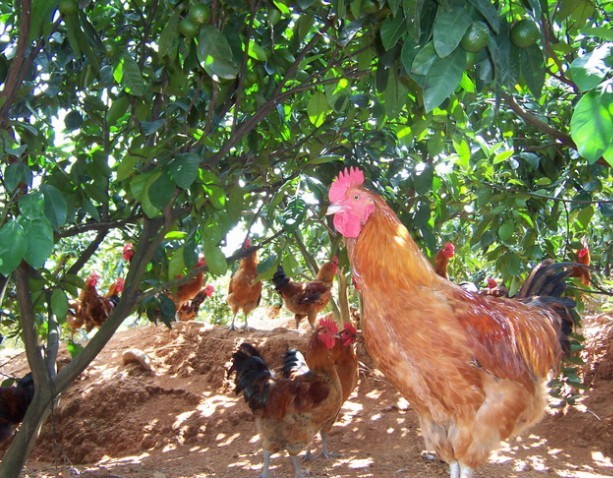
How to raise native chickens well in mountain orchards
[ Feeding management]
The main thing is to do a good job of brooding-period management. The entire brooding period takes place in chicken houses in the orchard and winter fallow fields, so during the brooding period the main things to do well are keeping the chicks warm and preventing and treating disease.
Preparation before brooding: where there is a power supply, infrared light bulbs can be used for heating; where power is lacking, a homemade iron-barrel stove can be used for heating, with a chimney to vent the gas outside the house. In the brooding room, 4——5 days before the chicks arrive, after disinfection, spread dry rice straw, rice husks or sawdust as litter. (The litter is replaced once a week during the brooding period.) 1 day——2 days before the chicks arrive, turn on the heating equipment to pre-warm.
Feeding management during the brooding period: chicks are generally kept indoors for warmth. The age at which heating is stopped depends on the season; in winter and spring it is about 30 days, in summer about 10 days, and in autumn about 15 days, and it should be handled flexibly according to actual conditions.
[Pay attention to ventilation]
This is especially important during brooding in winter fallow fields. Ventilation and warmth retention are opposed to each other, but both must be taken into account. It is often judged by the smell inside the house; generally, it is best if there is no unpleasant odor when entering the brooding house in the morning.
[ Grazing]
After chicks have generally been kept indoors for one month, choose a sunny day for trial grazing in a small area, then gradually expand the grazing area and extend the grazing time. Grazing not only increases exercise and strengthens the physique, but also lets the chickens forage for insects and grass, supplementing crude fiber, vitamins, animal and plant protein, trace elements, and so on.
[ Disease prevention and control]
With the semi-grazing raising method in orchard winter fallow fields, veterinary personnel are required to adopt disease prevention and control measures according to the local epidemic situation.
[Prevention and control of common diseases]
(1) Pullorum disease in chicks: starting from 3 days of age, use norfloxacin or Pushaping in drinking water or norfloxacin in feed; use each drug for 3 days——5 days, with intervals between uses;
(2) Coccidiosis: this is the most common and difficult-to-control disease in orchard chicken raising. Starting from 12 days——15 days of age, select three anti-coccidial drugs, use each drug for 3 days——5 days, and feed them in rotation;
(3) Deworming: because grazing makes them prone to ascariasis, feed levamisole once each at 30 days and 60 days of age;
(4) Feather pecking: native chickens have a habit of pecking and fighting each other, with the peak at 3 weeks——5 weeks of age. Prevention and control measures include shading the chicken house with black cloth and adding gypsum or sodium sulfate, as well as beak trimming at 8 days——10 days of age.