How do centipedes mate and reproduce
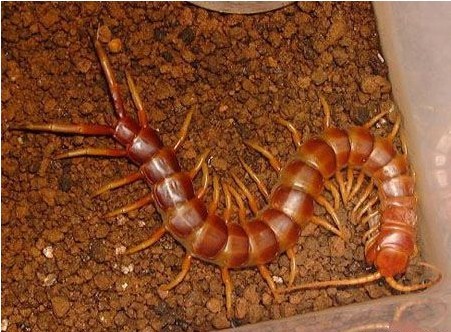
Centipedes are ovoviviparous and reproduce quickly. They generally mate in June, July and August. Under normal conditions, it takes 4 months from mating to egg laying. When laying eggs, the female centipede digs a small pit in the soil, and her body curves into an S shape. The rear telson segments rest on the back of the middle part of the body because of the body's curvature. The egg material discharged from the genital pore accumulates on the back and sticks together into a cluster. She then turns her body and curls around the egg cluster. The egg cluster usually contains about 60-70 eggs, and at least 20-30. After about 20 days, the centipede eggs shed the egg membrane and embryonic skin. The hatched centipede larvae are milky white. The female centipede still tightly holds the cluster of larvae between her legs, and the larvae move very little. After 25 to 30 days, the larvae undergo their second molt. Their body shape is similar to that of the adult, the body color is still milky white, and the middle part of the body is slightly fatter. After 35 to 42 days, they undergo their second molt, the body color becomes grayish yellow, and their activity increases. They no longer cluster tightly together, but instead gather loosely on the mother's ventral surface. At this point, the larvae and mother can be separated. Place the mother in a large group to let her mate, and give the post-laying centipede plenty of food. Feed the young centipedes small food. (They can also be raised individually: put soil in a wide-mouthed canning jar and place the mother centipede inside.)
During reproduction, pay attention to the following environmental factors:
Increase feeding before laying: centipedes do not eat or drink during incubation and rely on consuming their own nutrients to maintain activity. Before laying eggs, the mother has a habit of eating heavily to store nutrients. At this time, increase the amount of food and pay attention to adjusting the variety of food to encourage the mother to eat more and increase her pre-incubation nutrition.
Care during incubation: during the period when centipedes hold eggs and raise young, they react to some extent to disturbance and strong light. Therefore, during incubation, observations should be made carefully and gently; do not move them casually or expose them to strong light. No feeding is needed during incubation. Keep some water available in the incubation container at all times, with slight moisture around it, so that the normal development of the embryo will not be affected.
After incubation ends, although the young centipedes temporarily form groups and live together, they can also move and forage alone. At this time, the mother gradually leaves the incubation nest and moves alone. Because centipedes have the quirk of fighting over food, with the strong bullying the weak and the large bullying the small, the large and small centipedes should be separated into different containers for rearing in a timely manner.