Key Breeding Techniques in Turkey Farming
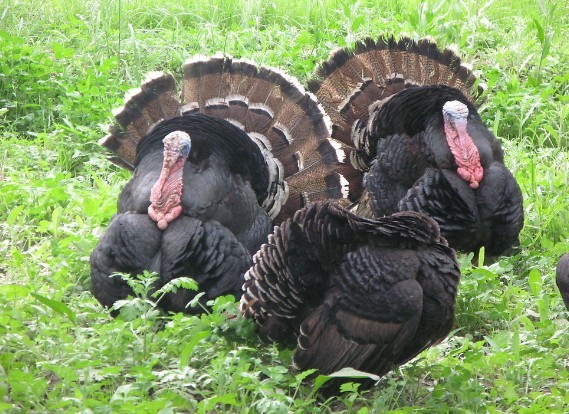
Breeding Techniques for Raising Turkeys
Individual Selection
For breeding toms, choose those that are robust and disease-free, large in body size, strongly masculine, lively, with glossy feathers and thick, straight legs; for breeding hens, choose those that are healthy and disease-free, docile in temperament, with a flat back and straight tail, broad chest and large body, and brightly colored feathers and wattles. Breeding birds should be replaced after a period of use, purified and rejuvenated, inferior breeds culled promptly, and superior breeds retained. The useful lifespan of breeding hens is 2 years, while toms can be used for 3—4 years.
Mating and Egg Laying
Turkey hens begin their first egg-laying cycle from 34 weeks of age. The laying period is from March to September each year, and after laying about 10—15 eggs, they incubate them on their own. They lay 4—6 cycles per year, with 14—20 eggs per cycle, and at most 28 eggs. Turkeys mostly mate naturally, and inbreeding should be prevented. During natural mating of breeding turkeys, because of the large difference in body weight between males and females, the hens are often injured, which leads to a low reproduction rate in hens and reduces economic returns. Therefore, artificial insemination can be used to solve this problem. At the same time, the rearing ratio of breeding toms can be raised from 1:4—5 under natural mating to 1:30, and feeding costs can be greatly reduced.
1 Semen collection: Turkeys are generally semen-collected by the massage method. The breeding turkeys must first be trained for 2 weeks so that they develop a sexual reflex, after which semen can be collected. During collection, an assistant sits on a stool and holds one leg of the breeding tom with each hand. The collector rhythmically massages along the back from both wings to the base of the tail and toward both sides below the cloaca multiple times, and spreads the thumb and the other four fingers of the left hand to support both sides of the cloaca, with the palm pressed tightly against the tail feathers; at the same time, the right thumb and the other four fingers are spread to support the abdominal positions on both sides of the cloaca and massage rhythmically. When the breeding tom becomes sexually excited and the degenerated copulatory organ is seen erect and protruding from the cloaca, the left thumb and index finger are then used to squeeze around the cloaca of the breeding turkey with slight force so that the semen (slightly yellowish-white thick liquid) is expressed and flows into a previously prepared semen container (commonly a sterilized clean small glass test tube or semen collection cup). Each collection from a breeding tom yields 0.2—0.3 milliliters of semen, with a sperm concentration of about 8 billion per milliliter, collected once every 3—4 days. After collection, whether diluted or not, the semen should be placed in warm water at 35—40℃ for temporary storage. During semen collection, movements should not be rough, contamination by feces should be avoided, contaminated semen must not be used for insemination, and collected semen must be used for insemination within 30 minutes to avoid lowering semen quality and affecting the fertilization rate.
2 Insemination: To ensure a relatively high fertilization rate, insemination should be carried out after the breeding hen has finished laying, at 2 p.m., and in a quiet, clean place to obtain the highest fertilization rate. The insemination method uses an insemination device inserted directly into the vagina. Before insemination, first cut off the feathers around the cloaca with scissors and wipe clean with physiological saline. The assistant of the inseminator holds the hen's two legs and the tips of the two wings separately with both hands to restrain it. The semen to be inseminated needs to be diluted, with a dilution ratio of 2—3 times. The commonly used diluent is prepared from physiological saline or 5%—7% glucose, or 2.8 g sodium glutamate, 1.8 g glucose, and 1OO ml distilled water. The insemination device is a BCG vaccine syringe with a small plastic tube, and the diluted semen is loaded into the syringe barrel. During insemination, the inseminator faces the tail of the breeding turkey, moves the tail feathers to the left side with the right hand, and presses lightly downward with the thumb closely against the lower edge of the cloaca so that the cloaca opens; then the left hand naturally inserts the insemination device containing semen into the vagina. Insemination interval for hens: about 14 days for fresh semen, 8 to 1O days for diluted semen, and the amount of semen inseminated per turkey is 0.025 milliliters. After insemination, the hen is returned to the rearing cage for careful feeding.
For natural mating of turkeys, the hens should be allowed to mate in time before laying. During the laying period, toms should be separated and raised individually to avoid excessive disturbance to the hens and to prevent effects on laying. At the same time, before mating, the sharp claws of the toms should be trimmed smooth to avoid trampling injuries to the hens and to prevent effects on the hens' laying and brooding.
Hatching of Breeding Eggs
1 Natural incubation: Turkey hens have a very strong brooding instinct. For farmers raising turkeys in small numbers, breeding eggs can be naturally incubated by turkey hens or local broody hens. The method is to make a nest in a bamboo basket for the turkey hen to sit on the eggs and incubate. The basket is lined with straw, about 20—30 cm thick, and then the breeding eggs are placed in. A turkey hen generally sits on 14—18 breeding eggs. When brooding, turkey hens prefer dim, concealed, and secluded places. During the brooding period, toms need to be raised separately to prevent disturbance to the brooding hen. Every 2 days of brooding, the hen should be let off the nest to move around, feed, and drink. During the brooding period, turkey hens should be fed less feed with high water content, and some grain feed can be added, appropriately raising the daily ration standard. On the 7th—8th day, 15th day, and 25th day after the breeding eggs are placed for incubation, candle and inspect the eggs once each time to remove infertile eggs and dead embryo eggs. On the 26th day after incubation, the chicks inside the shells have already formed, and some begin to peck the shells. Generally, all chicks can hatch in 28—29 days. After brooding, the turkey hen is relatively weak physically and should be fed separately for a few days so as to recover health as soon as possible.