Introduction to Porcupine Farming Techniques and Key Points of Daily Feeding Management
Introduction to Porcupine Farming Techniques
I. Site Selection Requirements
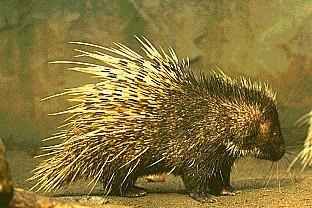 Porcupine" style="cursor:pointer" onclick="window.open('https://www.zhifujing.org/d/file/uploads/allimg/110430/1_110430130139_1.jpg')" />
Porcupine
1. Semi-free-range rearing: Choose a site on hilly slope land facing south, with good drainage conditions, relatively thick soil, and forest trees. Build a perimeter wall 1.1-1.2 m high (first dig a trench 50 cm deep
and 20 cm wide at the base of the wall, pour in concrete, then build the wall above the trench to prevent porcupines from digging holes from the bottom of the wall and escaping) and install a metal gate for the entry and exit of feeding personnel. The size of the site is determined by the designed
stocking population. A male-to-female ratio of 1:3 to 1:4 is suitable. Place porcupine breeding stock and feed inside the walled area, and the porcupines will dig their own burrows for resting and foraging.
2. Artificial captive rearing: Build a roofed shed, with the breeding pens divided into inner and outer nest chambers. Lay a solid concrete floor (with bedding straw placed on the floor). The inner and outer nest chambers are generally 2 m wide, 3 m long
, and 1.1-1.2 m high; the inner nest is the place where porcupines rest and give birth, and the outer chamber is the area for their activity and sunbathing. A drinking water pool is built on the side of the outer chamber near the metal gate. Feed is placed
in the inner nest chamber on rainy days, and can be placed in the outer chamber on sunny days.
II. Feeding and Breeding
Under wild conditions, porcupines like to eat corn, wheat, rice, red taro, Chinese cabbage, radish, pumpkin, peanuts and many other crops, and porcupines have an extremely strong digestive capacity. Therefore, under artificial feeding conditions
, in addition to the above feeds, pine roots, holly branches, etc. can also be provided. The total daily ration should be set so that it is basically finished each night with a slight remainder. Any small amount of unfinished feed should be completely cleared from the site the next day
. Porcupines come into estrus in autumn and winter, and give birth in spring or early summer. Porcupines mate at night; since electronic scanning technology is generally not used, it is very difficult to observe how many times they mate in one night. The gestation period of porcupines is
about 110 days, and the lactation period is about 50 days. They usually have two litters per year, with two young per litter.
III. Disease Prevention and Control
Porcupines have strong vitality and almost never fall ill. However, in late spring and early summer, green feed should preferably account for only 30% of the total daily ration, to prevent gastric bloating and nitrite poisoning. At the same time, replace the clean water once
a day, and periodically add 0.5% ciprofloxacin (powder) to the drinking water, regularly carry out intestinal deworming, replace bedding straw and disinfect the site.
Porcupine disease prevention and control:
Although porcupines have very strong vitality and are not prone to illness, attention should still be paid to the following: in late spring and early summer, green feed should not exceed 30% of the daily ration, to prevent gastric bloating and nitrite poisoning;
the clean water should be replaced once a day, and 0.5% ciprofloxacin powder should be periodically added to the drinking water; intestinal deworming, replacement of bedding straw and site disinfection should also be carried out regularly.