A Detailed Guide to Porcupine Farming Techniques and Feeding Management Methods
1.Site requirements
The area is (1.8×1.2m).Porcupine FarmingWindows are installed on the walls at both ends of each rearing room to ensure air circulation. On the floor of each rearing room, two rows of rearing pools are built along both sides of the long walls, with a 6.0m×0.7m walkway in the middle. The rearing pools are built of red bricks and finished with cement mortar, with dimensions of 0.25m×0,25m×0.18m. On the side of the rearing pools facing the walkway, a 0.2m×0.2m drainage ditch is built for washing during cleaning. A dedicated drinker is installed in each rearing pool for use as a drinking water pool.
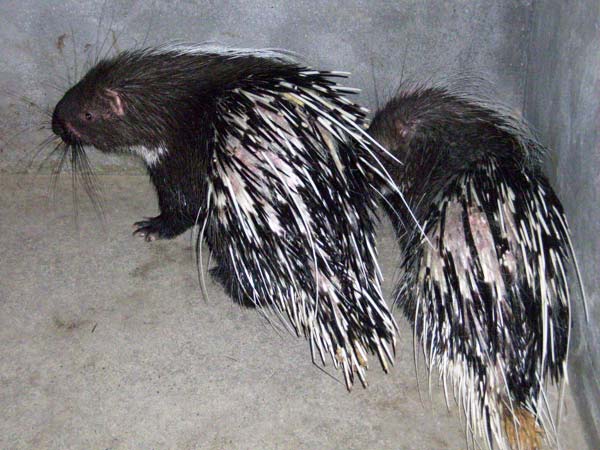 Porcupine" style="cursor:pointer" onclick="window.open('https://www.zhifujing.org/d/file/uploads/allimg/110430/1_110430134806_1.jpg')" />
Porcupine Farming Techniques and Feeding Management
2.2, Gradual acclimation:
II.Domestication
2.1, Age-based group domestication:
During transport, the first batch of trial porcupines had their crates covered with black cloth, and their environment was kept as quiet as possible. After arrival, the porcupines were first divided by body size into 4 age groups: those weighing over 13 kg formed the adult porcupine group, 5-13 kg the subadult porcupine group, 1-5 kg the juvenile porcupine group, and under 1 kg the piglet porcupine group. Based on the social living habits of wild porcupines, within the same age group, individuals of similar size were further divided into groups of 1 male and 1 female or 1 male and 2 females, and kept in one rearing pool for separate raising and taming. Artificially bred porcupines were tamed starting from weaning, in groups of 2 to 4. After 3 months of age, they were again grouped as 1 male and 1 female per group and kept in one rearing pool for raising and taming.
Based on the burrowing habits of wild porcupines, during the early stage of domestication, black cloth was used to cover the windows of the breeding room to keep the room dark, and a cover board was placed over the breeding pool to create a dark-room environment similar to the porcupine's burrow. At the same time, the breeding room was kept quiet, and a dedicated keeper was assigned to manage it. Then, sweet potatoes, Miscanthus roots, bamboo shoots, fresh tender vegetables and clean water, which porcupines like to eat, were placed in the breeding pool to entice them to feed and drink, so as to strengthen their constitution and eliminate their fatigue and fear. After the porcupines' feeding and other activities had basically returned to normal, preliminary and appropriate basic domestication work was carried out by taking advantage of feeding, cleaning and other occasions. At the same time, the food was gradually transitioned to compound feed and commonly used roughage. During the initial period of feeding compound feed (1-2 months), an appropriate amount of brown sugar or white sugar should be added to the compound feed formula to increase its palatability, and then the sugar content was gradually reduced until no sugar was added. Before the body weight of young porcupines reached 1 kg, domestication had to be combined with artificial nursing. Then, domestication was further strengthened: the cover board on the dark room was removed, opportunities and time for contact with people were increased, porcupines were enticed with foods such as sweet potatoes and bamboo shoots, and the head of the porcupine was gradually and consciously touched and stroked to a limited extent, so as to eliminate the porcupine's fear of people. On this basis, the black cloth on the windows of the breeding room was removed to give the porcupines a bright breeding environment, so that the porcupines gradually adapted from a wild habitat environment to an artificial breeding environment. When approaching artificially bred young porcupines that had just been weaned for the first time, their hair on the head, neck and under the jaw was gently stroked, and gentle contact was made with them, so as to keep the young porcupines calm and avoid frightening them. During the first 5-7 days after leaving the mother porcupine, in addition to feeding the young porcupines their favorite sweet potatoes, Miscanthus roots, bamboo shoots, fresh tender vegetables and sugared compound feed, artificial nursing was also carried out 2-3 times a day, so that they could gradually transition in terms of food. During each artificial nursing, they were stroked for 3-5 seconds, and language stimulation was carried out at the same time, so that food stimulation and behavioral stimulation were closely combined. After many such training sessions, the young porcupines gradually developed affection for people and reached the point of not being afraid of people.
2.31. Establishing conditioned reflex domestication:
Porcupine farm keepers should signal when feeding the porcupines and when entering and leaving the animal housing, gradually familiarizing the animals with the keeper's voice, scent and footsteps. Frightening them and visits by others must be prohibited; in this way, after a period of time, wild adult porcupines can be brought to develop a preliminary conditioned reflex. At the same time, the porcupines should be tamed by feeding them at fixed times, in fixed amounts and at fixed locations, so that they eat a set amount of food at the appointed time and in the fixed place. Before feeding, sounds such as whistling should also accompany the process to help form the conditioned reflex. Then, on this basis, the intensity of various stimuli should be increased for the porcupines in a planned and step-by-step manner, the range of adaptation expanded, and their wild habits such as timidity, solitariness, irritability and strong aggressiveness gradually changed, so as to establish a stable conditioned reflex.