Gardenia always has yellow leaves and won't bloom? Remember these 5 care points
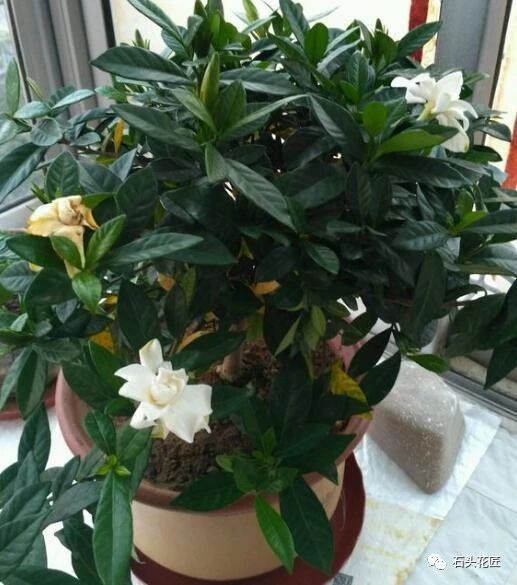
Recently Shitou saw many gardening friends complaining that the gardenias they grow either have yellow leaves or won't bloom. Growing up listening to the song: "Gardenia blossoms bloom and bloom, gardenia blossoms bloom and bloom!" Yet the gardenia you grow yourself never blooms, truly embarrassing!
Below are the reasons and solutions Shitou has summarized separately for gardenia yellow leaves and failure to bloom.
1. Improper lighting: Yellow leaves in gardenia due to lighting are very common. Generally, too strong light will make gardenia leaves turn yellow, or even scorch them; another situation is long-term cultivation in a dark place, where the leaves turn pale yellow.
Solution: Gardenia likes light, but it must not be exposed to strong direct sunlight. It is best placed in a spot with diffused light; 60% light intensity is enough for its growth.
2. Improper watering: When it comes to watering gardenia, many gardening friends say they can't control their hands, and water the pot whenever they have nothing to do! Of course, some gardening friends say they always forget to water the flowers. Either way, it's a watering problem.
Solution: Gardenia likes to grow in a moist environment, but that doesn't mean watering constantly. High-frequency watering causes water accumulation in the pot, the plant roots cannot breathe properly, and eventually root death and yellow leaves occur. Therefore, when watering the plant, check the dryness and moisture of the soil in the pot before each watering. Wait until the potting soil has dried down two-thirds (you can check with a wooden stick) before watering again, and water thoroughly each time.
3. Improper pH: Regarding pH, it mainly shows as salinization of the plant's soil, while gardenia likes acidic soil. Once this situation occurs, the plant struggles to grow, nutrient absorption is limited, and yellow leaves are inevitable.
Solution: To solve the soil pH problem, start with the growing soil. When potting the plant, choose acidic soil; for daily care, when watering, if you find the local water is alkaline, you can add a little salt-free edible vinegar to the water to neutralize the water quality.
4. Improper pruning: Failure to bloom in gardenia due to improper pruning is very common. Leggy branches, old branches, and weak branches all affect the plant's blooming; if you want the gardenia to bloom every year, pruning is definitely essential.
Solution: Apart from winter, gardenia does not bloom in winter but blooms in the other seasons. Therefore, pruning should be done according to your own pot's situation. Generally, you need to do a heavy pruning once each spring, cutting off old branches, weak branches, and the previous year's leggy branches; be sure not to prune before flowering, because gardenia flower buds all sprout at the tips of the branches, and once pruned, it will definitely not bloom; then, prune after each flowering, cutting off the spent flowers, cutting off the leggy branches, and thinning out the densely growing plant.
5. Improper fertilizing: Generally, if gardenia yellow leaves are caused by fertilizing, it is due to improper fertilizer control, too much or too little! And failure to bloom is also related to the frequency and type of fertilizing.
Solution: For gardenia care, fertilize once each year starting in spring, applying a compound fertilizer, strictly following the instructions; supplement once with a phosphorus-potassium fertilizer (monopotassium phosphate) before flowering to promote flower bud growth; supplement with compound fertilizer after flowering; and supplement with potassium fertilizer again before winter to ensure the plant overwinters smoothly.
That's all Shitou has to share on the reasons and solutions for gardenia yellow leaves and failure to bloom. If you have any other questions, please leave a comment below!