Scorpion Artificial Breeding Methods and Key Technical Points
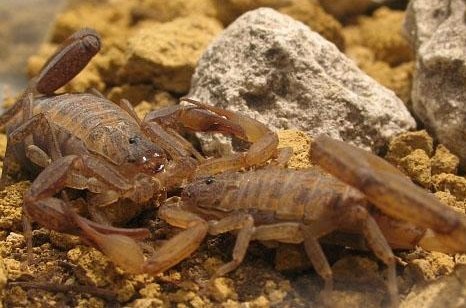
The scorpion, also known as "quanxie" or "quanchong," is both a precious traditional Chinese medicinal material and a top-grade delicacy on the dining table. Market demand for it is growing steadily, and raising scorpions for venom extraction in particular offers higher economic returns. The key breeding techniques are described below.
(1) Feed
Scorpions are carnivores, and their feed sources fall into the following 4 categories. (a) Catching small insects. Cabbage caterpillars, bean hawkmoths, butterflies, snails, locusts, grasshoppers and others are all the best feed for scorpions, and other small animals can also be caught. (b) Black-light lamp insect trapping. At night, black-light lamps are used to attract and trap insects such as noctuid moths, mosquitoes, mole crickets and leafhoppers for the scorpions to eat. (c) Artificial insect rearing. Rice bran and similar materials can be used to breed yellow mealworms as a partial feed source. (d) Prepared feed. In early spring when insects are scarce, and before winter sets in during the scorpions' heavy feeding period, fresh beef, mutton, rabbit meat and mouse meat can be supplied; these are all delicacies for scorpions, and the meat should be chopped up before feeding. The feed given to scorpions must always be fresh, non-toxic and free of spoilage.
(2) Facilities
There are generally the following 3 ways to raise scorpions. (a) Basin or vat rearing. This method is easy to operate and manage, and is suitable for beginners. Simply use 1 basin or vat with a smooth inner surface, spread 3 cm of aged soil or saline-alkali soil on the bottom, place some hiding nests made of old wood with pores on the soil layer, and cover the basin or vat with a perforated lid. (b) Film-lined rearing pool with surrounding walls. The pool walls are built of brick, 40 cm high, with no limit on area. The inner walls are covered with plastic film, and the film seams must be firmly glued so the scorpions cannot escape. The film should be wiped frequently to keep it clean and smooth. Stones, tiles and gravel should be piled inside the pool and covered with a layer of soil to create caves suitable for scorpions to inhabit. Weeds and trees can be planted in the pool. Scorpions are very good at climbing and squeezing through gaps, so when building the pool, full consideration must be given to preventing scorpions from escaping. (c) Indoor rearing. The interior can be divided into several small plots, and in each plot dig 1 winter storage area 50 cm deep (about 1/3 of the entire plot). Place crushed stones and rubble inside, and above that design 1 scorpion nest area 15 cm deep. Insert glass vertically around the entire scorpion nest area, 5 cm underground and 15 cm above ground, to form an escape-proof wall.
(3) Rearing
Separate rearing is an important part of artificial scorpion breeding. It not only prevents scorpions from eating each other due to differences in size and strength, but also allows different management methods to be adopted according to the characteristics of scorpions of different ages. For young scorpions, attention should be paid to preventing escape, since scorpions are at their strongest escape ability at this stage. Growing scorpions are in the fastest stage of growth and development in their lives, so sufficient feed should be supplied. For adult scorpions, attention should be paid to the male-to-female ratio, generally 1 male to 3 females is appropriate. After giving birth, they should be separated promptly to prevent adult scorpions from eating the young.
When the outside temperature falls below 10°C, scorpions enter hibernation, and the temperature in the hibernation area should not drop below 0°C. Therefore, when designing scorpion-rearing facilities, 1 winter storage area 50 cm deep should be dug. If the temperature is found to be too low, straw curtains can be placed over the kiln opening or vat opening to prevent the scorpions from freezing stiff. The humidity in the hibernation area should be maintained at around 15%. After all the scorpions have entered the hibernation area, seal it tightly with a wooden lid to prevent mice from entering; if protection is inadequate, after one winter there is a possibility that all of them will be eaten by mice.
Ants are the main natural enemies of scorpions. On the rearing site, pork bones should be used to lure and gather ants before eliminating them, and rodents, birds, lizards, frogs and toads should also be kept out.
(4) Reproduction
In nature, male scorpions rely on spermatophores to transfer sperm to female scorpions, and after receiving sperm the female can continue giving birth to young for 3-5 years. Scorpions are ovoviviparous: the fertilized eggs develop into young scorpions inside the mother's body. In July-August, a mother scorpion about to give birth seeks a suitable place, spreads the pectines to the left and right, and produces young scorpions one after another from the gonopore. Newly born young scorpions have their appendages curled inward, with the tail bent beneath the trunk, wrapped in white mucus, and are rice-grain shaped. After a few minutes, the young scorpions' tails and appendages emerge from the mucus.