How to improve fish farming profitability? Good attention to detail management is key
Two consecutive years of sluggish market conditions have dealt a considerable blow to snakehead farmers. The author visited the front lines and learned that the farming cost for fish sold before last year's Spring Festival was roughly 4.8-5.5 yuan/jin, while during this period the pond-side price for snakehead was only about 6 yuan/jin when large fish made up a larger proportion. For farmers with lower farming skill levels, there was already no profit to be made or even losses. Therefore, this year many snakehead farmers have switched to farming largemouth bass, yellow catfish, and others. The industry estimates that snakehead farming in the Shunde area will decrease by nearly 30% this year.
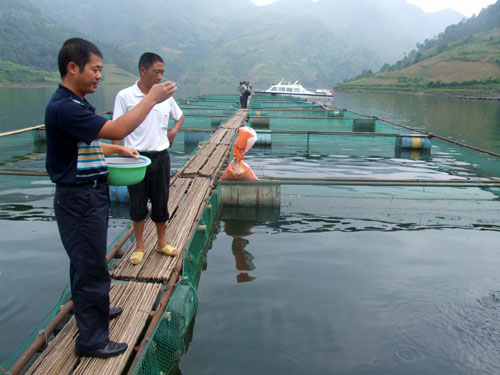
Does the sluggish industry make snakehead farming unprofitable? This is not actually the case. Even under last year's lower fish prices, some farmers still achieved relatively good economic returns. A-Shun, a farmer in Guanghua Village, Xingtan Town, Shunde, is one of them.
Pond area: 12 mu; water depth 2.0-2.8 m; farming period: 2010/5/20 to 2010/12/28.
Stocking situation: 80,000 snakehead at 9-chao size (250,000 black sesame fry stocked on April 24 and raised to this size before pond release), plus about 5,000 inferior fry; 2,000 bighead carp (6-7 cm each); 5,000 crucian carp (7-chao fry).
Harvest situation: 145,000 jin of snakehead, about 1.8 jin each, largest fish 3.5 jin each; 3,300 jin of bighead carp (>1 jin each); no crucian carp (eaten by snakehead).
Investment situation: pond rent, electricity, medicine, fingerlings, fish paste, feed (using "Qunfeng" brand extruded snakehead feed throughout), totaling 699,500.
Income situation: snakehead sold at 6.1 yuan/jin, bighead carp at 3.3 yuan/jin, totaling 895,390 yuan.
Economic benefit: 195,890 yuan, about 16,325 yuan/mu.
Feed conversion ratio 4000×40)/145000=1.1.
Survival rate 145000/1.8)/85000=94.7%.
Daily management and precautions for snakehead farming
Pond conditions Farming density Daily management Bait Time Daily feeding frequency and amount Precautions Disease prevention Disease prevention
Black sesame fry → 7-chao fry Pond surface: any size, mostly 5-10 mu Water level: about 1 m depth at the start of nursery rearing, gradually increased to 1.6-1.8 m, later can reach 2.2-2.5 m Snakehead fry 12-chao and above) 10,000-12,000 fish/mu Bighead carp (silver carp): 40-60 fish/mu, recommend 3 liang and above size Crucian carp: 150-200 fish/mu, recommend 1 liang and above Black carp, silver carp: 10-20 fish each per pond Note: too many miscellaneous fish will affect the feed conversion ratio Fertilize and cultivate water before fry release to breed plankton; adequate bait can avoid cannibalism. Zooplankton (water fleas) Dead water fleas + fish paste 5-6 days 2-3 days About 1 week 5 meals or more, small amounts multiple times, adjust according to fry size Bait must be sufficient; use fish screens to grade and farm every 3 days or so to avoid cannibalism and improve survival rate; smaller sizes can be fed 1-2 extra meals appropriately to promote their growth. Mainly deworming, especially trichodina Mainly deworming, especially trichodina
8-9g Adding water in stages helps improve survival rate; generally add water once every 5-7 days, about 10 cm each time. No. 0 feed + fish paste 5-7 days 5 meals Standard is eating it all within one hour
9-12g No. 1 feed + fish paste 8-10 days 4 meals Pay attention to gastrointestinal diseases when feeding chilled fish paste
5-10g No. 2 feed + fish paste About 15 days 3 meals Recommend using fish paste until average size reaches 3 liang and above before stopping. Best to feed to 70-80% fullness, small meals more often.
10-25g No. 3 feed + fish paste 15-18 days 2 meals Standard is eating it all within half an hour Entering the high-temperature season, prevent bacterial hemorrhagic disease
50-150g In the later stage nitrite is high; recommend running aerators more at noon; when nitrite is on the high side, recommend regulating water or changing water No. 4 feed + fish paste About 20 days
150-250g No. 5 feed 20-30 days At water temperature above 23°C feed two meals; when water temperature is low (below 15°C) definitely control the feeding amount, only feed when there is sun. Pay attention to liver disease (such as liver enlargement, discoloration, etc.)
250g and above No. 6 feed Until fish harvest Above 23°C feed 2 meals Standard is eating it all within 15-20 minutes
15-22 °C feed 1 meal
Below 15°C feed 1 meal every 5-7 days