Key Technical Points and Breeding Management Methods for Black Guinea Pig Farming
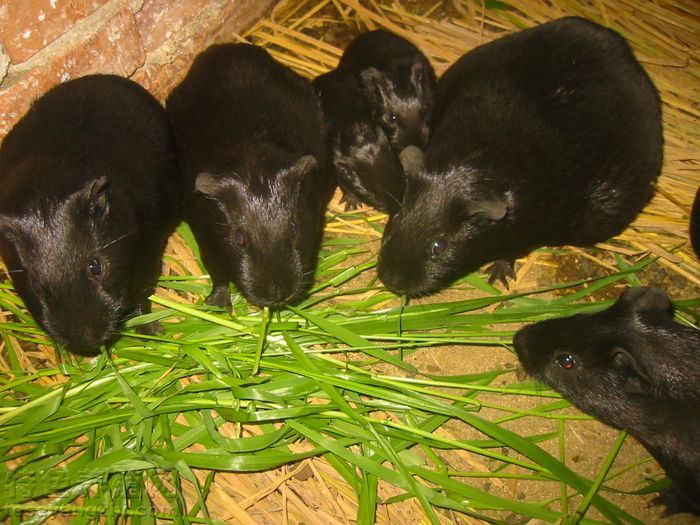
Black Guinea Pig
I. Morphological Characteristics of the Black Guinea Pig
The black guinea pig has black ears, black eyes, black toes, and a glossy black coat. It has a short, stout body, a large round head, a short neck, no tail, short small ears and limbs, and bright eyes. The ear shell is thin with clearly visible bright red blood vessels, and the upper lip is cleft. The incisors are arch-shaped and extend deep into the jaw, with sharp chewing surfaces, and can grow continuously throughout life. When occlusion is misaligned, the incisors and molars will overgrow. The black guinea pig has well-developed masseter muscles. The forelimbs have four toes, and the hindlimbs have three toes, each toe bearing a prominent large nail, with short sharp claws on the toes that do not scratch people, and it is not good at climbing or jumping. Its feet resemble those of a pig, and its body length is 225-355mm. The coat lies close to the body surface.
II. Living Habits of the Black Guinea Pig
1. Active Day and Night
In nature, wild black guinea pigs are the weak ones. Their ancestors lived for generations in the remote mountains and forests, under large trees, bamboo roots, or in thickets, dwelling in burrows. Because wild black guinea pigs are small and weak, in order to avoid attacks from ferocious beasts and birds of prey such as leopards, wolves, foxes, eagles, and hawks, they often can only forage stealthily, foraging for a while, then having to hide again, and when hungry sneaking out again to forage. Repeating this all day long over time, they developed the habit of being active day and night.
2. Timid and Easily Startled
Black guinea pigs are timid and prefer a quiet, dry, and clean environment. They are very sensitive to changes in the external environment. When there is an abnormal noise, vibration, or environmental change, they may prick up their ears and listen quietly, or become panicked, or jump around wildly, or make loud stamping sounds to “notify” their companions. A startled pregnant female black guinea pig is most prone to miscarriage; a female black guinea pig in the middle of giving birth may suffer dystocia if startled; some may bite newborn pups to death; a nursing mother guinea pig that is startled will refuse to let the pups suckle; and a black guinea pig that is eating will often stop feeding when startled. They are very unaccustomed to frequent handling and disturbance. Handling, relocating, or touching can cause the black guinea pig's body weight to drop significantly within 24-48 hours, and then recover quickly once the situation stabilizes. Therefore, maintaining a quiet environment in the black guinea pig enclosure is one of the issues worthy of attention in raising black guinea pigs well. To keep the environment quiet, the guinea pig house should not be built together with machinery; in daily operations inside the house, movements should be gentle, there should be no loud shouting, crowds should not be allowed to gather and watch, and animals such as dogs and cats should not be allowed to enter the black guinea pig farm.
3. Fond of Dry Conditions
Most livestock and poultry like to live in a clean and dry environment, and black guinea pigs share this habit. They eat a lot and excrete a lot, and the enclosure becomes unclean and damp due to drinking water and the excretion of feces and urine. Such an environment is not conducive to the growth of black guinea pigs. Although black guinea pigs have a strong ability to resist disease, if a clean and dry environment is not created for them, raising black guinea pigs well will not be so easy.
4. Fond of Living in Groups
The group-living trait is an instinctive behavior inherited by black guinea pigs from generation to generation. Many herbivorous animals share this trait; their ancestors developed a group-living environment as a measure of defense against enemies. A group composed of one male and multiple females shows obvious social stability. This is manifested in moving, resting, or collectively feeding in groups, and lying close together. Young guinea pigs follow adult guinea pigs in chasing estrous females. Dominant black guinea pigs in the group will bite the fur of other black guinea pigs. Under crowded or stressful conditions, one or more animals in the group may also have their fur bitten by other individuals, with the fur bitten off, appearing as patchy baldness, causing skin wounds and dermatitis. If a new male is introduced, fierce fighting will occur between the males, leading to serious bite wounds. After domestication, the Chinese black guinea pig still has not changed its old habits. Although modern cage rearing, pond rearing, and box rearing are already very safe, black guinea pigs still find it difficult to adapt to this habit. During the breeding process, we conducted such an experiment: a small number of black guinea pigs were housed separately in individual cages. The result was that those housed individually in separate cages and those housed in pairs were both inferior to group-housed ones in terms of reproduction and growth speed.
5. Afraid of Heat and Tolerant of Cold
The black guinea pig is a fur-bearing animal. It lacks sweat glands and finds it very difficult to regulate body temperature through sweating. Its dense coat makes it hard for body heat to dissipate from the body surface, which is the main reason black guinea pigs are afraid of heat. However, the dense coat gives black guinea pigs a relatively strong ability to resist cold. Nevertheless, for newborn or young black guinea pigs, attention should be paid to keeping them warm in winter. Based on our breeding experience, in terms of guinea pig house structure and daily management, heat prevention is more important than cold prevention.
6. Fond of Gnawing Hard Objects
The black guinea pig belongs to the mammalian order Rodentia. Like the domestic rabbit, it has the habit of gnawing hard objects, commonly called rodent behavior. The black guinea pig is of the double-incisor type. The first pair of incisors is called the “permanent teeth”, which are present at birth and do not undergo replacement afterward, and they grow continuously. The black guinea pig must instinctively wear them down by gnawing hard objects so that the upper and lower jaw tooth surfaces fit together. This habit of the black guinea pig often causes damage to cages, feeding utensils, or other equipment. To avoid unnecessary losses, some preventive measures can be taken, such as often placing leafy branches or coarse hard dry grass and other hard objects in the cage for them to gnaw and wear down their teeth; when building the guinea pig house, necessary reinforcement measures should be taken at the frame and edges of the cage door and other places that black guinea pigs can reach. Of course, building rearing ponds can reduce these preventive measures.