How to raise Angora rabbits? An expert explains breeding techniques in detail
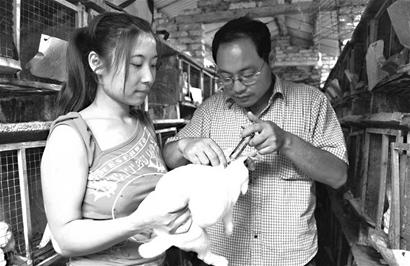
"Oh! I've been raising Angora rabbits for two years, but they're never as good as other people's rabbits. I don't know whether it's a problem with the hutch, or with the breed and disease prevention. I've never been able to find the reason. Please help me find an expert to talk about it." On June 16, Song Tianzhi, a villager from Gaota Village, Gaota Township, Nanjiang County, said to the reporter with a face full of worry. For this reason, the reporter interviewed Song Junping, a senior livestock breeding worker at the Nanjiang County Animal Husbandry Bureau, and asked him to give a careful explanation of how to raise Angora rabbits.
Build hutches rationally
Angora rabbits have living habits such as being timid and easily frightened, tolerant of cold but afraid of heat, and disliking dampness while preferring dryness. Therefore, rabbit houses must be built in a place facing the sun, warm in winter and cool in summer, with sufficient light, good ventilation, fresh air, and dry and quiet surroundings.
Whether newly building hutches or converting the space in front of and behind the house or pig and cattle pens, single-row, double-row, or multi-row hutches should be built according to the size of the herd.
Single-row: a span of about 2.5 m, with a 1.2 m walkway and a 0.8 m manure channel. The rabbit cage area accounts for about 30% of the total rabbit house area.
Double-row: rabbit cages are arranged either "face-to-face" or "back-to-back." For a "face-to-face" arrangement, a 1.2 m walkway is set in the middle and 0.8 m manure channels on both sides, with the rabbit cage area accounting for 52% of the total rabbit house area; for a "back-to-back" arrangement, 1.2 m walkways are set on both sides of the rabbit cages and a 1 m manure channel in the middle, with the rabbit cage area accounting for 32% of the total rabbit house area.
Multi-row: taking four rows as an example, set 3 walkways of 1.2 m, 2 manure channels of 1 m, a span of 8 m, and the rabbit cage area accounts for 60% of the total rabbit house area.
Rabbit cages use a combination of brick-and-wood structure, cement structure, and iron structure, with specifications of 65-70 cm long, 55-60 cm deep, and 45-50 cm high.
Select breeds
Selecting excellent breeds is the prerequisite for good returns, and stock must be introduced from qualified and regular breeding rabbit farms. At the same time, during the raising process, breeding rabbits with characteristics such as strong physique, full coat, abundant foot hair, strong disease resistance, fast wool growth, good wool quality, and stable genetic performance should be selected for self-breeding and self-raising, and high-yield improved seedling rabbits should be selected for trial raising, screening out the best individuals for breeding use. In this way, continuous renewal can achieve high-yield and improved breeding of breeding rabbits.
Feeding management
General feeding management: use cage raising, that is, one rabbit per cage for production rabbits, one litter per cage for newborn rabbits, young rabbits gradually separated into cages, and male and female breeding rabbits raised separately. Under normal circumstances, feed 3 times a day, that is, one-third of the daily ration (concentrate and grass) in the morning, two-thirds of the daily ration in the evening, and an additional feeding of grass around 10 p.m., with at least 200-300 g of fresh green grass or succulent feed per day, watering on time every day, feeding newborn rabbits milk, cleaning sanitation, and removing manure, with preventive disinfection once a week.
Feeding and management techniques for different age stages:
Newborn rabbits: feed breast milk well (especially promoting lactation), and pay attention to keeping warm and clean.
Young rabbits: raise them in groups according to physical strength, mainly feeding tender green grass, and gradually increase the feed amount.
Production rabbits: in addition to normal feeding, pay attention to adding feed such as protein, minerals, vitamins, and amino acids (especially sulfur-containing amino acids) to the daily ration, thereby increasing wool production.
Female rabbits: production female rabbits are required to have good mothering ability, strong lactation, and more than 4 pairs of teats. When the female rabbit is in heat and the vulva is black-purple, the conception rate is high, and mating should be repeated once at an interval of 6-7 hours. Pregnant female rabbits must be guaranteed sufficient nutrition, and plucking wool during the middle and late stages of pregnancy is strictly prohibited. After giving birth, feed more lightly salted water and succulent green feed. In addition to normal feeding, lactating female rabbits should be supplemented with 20-30 boiled soybeans per day to increase milk production.
Male rabbits: they can mate 1-2 times per day, for two consecutive days, then rest for one day. During the mating period, supplement protein, vitamin A, B, and mineral feed, and the light should not be too strong. The appropriate male-to-female ratio is 1:5.
Plant high-quality forage grass in a planned way: in spring, mainly plant alfalfa and Ixeris denticulata; in autumn, plant annual ryegrass. For every 100 rabbits, 1 mu of grass should be planted.
Disease prevention
After each wool shearing in spring, summer, and autumn, use the high-efficiency and low-toxicity "Chongkexing" produced by Beijing Agricultural University, also known as avermectin, injecting 0.15-0.2 ml per rabbit to prevent and treat the occurrence of rabbit mite and mange, while also increasing the rabbit's wool production and wool quality.
Earnestly carry out immunization injections three times a year for rabbit plague, Pasteurella, and other diseases. After newborn rabbits are 40-45 days old, first use the rabbit plague and Pasteurella bivalent vaccine, injecting 2 ml per rabbit; at 60-65 days, strengthen immunization once with the same vaccine, injecting 2 ml per rabbit, and thereafter immunize once every four months. At the same time, regularly and on schedule do a good job in sanitation, disinfection, and deworming, and strictly do a good job in safety work such as eliminating rats, ensuring that Angora rabbits have a good growth environment.