What are the breeding characteristics of pheasants? A detailed explanation of pheasant breeding traits
In pheasant farming, pheasant breeding is very important. To do a good job in pheasant breeding techniques, one must understand the breeding characteristics of pheasants. The following are the breeding characteristics of pheasants. Let us take a look below.
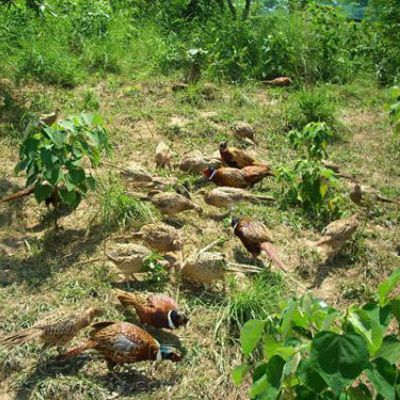
Pheasant
I. Signs of sexual maturity
The signs of sexual maturity in pheasants are the first successful mating by the male pheasant and the laying of the first egg by the female pheasant.
In the wild state, pheasants generally reach sexual maturity only 10-11 months after hatching, and male pheasants reach sexual maturity about 1 month earlier than female pheasants. Under natural light and natural climate conditions, pheasants hatched in June can mate and lay eggs in April of the following year. In the wild state, pheasant mates are mostly one male with two females, and there are also one male with one female, living together in one territory. Under artificial domestication conditions, pheasants generally can reach sexual maturity earlier. For example, the American ring-necked pheasant reaches sexual maturity at 4-5 months of age. After the American ring-necked pheasant was introduced to various parts of China for artificial rearing, its sexual maturity period varies with latitude, with a difference of about 1 month between the south and the north.
II. Breeding period
In the wild state, the pheasant breeding period is from March to July each year, with a difference of about 1 month between the south and the north. Under artificial rearing conditions, due to improvements in nutrition, temperature, light, and other conditions, pheasants begin mating and laying eggs earlier each year, while the date of stopping egg production is postponed, extending the breeding period. During the breeding period, pheasants mostly choose to nest on the ground in thickets composed of oak, hazel, poplar, birch, and Lespedeza bicolor, spreading dry grass, miscellaneous leaves, and so on in depressions on the ground. The area near the nest is mostly covered by grass and vines.
III. Male pheasants competing for mates
During the breeding period, male pheasants have a strong phenomenon of competing for mates. In the mutual pecking and fighting among several male pheasants, the winner is usually called the ”prince rooster”. Once the ”prince rooster” is determined, no further fighting will occur in the short term. However, after a period of time, some flocks still have the phenomenon of ”contending for kingship”, until a ”prince rooster” is produced again.
IV. Mating
In the wild state, during the mating and breeding period, pheasants often have one male mating with multiple females (1:2-4), forming a “mating group”, living together relatively stably, and mating, laying eggs, and incubating eggs. Only very few are one male with one female.
Under rearing conditions, the male-to-female mating ratio of pheasants during the mating and breeding period is one of the important factors affecting the fertilization rate of breeding eggs. Wild pheasants begin mating and breeding from March to April each year, with the most mating occurrences in May to June, and stop mating and breeding in June to July. For artificially reared American ring-necked pheasants, mating begins in March each year; generally about 50% of adult female pheasants accept mating in mid-April; mating is more frequent and occurs more often from May to July; after early August, mating gradually decreases, and stops by September. Within a day, the times when pheasants are relatively active in mating are early morning and dusk each day.
Male pheasants have various courtship postures. For example, the male pheasant walks quickly around the female pheasant and turns his head to observe the female pheasant's reaction; or the male pheasant repeatedly pecks food or sand grains near the female pheasant, pecking them up and putting them down again, and making ”gululu”, ”gululu” calling sounds to entice the female pheasant to come closer to him; or he raises his head, droops the inner wing, lightly kicks one foot backward, and gradually approaches the female pheasant.
Pheasant mating is completed in about 10 seconds. During mating, the male pheasant's neck feathers fluff up; he first raises his head and puffs out his chest, erects his tail feathers, quickly chases the female pheasant, approaches the female pheasant from the side, droops the inner wing, and keeps flapping the outer wing, circling around the female pheasant. If the female pheasant stands still or crouches, the male pheasant jumps onto the female pheasant's back, grips the feathers on top of the female pheasant's head, raises his tail, with the tail feathers tilted to one side, the male pheasant's tail lowers, the female pheasant lies prone, the tail feathers open, and when the cloacal openings of the male and female pheasants align, mating takes place; in an instant the male pheasant ejaculates and completes mating. After mating is completed, the female pheasant shakes her feathers, and the male pheasant walks away.
V. Egg laying
For wild pheasants, the female pheasant lays 2 clutches of eggs each year, and a few lay 3 clutches, with 6-14 eggs per clutch. The eggs are light olive-yellow, oval in shape, with an egg weight of 24-28 grams, a long diameter of 40.7-43 mm, and a short diameter of 32.7-34.8 mm.
Under artificial rearing conditions, pheasants begin laying eggs at the end of April; May, June, and July are the peak laying periods, accounting for 80%-85% of the annual egg production; after early August, egg production gradually declines; by September, egg laying basically ends. Generally, a female pheasant lays 20-25 eggs per year. For the American ring-necked pheasant, when raised with light-control methods, there are 2 egg-laying periods each year, with 30-40 eggs per period; one female pheasant can lay 70-80 eggs in the whole year, and even as many as more than 100 eggs.