What is a purple sweet potato? Introduction to purple sweet potato varieties
The purple sweet potato, also called black potato, is known in English as Purple Potato, and its flesh ranges from purple to deep purple. Besides containing the nutrients found in ordinary sweet potatoes, it is also rich in selenium and anthocyanins. In recent years, purple sweet potatoes have become very popular on both international and domestic markets, with very broad prospects for development.
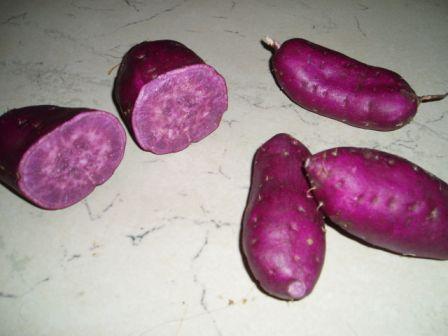
Purple sweet potato
Today, many countries have bred a number of good purple sweet potato varieties. The purple sweet potato varieties currently cultivated in various parts of China include:
1. Shanchuan Zi. This variety was introduced from Japan and has a high pigment content, more than 2 times the anthocyanin content of ordinary purple sweet potatoes; besides being eaten, it can also be used to extract pigment. Yield per 667 sq m is generally more than 1500 kg. The tubers are slender and poor in uniformity, and the main vine stems are 6 m to 7 m long. Using the tender stems and leaves (tips) of this sweet potato as a vegetable gives a taste even better than water spinach.
2. American Black Sweet Potato. This variety was developed in the United States. The taste is delicate, sweet and smooth, with a rich aroma. This sweet potato has strong sprouting ability, many branches, is sturdy, with the longest reaching 1 m, does not grow excessively, and is semi-erect. Yield per 667 sq m is generally 3000 kg. It is rich in nutrients; lysine and trace elements such as manganese, potassium and zinc, as well as iodine and selenium, which have anticancer effects, are all higher than in the American black sweet potato, and its color, aroma, taste and shape are all excellent, making it currently the most ideal health food. It can also be used to extract pigment.
3. German Black Sweet Potato. Introduced into China in 2002, it has medium vines, many branches, uniformly sized tubers, delicate flesh, and is sweet and tasty, with relatively strong disease resistance. Yield per 667 sq m is generally 4000 kg to 5000 kg, tuber production per plant can reach more than 10 kg, and the largest single tuber weighs 5.7 kg. Besides being eaten, it can also be used to extract pigment, and it is one of the best purple sweet potato varieties.
The purple sweet potato varieties that have been bred so far in China include:
1. Jishu No. 18. This variety was bred by the Crop Research Institute of the Shandong Academy of Agricultural Sciences, with a yield per 667 sq m of more than 3000 kg.
2. Guangshu 135. This variety was bred by the Guangdong Academy of Agricultural Sciences, with a yield per 667 sq m of 2000 kg to 2500 kg.
3. Ningzi No. 4. This variety was bred by the Grain and Oil Crop Research Institute of the Jiangsu Academy of Agricultural Sciences, with a yield per 667 sq m of about 500 kg. The above 3 varieties can also be eaten fresh, and all have characteristics such as drought resistance, tolerance of poor and thin soil, strong adaptability, relatively high yield, uniform tubers, smooth tuber skin, bright color and delicate flesh, and are suitable for planting in the vast sweet potato production areas. 4. Jingshu No. 6. This variety was produced by crossing a Brazilian sweet potato with a Chinese sweet potato. It has long stems and vines, and both the skin and flesh of the tubers are purple. It has high sweetness and good quality, with a yield per 667 sq m of 1500 kg to 2000 kg and a high dry matter rate, and it is mainly used for deep processing and pigment extraction.
The deep processing of purple sweet potatoes is mainly for extracting anthocyanins. Anthocyanin is a natural purple pigment additive; it is safe with no toxic side effects, and although it is more expensive than synthetic pigments, it still sells well on the international market. Purple sweet potatoes can also be peeled, dried and crushed, then processed into whole flour, which is attractive in color and rich in nutrients. It is an excellent raw material for food processing and can be used as the main ingredient and an auxiliary ingredient for various pastries. At present, South Korea imports about 500 tons of purple sweet potato whole flour from China every year. In addition, fried chips, frozen potato cakes and vermicelli made from purple sweet potatoes as the raw material are quite favored by the market for their rich nutrition and good taste.
The cultivation method for purple sweet potatoes is basically the same as for ordinary sweet potatoes.