A rose cutting grown for 1 year bloomed with a showstopper effect, I'm content
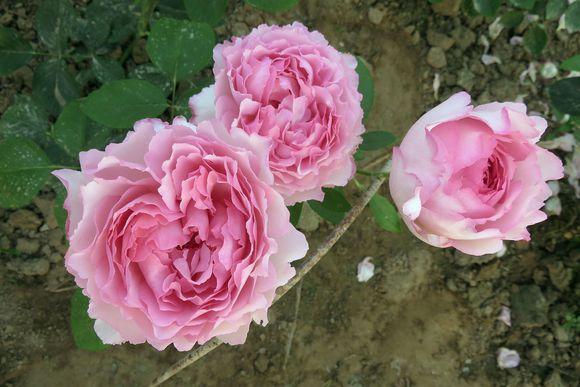
A flower enthusiast planted some roses in the ground, all from cuttings, and transplanted them once in winter, so the flower quantity was affected, but they still bloomed into showstopper-grade roses. This flower is called Eve, and it blooms with a very elegant, fairy-like air.
How to care for showstopper-grade roses: Caring for roses also comes down to the right time, the right place, and the right people, that is, light, fertilizing, soil, and pruning working together and reinforcing one another. Maybe some flower enthusiasts say that they haven't met any of these conditions, yet the roses at home still bloom beautifully. Well, Huahua would say, hehe, congratulations, you're like other people's children who do well no matter what, while most children still need their parents' careful company to grow up well.
Roses are the same. Some roses don't need much care at all and still bloom in countless numbers, while most roses, especially potted roses, still need some thought to bloom in good form.
Light
The roses at the flower enthusiast's home indeed didn't get much light, and they grew like this without being rained on, but there is one advantage: they were planted in the ground, so at least the soil is loose and breathable. But Huahua still suggests giving roses more sunlight, and potted roses need this even more, because no matter how big the pot is, the soil is limited, and breathability is definitely somewhat worse than in the ground. This requires more light to sterilize and promote photosynthesis in the leaves, making the plant grow more vigorously.
Fertilizing
Whether planted in the ground or in pots, roses need fertilizing. Only with enough fertilizer can nutrient supply be guaranteed. Roses like fertilizers rich in nitrogen, phosphorus, and potassium and also rich in humus, and it is best to use organic fertilizer. In rural areas it is very easy to make organic fertilizer without spending money. For example, rice straw, wheat straw, leaves, poultry and livestock manure, and so on can all be fermented into organic fertilizer. Flower enthusiasts in cities who prefer to keep clean can buy ready-made organic fertilizer. Generally, roses should be fertilized about once a week. During the flowering period, use light fertilizer less, with the dilution ratio doubled compared with the original, once every 2 weeks, and it must not be poured onto the flower buds.
Watering
You cannot rigidly stipulate watering once every few days, because the climate of the four seasons differs quite a lot, so watering should follow "water when dry, stop when wet," and the amount of watering should be determined according to your local climate, soil conditions, and the strength of the plant.
Roses like a moist environment and also have a relatively large demand for water, so during care they must be watered appropriately. If watered too much, the potting soil is easily flooded, causing a large amount of standing water. Generally in summer, water once a day; when the surface of the potting soil turns white, water once. In winter, water less; half-dry and half-wet is enough.
Pruning
A rose has 1 flower bud, and it should generally be cut about 1 cm above the axillary bud. If the branch is too long, you can prune off half of the branch, which not only makes the plant shape more beautiful but also provides enough nutrients for the flowering branches.
For roses whose plant shape is not large enough, pruning is generally done after summer, and the cut should be made about 1 cm above 5 leaves, so as to promote plant development and produce more flowers.
If it is a young rose seedling, remove the outer buds, as this helps good ventilation for the rose and prevents pests and diseases or poor branch development.
There are many varieties of roses, and among them there is one variety that is specifically upright in form. If it is this kind of form, its lateral bud development ability is generally relatively poor. We can start from here and cut off the lateral buds so that the main stem can develop better.
After pruning, place the rose in an environment with a temperature of around 20°C. At this time the rose grows fastest. It is best to place it at a window position where it can absorb at least 5 hours of light every day. After the rose leaves grow out, watering can be controlled, trying to spray once every half day and water once a day. After the rose shows flower buds, in summer it also needs more spraying to cool down.