Prospect Analysis and Key Rearing Techniques for the White Jade Snail
Recently, some farmers have written in asking about the farming prospects and rearing techniques of the white jade snail. An introduction to the relevant aspects of white jade snail farming is given below.
I. Farming prospects of the white jade snail
The prospects for farming the white jade snail are very good. Edible snails are a delicacy, favored by people both in ancient and modern times and in China and abroad. People often speak of French-style baked snails, snails in red sauce, roasted snails and so on, all of which are world-renowned delicacies. Snail meat is white, tender, nutritious and delicious; its protein content is higher than that of chicken, duck, pork, beef and mutton, it contains almost no cholesterol, and its fat content is very low. Snail protein is rich in essential amino acids for the human body, with as many as 20 kinds. In addition, it contains various other nutrients, such as calcium, phosphorus, iron, thiamine, glucose, glycogen and other carbohydrates. Because the white jade snail has high comprehensive utilization value, high protein, low fat and contains multiple nutrients, it has become a delicious dish on people's dining tables. Moreover, the white jade snail has smooth sales channels and is a pillar industry for earning foreign exchange through exports.
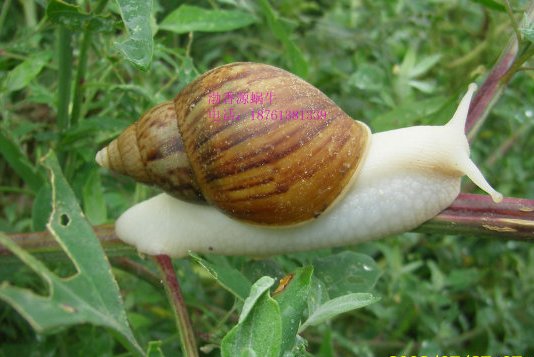
II. Rearing techniques for the white jade snail
1. Living environment
Like other snails, the white jade snail likes to live in dark, damp environments that are loose and rich in humus. It hides by day and comes out at night, fears light and heat, and is most afraid of direct sunlight. It is extremely sensitive to the environment; when humidity and temperature are unsuitable, the snail retracts its body into its shell and secretes mucus to form a protective membrane, sealing the shell opening to overcome the interference of an unfavorable environment. When the environment becomes suitable again, it automatically dissolves the protective membrane and resumes activity. Therefore, during the rearing process, attention must be paid to the effects of temperature and humidity.
The suitable temperature is 16—30°C, humidity 60%—85%, soil moisture around 40%, and pH 5—7. When the temperature is below 15°C or above 35°C, it becomes dormant and stops growing and reproducing.
2. Feeding habits of the white jade snail
Various green plants and bran can all be used as feed. Generally, in spring, broad-leaf plants such as Chinese cabbage, green vegetables and lettuce are fed; in summer, large amounts of sugarcane, sunflower leaves and various melon and fruit peel residues can be fed; in autumn, when temperatures are low and food intake decreases, some vegetable leaves and potato slices can be fed. The white jade snail does not eat green grass or weeds, and refuses to eat scallions, chives and garlic, which have pungent odors.
3. Reproduction
The white jade snail is hermaphroditic and mates with another individual. In artificial rearing, as long as temperature and humidity are suitable, it can reproduce throughout the year. From hatching to sexual maturity generally takes about 6 months; after mating and fertilization, eggs can be laid in 15—20 days, with the eggs laid inside burrows. The eggs are the size of mung beans, covered with a white, shiny membrane. Each time, 100—200 eggs are laid, and young snails hatch in 8—15 days. The lifespan is generally 5—6 years.
4. Rearing management
(1) Rearing methods: according to the farming site and equipment, they can be broadly divided into two types: outdoor open-style and indoor closed-style. For the outdoor type, soil trenches can be dug or a greenhouse can be built. If trench rearing is adopted, the soil trench should be built in a wind-sheltered, sunny place, dug 50—70 cm deep and 2 m wide, with the length determined by the number of snails reared. The top of the trench should be higher on one side and lower on the other, with a slight slope, and covered with plastic film and bamboo blinds to prevent escape and protect against harm from natural enemies such as frogs and birds. For indoor rearing, earthen basins, plastic boxes, wooden boxes, cement pools and the like can be used, sealed with sand covers, wet cloth, plastic film and so on to retain moisture and prevent rats.
(2) Preparation of rearing soil: the rearing soil should be moist, loose and fertile, so it is best to select unpolluted garden soil and yellow sand, then add a small amount of stone powder and mix them. After exposure to the sun for 3—5 days for disinfection, sieve it and set it aside for use. The soil formula ratio is: fine soil 30%, sandy soil 30%, yellow sand 20%, coal cinder ash 15%, stone powder 5%. After adding water, the moisture should be around 40%, that is, it forms a ball when squeezed and breaks apart when tapped. The soil thickness in the basin is divided as follows: 10 cm for adult snails, 7 cm for growing snails, and 3 cm for young snails. The rearing soil is replaced once every 1—2 months.
(3) Feeding methods. For young snails, feed some fresh, tender vegetable leaves and add some concentrated feed. The temperature must not be lower than 20°C and should be controlled at 25—30°C. Do not allow excessive temperature fluctuations, and when spraying water, do not spray the young snails directly. Calcium-containing food in the feed must not be lacking. After 1 month, transfer them into adult snail rearing basins. The stocking density should gradually change from dense to sparse as individuals continue to grow. Stock 400—500 per square meter, and 200—250 before harvest. A rearing box of 60×30×25 cm can hold 100 snails. After 5—6 months, when the shell height is 4 cm and the body weight is 40 grams, they can be harvested.