Detailed Explanation and Practical Key Points of Fermented Bed Pig Farming Technology
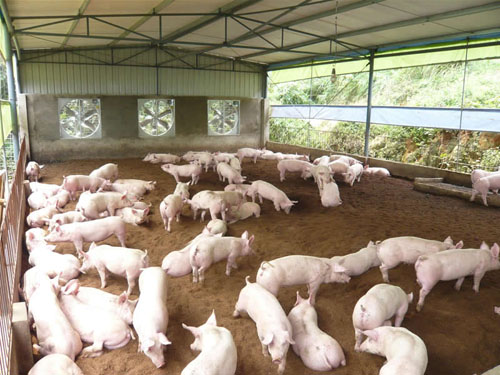
Fermented bed pig farming technology is an emerging environmentally friendly pig farming technology that can solve the pressure that the pig farming industry brings to the environment. It can reduce environmental pollution without increasing investment, and it can also lower labor intensity and produce healthy, disease-free pigs, significantly improving economic benefits.
Pig house construction: The pig house for fermented bed pig farming can be slightly modified on the basis of an originally built pig house, or a greenhouse can be used. It is generally required that the pig house run east-west, face south with its back to the north, have sufficient lighting, and be well ventilated, with the north and south sides able to be opened. Usually each pig house has a net area of 25 sq m and can raise 15-20 meat pigs. The pig house wall is 3 m high, and the ridge is 4.5 m high. A window that can be freely opened and closed is set in the middle of the south-facing roof surface. Sunlight can shine on 1/3 of the entire pig bed area, and it is required that within one day sunlight can reach every corner of the entire pig bed. An automatic feeding trough is built on the north side, and an automatic waterer is set on the south side.
Preparation of the fermented bed: Fermented beds are divided into two types: underground fermented beds and aboveground fermented beds. In the south, where the groundwater level is relatively high, aboveground fermented beds are generally used. Aboveground fermented beds are built on the ground surface, require a certain depth, and are then filled with already prepared organic bedding material. In the north, where the groundwater level is relatively low, underground fermented beds are generally used. Underground fermented beds require digging 90-100 cm below the ground surface and filling them full of prepared organic bedding material.
Bedding material production: The fermented bed is mainly composed of organic bedding material. The main component of the bedding material is sawdust, accounting for 90%, while the other 10% is soil and a small amount of coarse salt. The total filling thickness of the pig house is about 90 cm, and about 150 kg of bedding material is needed per sq m. For example, a pig house with an area of 25 sq m needs about 3750 kg of bedding material. If conditions are good, 30-40 cm deep wood segments can first be laid, and then sawdust can be laid on top. If sawdust is insufficient, 50 cm deep corn stalks or 30 cm thick rice husks can first be laid, and then sawdust can be laid on top. The amount of soil used is about 10% of the total material, about 415 kg, and it is required to be clean soil that has not used chemical fertilizers or pesticides; the amount of salt used is 0.3% of the total material, about 12 kg; the microbial stock culture is used at 2 kg per sq m, and one pig house uses 50 kg; water 1000 kg; activator (a mixed raw material of Tianhui green juice, lactic acid bacteria, animal amino acids, rice vinegar, etc.) 8 kg.
Mix the microbial stock culture, rice bran, and sawdust in a certain proportion, add a certain amount of Tianhui green juice and amino acid liquid, and bring the water content to 60%, ensuring that beneficial bacteria multiply in large numbers. Adding a small amount of distillers' grains, rice husk charcoal, rice husks, etc. for fermentation is also ideal. After 2-4 days of fermentation, the organic bedding material for the fermented bed can be made. The fermented bed bedding material can be used for more than 10 years.
After laying sawdust, soil, and microbial stock culture layer by layer, spray on salt water and nutrient solution, adjust the moisture to 65%, and spraying water should preferably begin after 50% of the filling material has been laid. Fill the bedding material full in this order. After 2-3 months of raising pigs, the bottom layer of the pig bed becomes a naturally reproducing state, the middle part forms white bacterial bodies, and its temperature can reach 40-50°C. After pig manure ferments, it becomes feed for the pigs.
Fermented bed management: Generally speaking, it is similar to the daily management of conventional pig farming, but the fermented bed has its own unique aspects, so there are also differences in daily management: (1) Pig stocking density. Generally, 1.2-1.5 sq m per pig is appropriate, and the stocking density can be appropriately increased for piglets. (2) The bed surface of the fermented bed must not be too dry. A certain humidity is conducive to the reproduction of microorganisms. If it is too dry, it may also cause respiratory diseases in pigs, so the activator can be sprayed regularly on the bed surface. (3) Pigs must first have internal parasites completely removed to prevent bringing parasites into the fermented bed, so as to avoid the pigs bringing worm eggs back into their bodies and becoming ill when they gnaw on the mycelia. (4) Pay close attention to the activity of biological bacteria, and add activator when necessary to regulate the activity of biological bacteria to ensure that fermentation can proceed normally. (5) When the sawdust in the pig house decreases, appropriately supplement the microbial stock culture and nutrient solution. (6) To help pigs root and turn over the ground, the feed amount for pigs should be controlled at 80% of the normal amount. Pigs generally defecate and urinate in fixed places, and when the manure and urine form a pile, it is enough to dig a pit and bury it. (7) Ground humidity must be controlled at about 60%, and if there is too much water, ventilation openings should be opened to regulate humidity. (8) The use of chemical drugs and antibiotic drugs is prohibited in the pig house to prevent killing and inhibiting biological bacteria, which would reduce the activity of the biological bacteria.