Technical Points and Methods for Raising Free-Range Chickens Under Forest Canopy
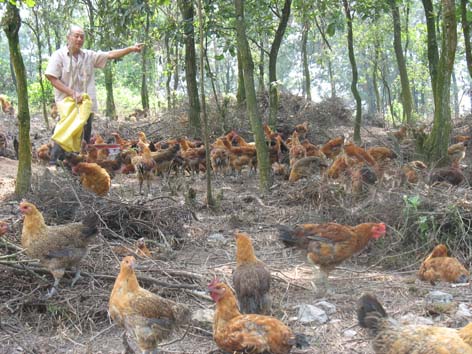
"Our green free-range chickens here are in high demand! This is all thanks to the Party's good policies, which support and help us farmers develop under-forest economies. Raising chickens under the forest kills three birds with one stone: the insects and grass under the trees serve as food, saving money on feed; adult chickens and eggs sell very well, fetching two to three times the market price; and the chicken manure enriches the soil, generally advancing the maturity of poplar trees by one to two years." These are the benefits of raising chickens under the forest.
In recent years, with the improvement of people's living standards, developing pollution-free food has become a major direction, and under-forest chicken farming has become increasingly common. However, most farmers do not have an adequate grasp of the techniques for raising free-range chickens under forest canopy, resulting in reduced economic benefits. Raising free-range chickens under forest canopy mainly involves mastering the following key aspects:
1 Site Selection
Not just any woodland can be used for raising free-range chickens. You should choose woodland with high, dry terrain, good drainage conditions, and good ventilation and light penetration. Woodland with intercropped forage grass under the canopy is best. Avoid raising free-range chickens under economic forests (apple, pear, apricot, peach and other tree species).
2 Focus on Disease Prevention and Control
Brooding should follow the growth requirements of the chickens. Brood the chicks collectively at a nearby location in the township (or project area), then release them into the woodland after about 30 d. Vaccination work should be done well during the brooding period. The specific vaccination schedule is as follows: at 1 day of age, inject Marek's disease vaccine subcutaneously in the neck. At 5 days and 17 days of age, use the Newcastle disease-infectious bronchitis-28/86 vaccine for eye drops and nasal drops. At 11 days and 25 days of age, use infectious bursal disease vaccine as nasal drops; at 30 days of age, inject Newcastle disease-infectious bronchitis H52 vaccine subcutaneously. If vaccination is needed after release, drinking water immunization is best. If injection or wing-web stab vaccination is required, it should also be arranged at night after the chickens return to roost. Separate the chickens into small groups and vaccinate group by group to reduce stress in the chickens.
3 Feed Supplementation
Based on the forage grass and insect resources in the woodland, formulate reasonable frequency and quantity of artificial supplementary feeding. Ensure at least 1 feeding per day, and place it in the evening, which is more conducive to the normal growth and development of the chickens and improves economic benefits. Drinking water must be kept clean and hygienic, and the water should be changed at least once a day. Especially in hot summer, the water should be changed more frequently.
4 Environmental Disinfection
Because free-range chickens come into direct contact with the external environment, compared with confined chickens, this places higher demands on environmental hygiene and disinfection work. Generally, the site should be disinfected once a week to reduce the presence of pathogenic microorganisms. When selecting disinfectants, use multiple types in rotation and cross-use. Commonly used disinfectants include: ① Compound phenols: Xundudi, Nongjiafu, Xundumie, lysol, etc., which have a good killing effect on pathogenic microorganisms. ② Aldehydes: glutaraldehyde, ethylene oxide, formaldehyde, etc., which are high-efficiency disinfectants; both their gas and liquid forms have a strong microbial killing effect. ③ Quaternary ammonium salts: Disinfect-99, Baidusha, etc., which have a good killing effect on bacterial vegetative forms and lipophilic viruses. ④ Chlorine-containing preparations: 84 disinfectant, Xundujing, Youlujing, etc. They can kill all types of microorganisms and can be used for drinking water disinfection. ⑤ Peroxide types: peracetic acid, etc., which have a good disinfection effect and are cheap, but are somewhat corrosive.
How to save feed when raising free-range chickens under forest canopy:
When farmers raise free-range chickens using the under-forest method, feed waste is easily caused. The following measures in the production process can effectively prevent feed waste.
Scientifically choose feeders or feed buckets, and reasonably control the feeding amount. Because free-range chickens tend to crowd when eating, they often knock over feeders or feed buckets, causing feed waste. Therefore, during feeding, the feeders or feed buckets should be fixed in place, with their height level with the chickens' backs, and the number should be appropriately increased. Do not add too much feed at a time; adding to 1/3 of the feeder or bucket capacity is sufficient, and it is advisable for the chickens to finish eating within 40 minutes. Feed 4 times per day. In summer, feed more in the early morning and in the cool evening, and feed less at noon when the temperature is high.
Use scientific feed formulation to reduce feed costs. Use local raw material resources, and under the premise of keeping the feeding standard unchanged, choose cheap raw materials to effectively reduce feed costs. For example, cake and meal ingredients can be used to replace part of the fishmeal, or sesame cake, peanut meal, and rapeseed meal can be used to replace part of the soybean meal, etc.
Promptly cull chickens that do not meet standards. Chickens that do not meet standards refer to sick, weak, and disabled individuals as well as low-yielding or non-laying hens. In addition, surplus roosters should also be culled promptly.
Store feed scientifically. The warehouse for storing feed and raw materials should be dry and ventilated to prevent the feed from becoming moldy. When purchasing raw materials, buy them multiple times in small quantities according to production needs, and minimize the storage time of raw materials to prevent them from becoming moldy. In addition, prevent rodent damage and bird damage to reduce unnecessary waste.