Detailed Guide to Miniature Fragrant Pig Raising Techniques, Helping You Farm Scientifically
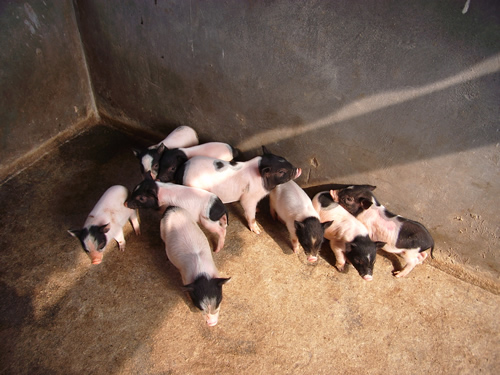
The miniature fragrant pig is unique to China and has the characteristics of being easy to raise, offering a high feed conversion rate, and selling well. It is a good project for farmers to escape poverty and become prosperous. The specific raising techniques for miniature fragrant pigs are as follows:
A pig house should be built on dry, level ground that is sheltered from the wind and faces the sun. The pig house may be either single-row or double-row in form, but the walls must be built with brick and stone and faced with cement so that it can be washed and cleaned easily and the pig house kept clean. The pig house for miniature fragrant pigs should be cleaner than ordinary pig houses. The pig house for miniature fragrant pigs should be built somewhat taller than ordinary pig houses. According to the experience of miniature fragrant pig raisers, each miniature fragrant pig should occupy 0.8 sq m, and keeping 8 to 10 pigs per pen is suitable. A manure yard should be set up outside the pig house, and the area of the manure yard should be a little larger than the pig house; calculated at 1.5 sq m per pig, 10 pigs should have a 15 sq m manure yard. In summer, a shade shed should be put up over the pig house. In winter, a plastic shed should be used to raise the room temperature; this is an important condition for raising miniature fragrant pigs well.
Feeding piglets well is the key to improving the survival rate and the commercial pigs. After miniature fragrant pigs are born, the sow's teats should be fixed so that the piglets can take in good colostrum, and warmth should be strengthened to get them to start eating early. Generally, after 4 days of birth, concentrated feed can be given as a supplement, and after one month of age, vaccines against swine fever, swine erysipelas, and swine pasteurellosis should be injected in time.
Miniature fragrant pigs are lively and active, yet timid and easily frightened, so a quiet, dry, and clean raising environment should be maintained. Feeding is mainly based on feeds such as barley, rice bran, and wheat bran. However, weaned piglets should be fed a compound feed, with the feed formula as follows: corn 10%, rice bran 50%, soybean cake 8%-10%, wheat bran 30%, flour 1%, salt 0.5%; each kg of feed should contain 10.5 megajoules of digestible energy and 16.2% crude protein. In order to improve the feed conversion rate and reach the standard for commercial pigs as quickly as possible, scientific feeding should be carried out. First, feeding should be at fixed times, 4 meals per day, starting at 7 a.m., once every 4 hours; second, feeding should be in fixed amounts. For pigs weighing more than 20 kg, feed at 4.5% of their body weight; for pigs within 20 kg, feed at 3.5% of their body weight. At the same time, achieve openness in the front and restriction in the back, that is, after 2 months of age, restrict their activity and promote fattening so as to ensure a relatively high meat yield.
First, prevent disease before it occurs: wash away manure once a day, put up a shade shed in summer for sun protection, cover with a warm shed in winter for heat preservation, often scrub the feed trough and water trough, and regularly disinfect the pig house; second, treat disease early, with particular attention to preventing and treating piglet paratyphoid.
After piglets are raised to 5 to 7 weeks of age, they can be marketed as raw material for roast pig, and at this time they should be sold in time. If selling breeding pigs, then they can be sold at the specified time.