What kind of fertilizer is best for orchids? These few options are both money-saving and safe.
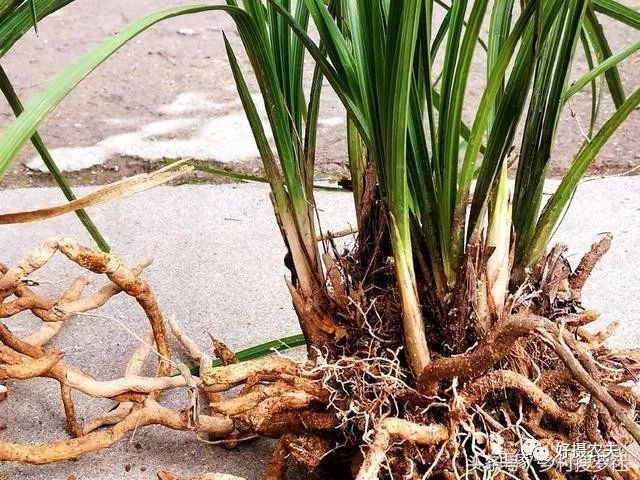
Orchids love fertilizer. We know this from searching for wild orchids in the mountains: those large clumps of wild orchids with dark green leaves mostly grow in fertile humus soil, and the root system of wild orchids grows horizontally, parallel to the ground surface. This is to absorb as much fertility as possible. So recently, when orchid friends were discussing orchids with Haoshe Farmer, they mentioned that orchids are actually better suited to shallow, wide pots rather than deep pots. Of course, that is a topic for another time.
A wild orchid with 5 shoots can spread its roots to cover a circular area 60 cm in diameter. Only in more humus soil can it obtain the fertility it needs.
For fertilizing orchids, organic fertilizer generally comes first. First, mix humus soil into the growing medium, which can take care of the fertility needed during the early acclimation period. Haoshe Farmer's method for choosing humus soil is a bit troublesome. One: do not select it on ridge tops. Two: do not select it on hillsides. The humus soil Haoshe Farmer chooses is in the gully where two sloping hillsides meet. Because of long-term rainwater washing down more organic matter from both hillsides, the soil in this kind of place is better.
For later fertilization, you can use thoroughly rotted rapeseed cake or tea seed cake, take the leachate, and water it on. You can also mix thoroughly rotted cake fertilizer into the growing medium, but it absolutely must be thoroughly rotted and composted. The specific method is to compost the required cake fertilizer in a water vat, seal the mouth of the vat with plastic film for three to five months, and take the upper liquid to water on. Then mix the residue at the bottom into the growing medium. Growing medium made with this cake fertilizer has a long fertilizer effect period, and the fertility is released gently.
Combine this with foliar feeding. Orchid leaves have a very strong absorption capacity. Use a foliar fertilizer with a balanced ratio of nitrogen, phosphorus, and potassium. When spraying, spray both the front and back of the leaves. In fact, the back of the leaf has stronger absorption. Commonly used is urea plus monopotassium phosphate, once every half month. Stop spraying during periods of high and low temperatures.
As for root application of chemical fertilizers (the various chemical fertilizers commonly used in agriculture), it is generally not recommended. However, there is a slow-release fertilizer specifically for orchids on the market. As for its actual effect, Haoshe Farmer has not tried it personally, so I dare not make reckless comments.
If you feel that the articles from this official account are somewhat useful for growing orchids, then share and forward them to more friends. The official account reprint function has been enabled, and any official account can reprint directly from here.