New cylindrical cultivation technique for oyster mushrooms helps you achieve high yields
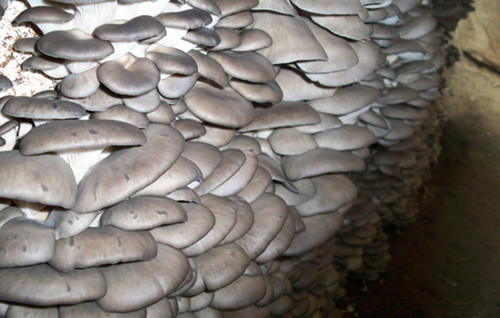
With the traditional bag cultivation method for oyster mushrooms, after two flushes the mushroom bags lose water and nutrients severely. Then the soaking method is used to replenish water and nutrients, which is not only troublesome and time-consuming to move around, but also makes the moisture inside the bags difficult to control. Water and nutrients supplied all at once are hard for the mycelium to absorb, and if the nutrient solution concentration is too high, it can also cause reverse osmosis of water from the mycelium, resulting in fertilizer damage. Compared with the traditional bag cultivation method, the new cylindrical high-yield fruiting technique for oyster mushrooms has many advantages: First, the contact surface between the substrate and air is small, reducing contamination and water evaporation, and avoiding the drawbacks of the traditional bag method, such as a high contamination rate after the second flush and difficulty in retaining water; second, it eliminates the tedious process of moving bags around for soaking and water replenishment, greatly reducing labor and costs; third, the mycelium can selectively and steadily absorb nutrients from the soil through ion exchange, thus completely eliminating the negative effects caused by directly replenishing water and nutrients to the mycelium that are difficult to absorb at once; fourth, the fruiting bodies are clean and free of soil, with good quality and a high selling price. Fifth, the fruiting period is long and the yield is high; a single cultivation can produce 6-7 flushes of mushrooms. The specific cultivation technique is introduced as follows:
Material selection and bag filling. Carry out material selection, ingredient mixing and substrate blending according to the conventional bag cultivation method. In winter, when temperatures are low, raw material cultivation can be used. Take 40 cm wide tube film and cut it into 75 cm lengths. First tie one end of the tube film tightly to form a bag, then place a bamboo tube with a diameter of 10 cm and a length of 40 cm upright on the ground in the center of the bag. Then first sprinkle a layer of spawn at the bottom of the mushroom bag before filling with substrate, compacting while filling. When the substrate reaches 10 cm high, sprinkle two rings of spawn around the bamboo tube and along the outer periphery near the bag wall, forming two concentric rings of spawn. When the substrate reaches 20 cm high, inoculate another layer of spawn in the same way. When the substrate reaches 30 cm high, sprinkle a layer of spawn over the entire surface, pull out the bamboo tube and tie the bag opening tightly, thus forming a large mushroom disk 30 cm high with three layers of substrate and four layers of spawn.
Incubation of mycelium. The incubation room should first be disinfected by spraying with a 2%-3% Lysol solution, and insecticidal and repellent treatment should be done by spraying with a 400-fold dilution of 40% dichlorvos. Then close doors and windows and keep sealed for 24 hours. The next day, open windows for ventilation and sprinkle a layer of lime powder on the floor. Move the mushroom disks into the incubation room and stack them in a “pin” shape for mycelial running, generally stacking 3-4 layers. When winter temperatures are low, cover the stack with film to increase temperature. During the mycelial running period, alternately spray 2%-3% Lysol solution into the air every 4-5 days for air disinfection. When the mycelium begins to germinate, open doors and windows for 30 minutes every morning and evening. When the mycelium at both ends of the mushroom disk is thick and white and two thick white mycelial rings appear in the middle, turn the stack and cut a small opening at each of the two ends at the hollow areas. When rebuilding the stack, turn the mushroom disks upside down, and when stacking, align the central hole of the upper disk with the gap between the four disks below to facilitate ventilation. The entire mycelial running period is about 35 days in winter, by which time the mycelium will have fully covered the mushroom bags; during this period, turn the stack no fewer than 3 times.
Construction of the mushroom columns. After the mycelium has fully run through, the mushroom disks can be moved into the fruiting room to build mushroom columns. First untie the film at the upper end of the bottommost mushroom disk and roll it toward the surroundings to expose the entire upper mycelial surface, then sprinkle a layer of fine moist soil about 1 cm thick. Then roll the film at both ends of the several mushroom disks stacked above toward the surroundings to expose the mycelial surfaces, and then stack them upward hole-to-hole and face-to-face to a height of 4-5 layers, spreading a layer of fine moist soil about 1 cm thick at each contact point between the mycelial surfaces of every two layers. Finally, cover the top of the mushroom column with about 2 cm of fine moist soil, fill the central hole of the mushroom column with fine moist soil, and make a pot-bottom-shaped water storage pit in the center of the top of the mushroom column; the mushroom column is then completed. In this way, build several rows of mushroom columns in the fruiting room one next to another, with the row spacing determined by ease of operation.