How to raise American bullfrogs? These basic rearing facts you need to master
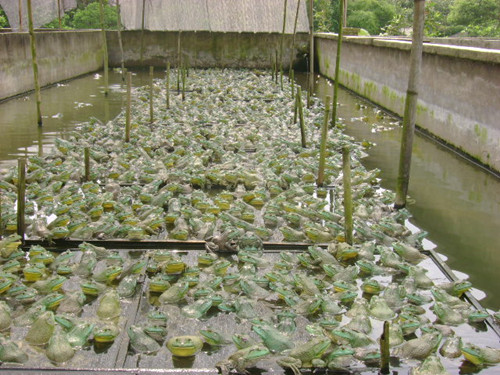
A. Characteristics of the American bullfrog:
The American bullfrog is a large edible frog. To support China's "vegetable basket" project, it was introduced into China from Florida, USA, in 1997. The American bullfrog weighs 5-7 times as much as an ordinary frog, and has the characteristics of a docile temperament, low investment, fast growth (raised in the same year, returns in the same year), high reproduction, a wide range of foods, easy rearing, and few diseases. Its market demand is large, and its farming prospects are very good.
B. Construction of the American bullfrog site:
For the American bullfrog site, it is best not to occupy farmland. Full use should be made of wasteland, marshland, or areas in front of the house, behind the house, in the yard, and so on. The farm must have convenient water intake and drainage, and nylon netting or other barriers should be used all around as walls to prevent the American bullfrogs from escaping and to keep out their enemies. The wall height is 1 m, and the lower end only needs to be buried 20 cm in the soil.
C. Construction of American bullfrog ponds:
Generally, it is suitable to build 4 frog ponds, divided into a parent frog pond, a hatching pond, a tadpole pond, and an adult frog pond. The areas of the frog ponds are respectively: 10-25 sq m, 3-6 sq m, 30-70 sq m, and 130-180 sq m, and the water depths are respectively 30-50 cm, 40-60 cm, 50-70 cm, and 60 cm. The size of the frog-rearing ponds can be determined by oneself according to the farming area. Each pond should have irrigation and drainage conditions, and the water inlet and outlet should be sealed with sand netting. Parent frogs are stocked at a male-to-female ratio of 1:1, with 2-3 pairs per sq m, and the hatching pond is stocked with 2 egg masses per sq m.
D. Management during the tadpole stage:
⟧ South of the Yangtze River, the American bullfrog lays eggs in February, and north of the Yangtze River it lays eggs in March-April. It lays eggs every year in both spring and autumn, and the egg-laying time is generally 4-6 in the early morning. Farmers should pay attention to patrolling the site when the American bullfrogs lay eggs. Within 40 minutes after the parent frogs lay eggs, the egg masses should be scooped up with enamel basins, plastic basins, or other containers to the hatching pond for hatching, and they usually hatch into tadpoles in 3-4 days. After the tadpoles hatch, they cannot be stocked. Only after the yolk sac disappears and they can actively feed should the tadpoles be caught from the hatching pond, counted, and then stocked in the tadpole pond and fed bait. Suitable bait includes soybean powder, soybean cake powder, rice bran, soybean residue, peanut cake, fish meal, and silkworm pupa powder, and various trace elements should also be added to increase nutrition. As the tadpoles gradually grow, the rearing density should be gradually reduced. It takes about 75 days for tadpoles to hatch into young frogs.
E. Rearing and management of adult frogs:
The stocking density of young frogs after metamorphosis is about 80-100 per sq m. Suitable bait includes small earthworms, yellow mealworms, housefly maggots, small miscellaneous fish, animal offal, and so on, fed once each in the morning and evening, achieving fixed timing, fixed quantity, and fixed location, with 100-120 g of bait put in for every 100 young frogs. After the young frogs grow to 50 g, the rearing density is 60 per sq m, and the bait can all be changed to complete expanded pellet feed. Complete feed can be trained and fed by the "activation" method. For example, use wooden boards to make a feeding platform, with water 20 cm deep inside, and put in loaches, live fish, and so on with strong activity. When the loaches and live fish swim, they drive the dead bait in the platform, and the frogs mistakenly think it is live bait and jump up to swallow it. In this way, the goal of gradually domesticating the American bullfrog to eat dead bait can be achieved, and domestication generally takes about one month. When the American bullfrog weighs more than 150 g, the rearing density is 30-40 per sq m. The bait should contain nutrients such as crude protein, crude fat, carbohydrates, inorganic salts, and vitamins (for example: add earthworms, fish meal, animal offal, field snail meat, fish, shrimp, silkworm pupae, soybean cake, bran, green vegetables, and so on to the complete feed). The feeding amount is reduced to once, and it is suitable to feed at 4-5 in the afternoon each day. At the same time, every day from 6-11 at night, black light lamps should be used to trap insects to supplement animal protein feed. When the American bullfrog grows to 300-500 g, it can be caught and sold.