What are the taboos in rex rabbit breeding? What breeders need to know
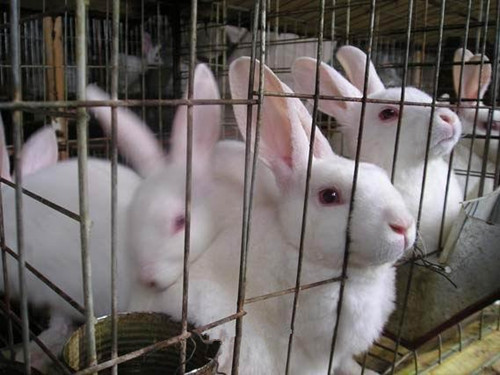
1. Avoid dampness and contamination. Rex rabbits are small, love dryness, and like cleanliness, and they have weak disease resistance. Therefore, the rabbit cages and rabbit housing must be cleaned regularly every day, feces removed, feeding utensils washed, and disinfection carried out regularly, always keeping the rabbit housing clean and dry so that pathogenic microorganisms cannot reproduce and parasitize, in order to prevent the occurrence, spread, and death of rabbit diseases.
2. Avoid startling them. Rex rabbits are timid and easily frightened, and are quite sensitive. Do not catch them casually or make loud noises, and do not allow crowds to gather around them. Keep a quiet environment, and also watch out for disturbances from cats, dogs, yellow weasels, rats, snakes, and the like.
3. Avoid extreme heat. Because rex rabbits have underdeveloped sweat glands and their whole body is covered with fine fur, they fear heat. Therefore, in summer the rabbit housing should be shaded and ventilated, direct sunlight prevented, and attention paid to temperature control and heatstroke prevention.
4. Avoid a single feed. A single feed cannot meet the rex rabbit's needs for nutrients, affects appetite, and may even cause nutritional deficiency diseases. Therefore, the food given to rex rabbits should be varied, mainly green and coarse feed, with reasonable matching.
5. Avoid overfeeding rex rabbits. When feeding rabbits, feed at fixed times and in fixed amounts, give less and add frequently; in principle, let the rabbits eat their fill and eat well, and do not let the amount vary suddenly. Never let rex rabbits eat while trampling the feed, as this not only wastes feed but also makes them prone to infection.
6. Avoid sudden feed changes. Feed should be matched with green and coarse feed, and changes should be made gradually; never feed moldy or spoiled feed. If the feed is suddenly changed, it easily causes poor appetite in rex rabbits, or overeating, leading to gastrointestinal diseases and other adverse phenomena. When changing feed, transition gradually so that the rex rabbit's digestive function has a process of gradual adaptation, which is beneficial to the rabbit's digestion and growth.
7. Avoid spoiled or contaminated feed. Do not feed rotten, moldy, trampled, contaminated, or unknown-source forage, or green fodder covered with dew or sprayed with pesticides before the safe interval has passed, and even more so do not let them drink contaminated water. The feed given to rex rabbits must be fresh and high quality, and the water must be clean.
8. Avoid feeding by day and stopping at night. According to the rabbit's habit of hiding by day and being active by night, the feed given to rex rabbits at night should be more than during the day. Especially at night, feeding coarse feed once is more helpful for fattening and growth. 9. Avoid water shortage. Rex rabbits are small and lively. Their metabolism is vigorous, and their water requirement is very large. Therefore, water should be supplied in time according to the rex rabbit's age, physiological condition, season, climate, and the nature of the feed.
10. Avoid inbreeding. Among specialized rabbit farmers, the phenomenon of breeding by mating littermate males with each other and between mother and son or father and daughter is widespread. With this kind of inbreeding, because the blood relationship is too close, the offspring often have weak constitutions, poor disease resistance, and slow growth and development, causing degeneration of productivity, vitality, and fur quality.
11. Avoid breeding too early. The sexual maturity of rex rabbits comes earlier than physical maturity, so it should not be assumed that breeding can begin as soon as there are signs of estrus. Generally, breeding male rabbits should be 7 to 8 months old, and female rabbits need to be 5 to 6 months old to begin mating, preventing inbreeding so as to avoid reducing quality.
12. Avoid indiscriminate mating and random pairing. Generally, a male rabbit should not mate more than 2 times in 1 day, and after 3 consecutive days of mating, it should be given 1 day of rest. For 1 male rabbit, it is best that the number of ejaculations in 1 year does not exceed 60. When mating again, it is strictly forbidden to pair rabbits that have the same serious defect or opposite serious defects. Mating between old and old, old and young, and young and young rabbits is prohibited. Old and young female rabbits should be mated with prime-age male rabbits. Young male rabbits can only be mated with prime-age female rabbits. Usually, when prime-age male and female rabbits mate, their offspring have the most stable heredity and the best vitality and production performance.
13. Avoid breeding in summer. Summer is hot and rainy. Female rabbits do not come into estrus normally and are not easy to conceive, and the few that do conceive and give birth, because of poor appetite due to hot weather, produce insufficient milk, and the young rabbits develop poorly; poor management can cause young rabbits to fight over the nest and die. Even if they survive, because of poor development and weak constitution, they are prone to coccidiosis after weaning and die in large numbers. Some pregnant rabbits often suffer heatstroke due to high temperatures, causing miscarriage and difficult birth. Male rabbits often suffer testicular atrophy due to high temperatures, with poor semen quality and more dead sperm, resulting in mating without conception. Therefore, breeding should be stopped in summer.
14. Avoid weaning young rabbits too early or too late: Under normal circumstances, the earlier the weaning, the higher the mortality rate of young rabbits. If weaned too late, the young rabbits rely on the mother rabbit's milk for nutrients for a long time, which affects the formation of various enzymes in the digestive tract and can cause slow growth of the young rabbits. At the same time, it also has a direct impact on the health of the mother rabbit and the number of litters bred each year. Therefore, young rabbits should be weaned at 40-50 days, when they weigh about 750 grams.
15. Avoid blindly mixing groups in rearing: When rex rabbits are reared in mixed groups, infection is harder to control, and biting and fighting are likely to occur. Generally, young rabbits should be reared in separate groups according to male and female, speed of growth, and body size. When raised in cages, each cage can hold 4-5 young rabbits. During the growing period, male and female rabbits have already begun sexual maturity. Female rabbits begin to come into estrus, and male rabbits can already produce sperm. Therefore, male and female rabbits should be raised in separate cages, preferably one rabbit per cage.