Key cultivation techniques for grafting bitter gourd onto sponge gourd
Taichung District Agricultural Improvement Station / Lin Tianzhi, Hong Shitang
Bitter gourd (Momordica charantia) is an annual climbing herbaceous plant with strong heat tolerance but poor tolerance to low temperatures. Its stems and leaves are slender and weak, and it cannot withstand wind and rain. Its roots cannot tolerate waterlogging. When cultivated in the rainy summer, overly wet soil easily causes root rot, which then leads to wilting and death of the plant. Sponge gourd (Luffa) has strong growth vigor and is easy to cultivate. Its root system is moderately shallow, with very strong regenerative capacity. Its growth period is quite long, and it can continuously flower and set fruit, with a harvest period lasting as long as half a year. It also has relatively few disease problems. Sponge gourd and bitter gourd both belong to the Cucurbitaceae family, have strong compatibility, and are easy to graft. By using the sponge gourd's moisture-tolerant and highly regenerative root system as rootstock and grafting bitter gourd onto it, the weather tolerance of summer bitter gourd can be improved. Moreover, after grafting, bitter gourd shows markedly increased yield, an extended harvest period, enhanced disease resistance, and improved quality. In addition, if the terminal buds of lateral vines are used as scions, seed costs can be reduced, lowering the production cost of bitter gourd and thereby increasing the income of melon growers.
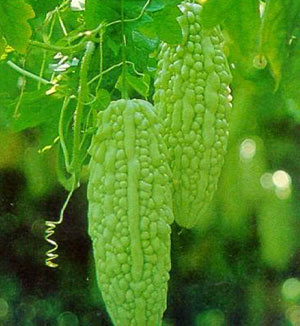
Cultivation techniques for grafting bitter gourd onto sponge gourd
Steps for grafting bitter gourd onto sponge gourd
Scion cultivation
After selecting the bitter gourd variety, disinfect the seeds for 2 hours with a 1500-fold water solution of Yili, or soak the seeds in warm water at 50 °C for 30 minutes, then place the seeds in a small cloth bag and soak them in clean water for 24 hours. After removing them, gently press out excess water by hand, then wrap the seed bag in a damp cotton cloth and place it in a cardboard box containing a 60~100W light bulb, maintaining the temperature at 25~30 °C for germination. Be careful to keep the seeds moist. After 2 days, germination begins, and germination should be stopped immediately at that point. After germination, before sowing, the seeds should be covered with a damp cloth to prevent the roots from drying out, or they should be sown immediately in a seedbed or seedling pot. Winter seedling raising requires heat-preservation facilities to aid growth. When the bitter gourd has grown 8~12 true leaves, pinch off the growing tip to promote more lateral vines for taking scions. At the same time, the terminal buds removed from the main vine can also be used first as scions. Aside from the fact that some rootstock uses sponge gourd, which can be raised first when the bitter gourd has 3~4 true leaves. Generally, sponge gourd used as rootstock is started after the bitter gourd is pinched. The method is similar to raising bitter gourd seedlings, except that the clean water soaking time is 18 hours, and the temperature inside the cardboard box is maintained at 25~28 for hours. After germination, it needs to be transferred to seedling pots to make subsequent grafting operations more convenient.
Grafting methods
(1) Cut grafting
1. Top cut grafting:
When the two cotyledons of the rootstock have emerged and the growing point has formed a round bead shape, this is the proper time for grafting, about two weeks after sowing and germination. In the operation, remove the growing point with a toothpick, then use a thin, sharp blade to make a vertical cut about 0.1 cm from the middle of the growing point at the top of the sponge gourd stem. Then take a terminal bud 3~4 cm long from the main vine or lateral vine of the bitter gourd, use the blade to shave the epidermis downward at an angle to form a slanted surface about 0.05 cm long. The cut surface must be smooth. Then lightly shave the opposite side at an angle as well, (the front of the stem slightly deeper and the back slightly shallower), forming a wedge shape. Then insert it into the cut in the rootstock stem, and fix it using the round space between the two teeth of a clip. Do not fix it with the clamping teeth, because the rootstock stem is young and tender and easily wounded and rotted. After grafting is completed, water should be supplemented appropriately, and a 1500-fold diluted solution of Yili should be sprayed. At the same time, use black plastic netting (cold gauze) with 50~60% shading rate, covering it in a tunnel-style frame for shade. During seedling raising, attention must be paid to regulating the temperature, humidity, and light inside the frame, with the principle of keeping the scion from wilting, rotting, or becoming leggy. During the period from grafting until fully established, pay attention to shading and ventilation during high temperatures. The temperature and humidity inside the frame must not be too high, otherwise both rootstock and scion are prone to rot. Especially during high temperatures, do not shade excessively, to avoid causing yellowing and leggy growth of the seedlings. During low temperatures, pay attention to wind protection and ventilation. Do not let cold wind invade. As much as possible, keep the temperature between 25 °C ~30 °C. The degree of ventilation should be based on the principle of not causing the scion to wilt. If wilting occurs, it indicates that the humidity inside the frame is too low or ventilation is excessive. After about two weeks of shading, they can be moved out. Grafted seedlings establish faster under high temperatures inside the frame and more slowly under low temperatures, so the time spent inside the frame should be increased or decreased as appropriate. After the graft has healed, the fixing clip can be removed, and after about 28 more days of management, they can be planted in the field.
2. Seedbed approach grafting:
After bitter gourd is germinated and sown in the seedling bed, pinch off the growing tip when the bitter gourd has 8~12 true leaves. The removed terminal buds can be used as scions for cut grafting. At the same time, sow sponge gourd in seedling pots. When the cotyledons emerge and the growing point forms a round bead, make the vertical cut as described above. At this time, on the lateral vine that has already grown to a considerable length from the side bud of the bitter gourd mother vine after pinching, at about 3~4 cm from the tip, use a blade to shave off the skin from front and back, with one side deeper, about 1 cm, and one side shallower, about 0.5 cm. The bitter gourd lateral vine must not be cut off. Finally, insert the scraped wound into the cut opening of the sponge gourd, then secure it properly from bottom to top with a grafting clip. No shading is needed, and the survival rate is extremely high. At temperatures above 26 °C, after 9~12 days (about 15 days at low temperatures), the bitter gourd lateral vine can be cut off. After 10~15 more days of management, it can be planted in the field.