Personal humble views on the development direction and route of rural pig farming
Over these past few years, my family has raised pigs, and I personally have come to understand a little about it. I will not talk about specific technical issues, because I am not a professional, haha, so I will not mislead anyone. As for questions about the route of future pig farming development, I would like to briefly exchange some personal opinions with everyone. In recent years, pork prices have fluctuated gently and cannot rise, while grain prices have climbed step by step, especially corn, which makes up the largest proportion of later-stage compound feed; its price has already risen to more than 1.2 yuan, and I remember that three years ago it was still less than one yuan. That is part of the situation with feed costs. There is also the current reality that raising pigs is difficult, making money is difficult, investment is large, risk is high, and returns are small, which has already troubled countless farmers. Without mature technology, large-scale deaths easily occur. There is also each farmer's level of carefulness; these all have an impact. Although our family pig farm has been running for 7 years without any very big problems or losses (and that is also because of my parents' years of accumulated technical experience and daily hard work), none of us farmers or farms can guarantee that no problems will arise in the next five or ten years. Everyone should be clear that many small, and even large, farmers switch drugs and feed from one company today to another tomorrow, and if something is expensive today, they use something cheap tomorrow. I do not need to say it; everyone knows this is not good, or rather, it will not work. Then let us talk about routine technical guidance. I think only a small number of farms have professional testing instruments and have hired professional veterinarians or technical farm managers, right? The vast number of farmers are even less likely to have these. So the technical side has fallen apart. During the time I was at home, I found that many farmers cannot even tell whether a pig is healthy or sick, and if they can tell, they do not know what medicine to use; knowing what medicine is good and has fewer residual toxins is even less likely.
Many friends, for example, if this year's market is good, aha, they made money, they are very happy, their faces are all smiles. Some people expand in front of and behind their houses. I will not talk about the environmental side; this awaits national policy for unified planning, because pig farming itself is one of the highly polluting industries. By the second year, the market is sluggish, pig prices fall sharply, and some farmers who did not raise pigs very well end up losing money. Their enthusiasm is greatly weakened. What should be left idle is left idle, those who should go out to work go out to work, and those who should farm go farm. It seems that in recent years, according to what my parents say, everyone seems to have felt out some patterns, and they are no longer afraid of losses. The more they lose, the more they raise, waiting for the market to improve. I want to say, why bother? It is not easy for every family to make money, so why can we not reduce our loss rate to the lowest, or even to 0? First, technology; second, cost; third, sales; fourth, added value. I roughly divide it into these four points.
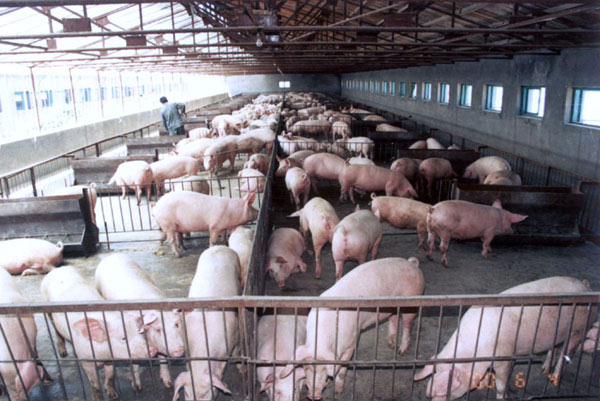
Technology. The veterinary station in our township cannot guarantee free technical guidance and support for everyone, and the government-provided free vaccines and other medicines also come from different manufacturers, so product quality cannot be guaranteed at a high level. Why can we not let everyone have timely and high-quality technical guidance?
Cost. Later-stage farming costs are mainly divided into feed, grain, and veterinary drugs (labor, water, electricity, and so on are not discussed here). Let me give an example. If a farmer has 10 sows that can produce, then he is not able to have the manufacturer supply feed directly (of course, the manufacturer would be willing). At most, he deals with a distributor or salesperson (and some salespeople do not even talk to small households). Then, between direct supply from the manufacturer and cooperation with distributors or salespeople, for the same product, which cost is lower? I do not need to say. As for how much lower, in the feed industry, profits are limited, but there will be profits (that is, it can save everyone money). Everything comes down to one word——volume (quality, quantity, demand). As for grain, I have not yet thought of any method for the time being, but it can also be centrally scheduled and supplied, which will save part of the cost to some extent. Veterinary drugs follow the same principle as feed. Why can we not lower our farming costs?
Sales. At present, most rural pig sales are handled by large and small traders who drive over to buy pigs, taking however many they need. When the market is good, no one sells, and neither does anyone else sell. Although everyone makes money, there are also times when pigs that should be sold miss the best market, which means earning less. Earning 10 yuan less per pig means 1,000 yuan less for 100 pigs. It happens in the blink of an eye. When the market is bad, no matter how much you beg them, they do not want them, and pigs whose breeds are actually still decent become disliked goods. This sales model is traditional, and it is also what everyone is used to accepting, and at the same time it has supported a group of pig intermediaries. Why can we not put more effort into sales, earn a bit more money, and reduce the layer-by-layer middle costs?
Added value. The farming industry itself is a side occupation and one of the five major agricultural industries. This year, the role of the farming industry in agriculture, especially in helping farmers become prosperous, is becoming more and more significant. So what added value does pig farming have? Pig manure and manure urine can be used as raw material for biogas digesters to generate energy and save non-renewable resources. After treatment of substances such as salt content in pig manure residue, it can be used for mushroom cultivation (I do not understand this part very well, and of course pig manure is not the most suitable for growing mushrooms). It can be used as coarse fertilizer for fields, a very good fertilizer. It can be made into granular fertilizer. It can be used as auxiliary material for fish and other feed, and so on. Why can we not let pig farming generate added value and reduce environmental pollution?
In recent years, in some TV dramas modeled on rural prosperity, the term cooperative has appeared. I mentioned this matter to my father, and he said: This place of ours is not suitable. If you do not believe it, you can try it. So I said nothing more. I think this thing called a cooperative should not be divided by region or area, nor should there be issues of restriction or applicability. The state supports and encourages, and very much hopes for, farmers to become prosperous, with those who become prosperous first leading those who become prosperous later, forming rural industrial chains, building a better new countryside, and moving toward a more comprehensive moderately prosperous society (this is not some lofty talk; it is speaking truth from facts, and anyone who feels it is exaggerated may leave). These things are policies, and they are indeed slogans, and we should strive toward these slogans.
Implementing rural pig farming cooperatives (or other forms of cooperation) must, of course, seek truth from facts and adopt different cooperation models according to different local conditions. This depends on everyone; I am only offering an opinion. First, there must be a leader who takes the lead, has experience, and has factual persuasiveness, with the pig farm as the center, mobilizing existing farmers and developing new farmers who have not yet raised pigs. For farming materials such as feed and veterinary drugs, by establishing a cooperative or company form, we negotiate with manufacturers and implement direct supply, ensuring the quality and supply of pig feed and veterinary drugs without running out of stock. For breeds, the core pig farm of the cooperative introduces and breeds them for self-propagation, then gradually transitions this to every farmer, achieving improved and highly optimized pig breeds. For pathogen control, regular disinfection, and technical guidance, we implement full coverage and general understanding of technology, achieving minimized and timely losses from disease outbreaks. For corn and so on, mold is very important. We must implement unified monitoring of grain, provide different scientific and reasonable mixed feed formulas according to different varieties and actual conditions, and maximize and scientize the actual feed utilization rate. In order to improve pork quality and reduce the harm to the human body from drug additives, the use of each of our products must strictly comply with relevant national regulations, and we should all choose biological farming materials. For the sales part, we establish cooperative units or company units to cooperate with large pork wholesale markets, meat processing plants, food factories, supermarkets, specialty counters, e-commerce sales platforms, and other demanding units (this part requires great effort, requires us to have very good product quality and meet the normal procurement needs of fixed markets, and requires a long period of effort). There is a lot more, so I will not talk about it for now. Everyone should understand my general meaning......
I personally believe that the future development path of the farming industry (and many industries) will definitely be scale-oriented and industrial-chain-oriented. Scale-oriented does not mean that one farming household is very large, but rather that within a regional scope a scaled industrial chain or intermediate industrial chain is formed, with more farming households putting in effort, using rural surplus labor for the goal of prosperity, and everyone working together with one heart, helping each other, understanding and supporting each other. It will definitely be better than now. We must correctly guide every farmer, solve their problems, and achieve win-win results. At present, my family has already successfully tested three farming households. Apart from pig houses, grain, and labor, everything else was provided by my pig farm. In the first half of 2013, each household raised an average of 50 pigs, which were marketed at 5 months with suckling, and the average income per household from 50 pigs in net profit (excluding all farming costs except labor) was about 25,000 yuan. The average per pig was more than 400 yuan. This is only one example, and the model tested this time was still a traditional model. If feed and veterinary drugs were fully manufacturer-based, technology were fully in place, and sales were fully direct-supply, then how much would it be? I do not know how to calculate this account; everyone can directly estimate it.
It is very late, and there are still some things I will not talk about. If I say too much, everyone will get tired of reading....
Good night everyone I hope every person who works hard can move toward a better moderately prosperous life in this era of peace!!!!
Pig Farm in Pannan Village, Daqiao Town, Dafeng City, Jiangsu Province (Linhong Pig Farm) Jin Shaozhe