How to tell real honey from fake? A must-read for anyone buying honey
When choosing honey, be sure to choose common honey varieties, such as black locust, Vitex, rapeseed, Schefflera octophylla, lychee, longan, and so on; exactly which ones there are depends on learning more. Do not buy strange honeys, and even more so do not make wild associations just from the name. Unscrupulous sellers are especially good at exploiting this mindset in buyers: they come up with particularly tempting names, then describe them along the lines of your associations, such as how rose honey and aloe honey beautify you, with tempting descriptions, while cleverly avoiding the parts that would reflect the honey's properties. For example, who has ever seen rose honey? If someone gives you a bottle of something and says it is rose honey, you have no way to tell whether it is real or fake. There are even lawless sellers who use ordinary honey with added ingredients such as honeysuckle and call it honeysuckle honey. You should know that although honeysuckle does have nectar, its flower opening is too small, and bees simply cannot get in to collect the nectar.
No one can sum up a set of methods for distinguishing real honey from fake, because such a method simply does not exist. In fact, the taste and mouthfeel of real honey are completely different from fake honey, and beekeepers generally tell real from fake by taste. But if you read this carefully, it will definitely help reduce your chances of buying fake honey.
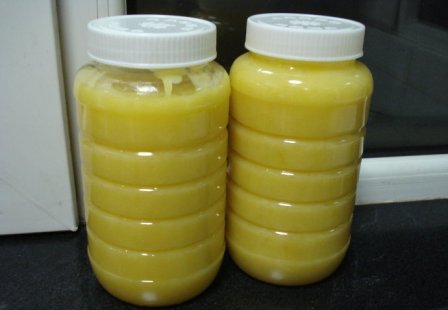
If a beekeeper can keep about 60 hives of bees, then he is a large-scale beekeeper and already very impressive. And about 60 hives of bees can produce 2 tons to 3 tons of honey each year. If the purchase price per jin can reach more than 20 yuan, the annual income would only be between 80,000 yuan and 120,000 yuan. This is only possible when all flowering periods are caught, there are no natural disasters, and the nectar-collecting conditions are extremely good. But the output of bee products, especially honey, is extremely unstable; drought, waterlogging, good and poor years, and so on all affect honey output. It is only with this income that beekeepers keep bees instead of farming the land! Beekeeping has high costs and is more arduous, and only at more than 20 yuan per jin would a beekeeper possibly take up this work. Otherwise, he would be better off staying home and farming the land comfortably.
But the wholesale price of bee products is far from this high. Even retailing on Taobao, one jin is only about 30 yuan, and another person would still need to work full-time on Taobao to sell all the 2-3 tons of honey produced.
To judge whether honey is real or fake, one dare not make a rash judgment.
Consumers have, to a certain extent, shaped the product trends of the honey market. The appearance of rare honeys, or honeys that do not exist at all, such as rose honey, snow lotus honey, ginkgo honey, motherwort honey, and so on, caters to consumers' special demands, and that is how fakes are concocted. Some people like highly concentrated honey, so concentrated honey floods the market. Some people are obsessed with imported honey, so all kinds of imported honey have appeared. Some people assume that native bee honey is good, so overnight native bee honey appeared in large quantities, yet no one tries to understand the survival situation of native bees. A bee species on the verge of extinction, one that the state is racing to save (by establishing Chinese bee conservation areas), a bee species currently seen only in remote mountains and old forests, is somehow producing large amounts of honey. Does that not seem strange? And what about the market for real honey (raw honey)? It is in a painful position: real honey is inferior to processed honey in concentration, color, aroma, and so on, so even if what you sell is real honey, some people will still question it.
Our country has a vast territory, with differing temperature differences, different bees, nectar-bearing flowers in different places, and so on, and so on. The honey produced differs in color, and its aroma, concentration, and taste also differ, so one cannot arbitrarily say what color is the best honey.
1. The concentration of honey: honey crystallizes at a certain temperature, forming two layers, top and bottom, with the bottom layer resembling white granulated sugar crystals. To distinguish real from fake: 1. For crystallized honey, as long as the temperature is slightly higher or it is left in sunlight for a while, the honey dissolves on its own; if what was added is white granulated sugar, it must be boiled at high temperature to dissolve. 2. You can scoop a little of the crystallized sugar from the bottle and put it in your left palm, then slowly rub it gently with your index finger. Real honey is very smooth; if it is fake honey, during the gentle rubbing there will be a feeling of resistance against the finger skin. Real honey will melt as its temperature rises.
2. The aroma of honey: pure natural honey has only a faint aroma, and it is slightly similar to the scent of the nectar-bearing flowers blooming in each season. The aroma is related to how long the honey has been stored; the longer the time, the fainter the aroma. Processed honey has too much aroma and it is very strong. 3. The taste of honey: pure natural honey, when taken orally, gives a slight stinging, uncomfortable sensation in the throat and esophagus, because pure natural honey contains a large amount of trace elements. If it is fake honey, there is no such sensation.
You can often see some beekeepers placing bees by the roadside. Are they all real beekeepers? You can tell easily!
As a beekeeper, first of all there must certainly be bees; do not be fooled by one or several rows of beehives and a tent! Some “beekeepers” just have a tent and some beehives, and there they are selling ‘honey’. If you look carefully, you see the beehives but not a few bees. If you want to open a hive to look at his bees, he will warn you that bees sting and block you from looking. If you ask him why there are so few bees, he will tell you they have all gone out to collect nectar. Such words are self-deceiving!!
With a real beekeeper you see a completely different scene: bustling activity, bees in swarms, and from far away you can hear the buzzing of bees. Without the owner saying anything, you will be afraid of being stung by bees. As you approach the apiary, you can smell the fragrance of nectar. And you can see the owner busy at the apiary from morning to night. Those who have beehives but no bees have nothing to do and just wait for someone to come buy their “honey”. I believe after reading this you will be able to identify real and fake beekeepers at a glance.