Why are 90% of koi keepers men?
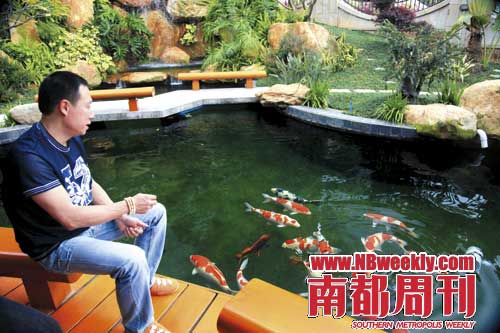
Several of the koi at Mr. Jiang's home have won awards in China, and the more than twenty koi in the whole pond are worth at least over a million yuan.
Brothers Liu Jinrong and Luo Kui have run their koi farm for 10 years. Every year in March, when the koi hatch, they go back to the fish farm in Sanshui, Foshan, to live as fish farmers for a few months, staying there every day to select fry. (Photo provided by the interviewee)
A beautiful koi gives a man a strong sense of possessiveness, far exceeding the thrill of a supermodel walking past him.
Southern Metropolis Weekly reporter_Hu Wenwen Photography_Sun Jiong Hu Wenwen
"Which one I like best, I can't say, for fear they'll hear me and blame me for playing favorites."
Liu Jinrong, owner of the Guangzhou Jinhan Wanli Center, visits various villa districts in Guangzhou whenever he has free time, checking on the koi kept by customers and dropping off some fish feed.
Liu Jinrong's koi farm has been running for 10 years. In earlier times, most koi keepers were people from Taiwan, China, and Hong Kong, China, because they were more deeply influenced by Japanese culture. In recent years, koi hobbyists in the developed areas of Guangdong have suddenly grown in number.
"After koi became popular, many villa owners built fish ponds. Some hobbyists killed an entire pond of fish and, in a fit of anger, converted the pond into a swimming pool, but they couldn't resist the temptation of others and went through major construction to change it back."
More than 90% of customers who buy koi are men. Even if a woman is very skilled at keeping koi, people won't think she's "trendy"; on the contrary. A successful man with a beautifully kept pond of fish at home will feel a great sense of achievement.
Luo Kui says with a laugh that a beautiful koi gives a man a strong sense of possessiveness, far exceeding the thrill of a supermodel walking past him.
"When you see a good koi, you'll feel that its every move is in sync with your heartbeat. You can stare at them blankly for hours on end without any aesthetic fatigue."
Usually, because there's a pond of precious fish at home, no matter how busy a man is outside, he'll think about going home early when he has time.
As soon as he enters the courtyard gate, his first words aren't to ask whether dinner is ready, but: "How are the fish today?"
To keep his group of fish worth a million, the owner of the villa visited for this interview, Mr. Jiang, spent five million just on building the fish pond.
"I've kept my koi for five years now," and for fish that are well accustomed to you, when the owner feeds them he can hold the food in his hand, reach it straight into their mouths, and then close it again. Great fun.
The Jiang family once had a "Tancho," which died because of a difficult birth, and the whole family grieved over it for months. When asked which one Mr. Jiang likes best now, he looks at the pond full of colorful fish and says with a smile, "Which one I like best, I can't say, for fear they'll hear me and blame me for playing favorites."
What's lacking isn't space, but fish
Lai Zhiyu from Taiwan, China, began keeping koi back in university.
Lai has many hobbies: jade, sports cars, bonsai, and horseback riding, all of which he enjoys, but time for keeping koi is always guaranteed.
Besides attending classes, Lai Zhiyu tends to his fish pond at home every day. On weekends, he goes to different fish farms to pick out small fish with people and test his own eye.
"When koi swim slowly, they appear leisurely and noble; but once they speed up, they're full of a sense of power."
"Once you start studying koi, there's no stopping, and the more you study, the more expensive the ones you keep. I run to the fish farms every week and have gotten very familiar with those owners. When I have nothing to do, I help them work, just so I can pick more good fish."
No two koi are the same. The patterns on their backs are like ink-splash paintings, with a great deal of refinement. For the aesthetic standards of koi, every country in the world takes Japan as the benchmark. Its national koi competition represents a world-class level, equivalent to China's national table tennis tournament, which no other country can surpass.
After arriving in Shanghai, Lai Zhiyu hadn't kept koi for a long time. Although the courtyard of his home villa is also very large, what's lacking isn't space, but fish.
"There are too few koi competitions in the mainland. I haven't seen good fish for a long time, and I miss them very much. That feeling is like having seen too many ugly women and really wanting to see a beauty again."
Shanghai doesn't have as many fish farms as Taiwan, China, where you can pick one good fish out of ten thousand. Moreover, he can't find any like-minded people around him, no one who knows quality. No matter how beautiful his own fish are, there's no way to share them with others, and in the end he might even be called a fool.
In the end, he still harbors a wish deep down: to dig an ideal pond in the Japanese-style garden at home, with half of it extending into the house, some potted plants along the pond edge, and cloudy water with big fish in the pond. The living room attached to one end of the pond would be sunken, fitted with a full glass wall, so that sitting on the sofa you could enjoy the koi as if in an aquarium.
"When work gets frustrating and I come home, I turn on the small light in the pond, watch those big fish brilliant as flowers swimming quietly past in the dark water, and listen to the gurgling of the water. I feel as if my soul has been purified. Even in the busy city, you can recover the atmosphere of nature."
Keeping koi as a family heirloom
"In the koi-keeping trade, many are family businesses, especially in Japan, where they're passed down from one generation to the next. Because the koi you keep will inevitably die, if it's not family, trust problems easily arise."
Liu Jinrong and Luo Kui, the owners of the Guangzhou Jinhan Wanli Center, are two brothers (who took their mother's and father's surnames respectively). One originally worked in real estate and the other in finance, but ten years ago they both quit their jobs to keep koi, and since then they've never wanted to change careers.
"When I used to work for others, communication between people was very complicated. Every day I had to socialize with people I didn't like, and I felt extremely exhausted. But the koi consumer group has given me a great sense of satisfaction. They're elites from all walks of life: industry, food and beverage, and politics. They're very happy to share their business experience with others, and we're very happy to tell them the tricks of keeping fish. There are no conflicting interests between us, the relationships are very simple, and it's very enjoyable."
"In Japan, people who specialize in breeding koi are respectfully called 'koi masters.' They're like Bole, able to find the best among a group of fish and then keep cultivating them. The earlier you spot a good fish when it's small, the higher your success rate in breeding koi."
Just like a beauty pageant, the selected small fish must go through six preliminary and semifinal rounds within a year, after which observation and selection continue. The good fish that make it to the end are one in ten thousand.
"Of the 4 million fish produced each year, only thirty thousand are ultimately sold. Whenever there's a competition, we bring out the fish we've bred for several years and that are in the best condition. So top-level hobbyists are all waiting for fish, choosing to reserve them in advance at that time. Once a fish wins an award, its value becomes tremendous."
The lifespan of a koi can even be longer than a person's. Bring an excellent small fish home and spend a few years, a dozen years, or even decades of effort on it, and a koi master will let the fish in his hands gradually express his own aesthetic tastes. Therefore, some people say that keeping koi is keeping a kind of future.