How to raise loaches in rice paddies? Luzhou local expert shares his experience
"Loach fry are generally stocked before the rice tillers, at 10000 to 15000 fry per mu, and before stocking the fry should first be disinfected with mild salt water." Recently, in a rice-paddy loach breeding field in Group 2, Baihe Village, Tianxian Town, Naxi District, Luzhou, Sichuan Province, Li Yunzhong, a skilled breeder and "local expert" in the village, was busy releasing yet another batch of newly purchased loach fry into his own paddy field while explaining cheerfully: "Raising loaches in rice paddies is easy to learn, but to raise them well, the key is still to master some basic techniques, otherwise you will fail."
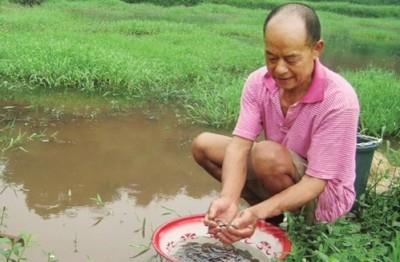
"Local expert" Li Yunzhong said that as long as you master the following techniques for raising ecological loaches in rice paddies, a bumper harvest is no problem.
"Paddy fields for raising loaches generally require a good water source, clay soil, relatively high fertility, no pollution, and convenient drainage and irrigation, and they should be easy to manage." Li Yunzhong explained that the paddy field area should preferably be small rather than large, with firm solid ridges around it; at the same time the ridges should be raised and reinforced, sufficient organic fertilizer should be applied before the loach fry are stocked, and quicklime should be used to disinfect the paddy field.
According to Li Yunzhong, the loach variety stocked directly affects the yield, so when choosing a variety you should select excellent loach fry with fast growth, strong reproductive capacity and disease resistance. When digging fish ditches, the shape can be a "cross" or a "well" pattern according to the paddy field area, and the ditches and channels must be connected with the water inlet and outlet. Li Yunzhong said that the fish ditches are generally dug in the middle of the paddy field, accounting for about 15% of the paddy field area, with a depth of 80 cm and a width of 100 cm, so that when the paddy field water is shallow or the summer water temperature is high, they can serve as a resting or cooling place for the loaches.
According to the experienced Li Yunzhong, when buying excellent loach fry, the fry should be at least 5 cm to 10 cm long. The stocking time is generally after the rice seedlings are transplanted and before tillering. After the loach fry are put into the paddy field, they should generally be allowed to grow naturally, and they can be regularly fed with soybean milk, flour, rice bran, soybean residue, wheat bran, rapeseed cake, chopped green vegetable leaves, earthworms, fly maggots or compound fish feed, and can also be fed human feces, pig manure and other materials as feed. The amount and time of feeding are generally 1 to 2 times a day, that is, once in the morning and once in the evening; the daily feeding amount is generally 4% to 5% of the total body weight of the loaches. When the water temperature exceeds 30°C, the water should be changed frequently and the water depth increased, and water polluted by pesticides must be strictly prevented from entering the field.
"If the loaches often swim to the surface to 'breathe' or swim around on the surface, it indicates a lack of oxygen; new water should be added, and fertilizing and artificial feeding should be stopped. At the same time, for fields used for raising loaches, soybeans can be planted on the field ridges in advance, and the soybean stalks and leaves can be used to shade the ditches to help the loaches escape the heat." Li Yunzhong pointed out that paddy fields or rice paddies used for stocking loaches should be managed by a dedicated person, and when treating rice pests, high-efficiency and low-toxicity pesticides should be selected and applied at conventional dosage; when spraying pesticides, deep water should be irrigated and the nozzle should be pointed upward.
"In the southern Sichuan area, loaches raised in rice paddies are most prone to 'catching' gas bubble disease and parasitic diseases. For the prevention and treatment of gas bubble disease, 4 kg to 6 kg of table salt per mu can be mixed with water and splashed over the whole field; for the prevention and treatment of parasitic diseases, 0.7 ppm copper sulfate or 0.5 ppm crystalline trichlorfon can be splashed in the paddy field." Li Yunzhong also explained that the best time to catch loaches is late autumn and early winter; when catching them, dried rapeseed stalks can be submerged in the ditches at the side of the field, and after the rapeseed stalks release a sweet taste, the loaches throughout the field will gather to suck the sweet water after smelling it; at this time a hand net can be used around the ridge to catch them, allowing a large harvest, and for loaches that have burrowed into the mud, the mud can be turned over to catch them.
According to experts from the Naxi District Water Affairs Bureau, raising loaches in rice paddies is a three-dimensional production model that comprehensively combines rice farming with aquaculture. Because there is abundant natural feed in the paddy field, loaches in the field can loosen the field mud, improve the soil and prey on pests, which not only benefits rice growth but also reduces pest damage. Therefore, raising loaches in rice paddies is a "win-win" project in which "loaches are strong and the rice is fragrant." Secondly, the technical difficulty of raising loaches in rice paddies is not very great, and the loaches raised are ecological, environmentally friendly and green organic food. In addition, ecological loaches sell well on the market, are in large market supply and demand, and command high prices, and are deeply favored by consumers. It is hoped that after learning about these simple and practical techniques, farmers will immediately be moved and take action, making full use of the abundant rice paddy resource advantages in rural areas to get rich together and move toward a moderately prosperous life.