How to increase the low egg production rate of pheasants? Master these 5 key techniques
Pheasants are the most popular breed among specialty breeding projects. According to statistics from Fujian Zhaobao Ecological Farm over 25 years, the number of customers who introduce pheasants for breeding grows by more than 30% every year. However, although it is widely reported that pheasant projects require little investment, produce quick results and deliver high returns, there are still a small number of people who fail to raise pheasants well, saying that their pheasants lay few eggs. To get to the bottom of the reasons, Zhaobao Ecological Farm has specifically compiled the following 5 key techniques for increasing pheasant egg production, as follows:
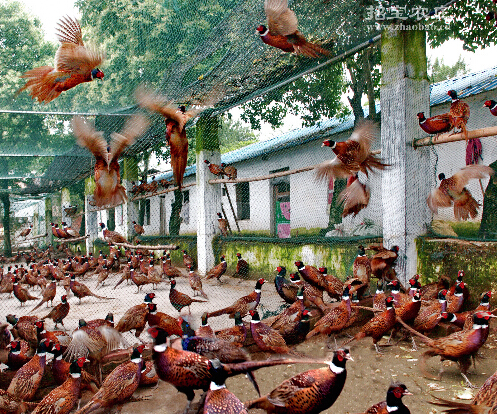
1. Strictly control lighting
When pheasants enter the laying period, they are very sensitive to light. The length of light exposure is related to the laying physiology of the hen. Increasing light can stimulate the secretion of sex hormones in pheasants and thus increase egg production; shortening light inhibits the secretion of sex hormones, thereby inhibiting ovulation and egg laying. Laying hens are very sensitive to light, and only correct lighting can achieve good egg production results. Lighting must be punctual, on time and regular.
Generally speaking, 15 days before the start of laying, the daily light period should be 14 hours, and the light should be increased gradually by 5 minutes per day until it reaches 16 hours. In open-sided chicken houses, chickens are affected by changes in the length of natural daylight. As seasons and latitudes differ, the length of natural daylight varies on different dates throughout the year, so the natural light period must be calculated and then supplemented with artificial light to reach 16 hours. This allows the chickens to lay continuously and reach the peak of egg production as quickly as possible. When using artificial light, the light intensity and the on-off times must be stable and must not be changed at will, otherwise it can easily cause prolapse of the cloaca in pheasants.
At present, many farmers keep laying pheasants completely free-range and cannot provide supplemental lighting, so their egg production rate is low, generally not exceeding 30 eggs/year.
⟧ 2. Keep dietary protein at 21%
Based on our farm's long-term practical experience, for pheasants to have high and stable production, the protein level in the feed should reach 21%, and animal protein should account for 50%. When the egg production rate of pheasants reaches above 70%, the above level must be achieved. If it is not reached, the peak laying period will be short, the body weight of the pheasants will drop rapidly, leading to fewer eggs, smaller eggs, fewer qualified breeding eggs, more sandy-shelled eggs and more deformed eggs. This requires breeders to study and observe carefully and learn more techniques. At the same time, those introducing the breed must choose a high-quality farm to learn the key techniques, otherwise the overall egg production rate can differ by 6-11 times.
3. Reasonable construction of pheasant housing
Whether the housing is built reasonably or not not only affects growth and disease occurrence, but also has a great impact on egg production. This is specifically shown in the following aspects:
1. Unreasonable housing construction is not conducive to ventilation, dryness and constant temperature requirements. The temperature difference between day and night may even be too great, making it very difficult for the animals to adjust. This leads to stress, decline in physical condition and so on, the disease rate will be very high, and egg production will also drop substantially.
2. Poor housing environment. Air pollution, poor ventilation, pheasants unable to live quietly, frequently disturbed, and so on.
4. Control body weight and age at first laying
To achieve high production in pheasants, attention must be paid to controlling the body weight and age at first laying of laying pheasants. According to our farm's 25 years of research on raising pheasants, when the body weight at first laying is controlled between 2.1-2.4 jin, the three indicators of high-quality production, high-production duration and high-production quantity have the best results. At the same time, when the age at first laying of pheasants is controlled at 160 days in the first half of the year and 175 days in the second half, all indicators show the best results. The specific measures are:
1. The feed formula should be scientific and reasonable, with different formula feeds given at different growth stages;
2. The feed must contain green feed, and the proportion of green feed must not be less than one third of the total intake of the pheasants, so as to control the body weight of the pheasants.
5. Other aspects
1. The peak egg-laying time for pheasants is from 9 a.m. to 2 p.m. every day. During this period, all production activities must be strictly prohibited and no behavior that disturbs the pheasants' laying is allowed, so as to ensure high production. Many farmers do not know that during this period, cleaning, catching chickens and so on can affect pheasant egg production for 5-7 days, and the egg breakage rate can reach 30-40%.
2. Regular and quantitative feeding: laying pheasants should receive 65 g of daily ration, fed at fixed times in 2 feedings per day, to ensure high production. Feeding sometimes more and sometimes less, unscientific nutritional matching, insufficient drinking water, poor environmental sanitation, mixing unfamiliar groups together, and so on, can all cause poor development of the flock, disease infection, being too fat or too thin, and so on, which naturally has an adverse effect on egg production.
3. During the laying period, when the weather is hot, the feed intake of pheasants decreases. Chinese herbal medicines for clearing heat and relieving summer heat can be added to the feed to increase the egg production rate. Prescription: Xiangru 150 g, Houpo 150 g, Huangqin 150 g, Huangqi 180 g, Bohe 150 g, Shengdi 180 g, Gancao 80 g, Biandou 150 g, Jinyinhua 180 g. Dry in the sun and grind into fine powder, then add to the feed at 2%. This can effectively solve heat stress syndrome in pheasants, increase the summer egg production rate of pheasants by 12-20%, and increase the fertilization rate by 10-15%. Fujian Zhaobao Farm has used this prescription for 20 years, and the effect is very obvious.