Intercropping chili peppers among rows of young trees yields high returns
In earlier years, some farmers who grew fruit trees achieved relatively high economic returns, so in recent years, some farmers have continued to plant fruit trees. However, fruit trees have a long cycle, and after planting, there will be several years without any harvest.
To increase income, farmers also intercrop low-growing crops such as wheat and soybeans in young tree orchards, but intercropping these traditional crops not only brings low economic returns, but also makes harvesting troublesome and easily damages the fruit trees. To address farmers' concerns, the Agricultural Technology Extension Center of Jize County, Hebei Province - the hometown of Chinese chili peppers - successfully promoted intercropping chili peppers in young tree orchards, achieving relatively high economic returns.
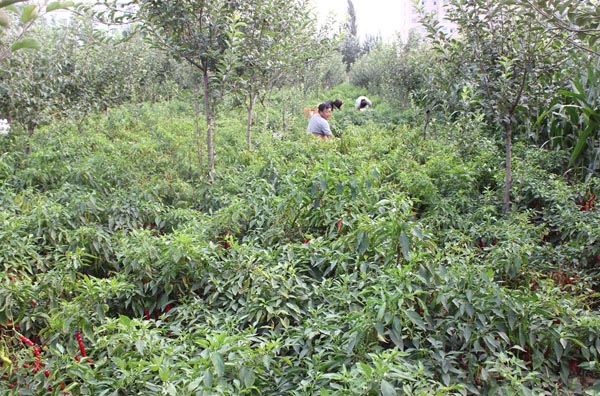
This autumn, the author saw in the farmland east of Jize County town that one- to three- or four-year-old young fruit trees were lush with branches and leaves, and the chili peppers intercropped between the rows of fruit trees were hanging all over the branches. Old Zhang was busy picking red chili peppers. He told the author: this year he intercropped chili peppers in all the rows of his more than 5 mu of fruit trees, some of which had begun to bear fruit and some of which were newly planted that year. Young fruit trees of one or two years had almost no effect on chili pepper yield, and the chili peppers intercropped in the fruit tree orchard were even better in quality than those planted alone. Pointing to the nectarine trees, he said that the 1.5 mu of nectarine trees bore fruit for the first time this year, and in summer they sold for more than 5,000 yuan. He thought these chili peppers could sell for at least five or six thousand yuan. In Jize County this year, just like Old Zhang, choosing to intercrop chili peppers among rows of young trees was very common.
It is understood that this year the county guided farmers to intercrop chili peppers on more than 5,000 mu among economic forests such as grapes, apples, peach trees, and honeysuckle, as well as in green belts, and it is expected that each mu can increase income by more than 2,000 yuan compared with intercropping traditional wheat and soybeans. The Jize County Association for Science and Technology is willing to provide farmers with free technology for intercropping chili peppers between rows of fruit trees. Contact: Mr. Xing, phone: 13930078756, QQ: 2735886832.