What technical key points should farmers master when raising Nanjiang yellow goats?
How can farmers raise Nanjiang yellow goats well? When it comes to the Nanjiang yellow goat breed, I believe many people know about it. This goat originates from Nanjiang County, Sichuan. Yes! The Nanjiang yellow goat is one of the high-quality meat goat breeds developed in China in recent years. Because the Nanjiang yellow goat has long and flexible thin lips, lower incisors that arch outward and are sharp, and a flat and firm upper palate, it is convenient for it to graze and cut off forage grass. The Nanjiang yellow goat eats a great variety of forage grasses. According to relevant statistics, among 655 species of plants, the Nanjiang yellow goat can utilize more than 500 species, accounting for 80%, which is 28% more than the plant utilization rate of cattle. The Nanjiang yellow goat's utilization rate of crop straw with high crude fiber content can reach 70%. It most likes to eat forage grasses and young branches and leaves of trees that are low in crude fiber and rich in protein.
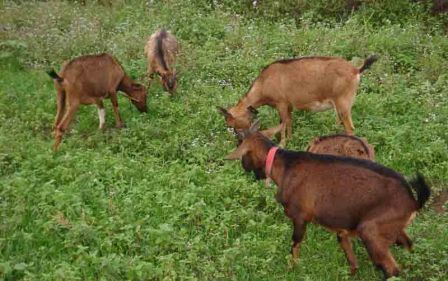
Feeding time is mostly concentrated during the day, and the start of feeding is closely related to sunrise. Each day they consume a large amount of food only within a certain period, while at other times they ruminate and rest. According to measurements, the goats' feed intake is very large in the early morning and at dusk each day. In addition, the feeding behavior of the Nanjiang yellow goat also changes with the seasons. In spring, when forage grass has just sprouted and tree branches have turned green, the goats are not picky about what they eat; in summer and autumn, when forage grass is lush, they begin to feed selectively. Farmers can plant some high-yield green feed to feed them. Forage grass is green and juicy, fragrant in smell, and good in palatability, which is unmatched by other feeds. Therefore, feeding Nanjiang yellow goats with high-quality forage grass can enhance disease resistance and increase production, such as meat yield and kidding rate. To raise Nanjiang yellow goats, you can plant: hn-mc sorghum-sudangrass, hn-mc Mexican corn, hn-mc ryegrass, hn-mc alfalfa, and other high-yield grasses.
Surplus green feed grass can be processed and stored, roughly in three ways:
First, drying and storage: in summer and autumn, dry the green feed that the goats cannot finish into green hay for the goats to use during the dry grass season.
Second, making silage: make silage from high-quality green grass, etc., to replace green feed in feeding goats in winter. For goat-raising households with abundant natural forage grass resources that have difficulty adopting full barn feeding, the grazing method can be used to raise goats. This method involves relatively extensive management, but heavily pregnant ewes, lactating ewes, breeding rams, and fattening goats should also be supplemented with a certain amount of concentrate after returning from grazing; the remaining goats can have forage grass as their daily ration, and the whole flock should be supplied with clean drinking water and supplemented with salt or human urine. If breeding households want to achieve high yields from Nanjiang yellow goats, they must do a good job in breeding management.
We have summarized the following aspects of feeding and management for fellow netizens' reference:
One, cleaning: every day, dirt on the body surface of Nanjiang yellow goats should be cleaned off to keep the body surface clean and also avoid pathogens.
Two, exercise: penned Nanjiang yellow goats must have exercise, maintained twice a day, either outside the shed or in the exercise yard inside the shed, for half an hour to one hour each time.
Three, heat prevention and warmth preservation: prevent cold and keep warm in winter, and maintain a suitable normal temperature of 20-35°C.
Four, feeding at fixed times and in fixed amounts: it is advisable to feed three times a day, giving less and adding frequently. The feeding amount should be determined according to body weight, and sudden changes in feed should be prevented to avoid causing digestive tract diseases.
Five, the goat shed should be disinfected regularly: 10% fresh limewater or 3% bleaching powder, etc., can be used for disinfection and sterilization, which can reduce the occurrence of diseases in Nanjiang yellow goats.
Six, timely prevention: regularly inject the “goat pox” vaccine every year.