Growing experience with grafted saplings of improved walnut varieties: a good agricultural project worth developing
Returning to the countryside to start a business, I did not want to do traditional farming, so I looked into many projects. They all seemed pretty good, and they all shared one thing in common: high labor intensity and slow returns. But this walnut growing is the only one that not only requires little worry, but can also show returns in just 3 years. According to the people at the sapling sales company, only the grafting technique for walnuts is quite difficult, while the growing technique is very simple. Is that true? Who is an expert? Please help analyze it!
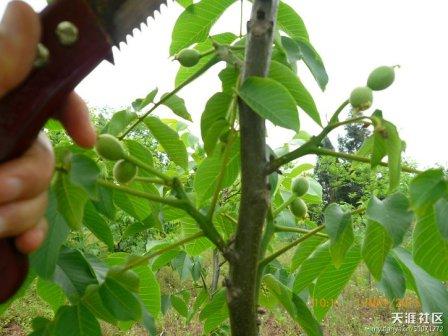
A small walnut tree in its 3rd year blooms and bears fruit
A small walnut tree in its 3rd year blooms and bears fruit
1. The grafting survival rate of grafted saplings of improved walnut varieties is indeed very low, generally around 30% in the south, and higher in the north.
2. The market is almost entirely made up of bosses who specifically sell walnut saplings. An industrial chain for improved walnuts has not been formed, and without an industrial chain it is very difficult to guarantee improved varieties.
3. The bosses selling walnut saplings on the market almost all buy them from farmers and then resell them, taking a cut in between. They either have no land of their own or only a small amount of land for appearances. There are very few real walnut enterprises, and without a real entity as a guarantee, it is very difficult to guarantee sapling quality.
4. For genuine improved walnut saplings, most will certainly bear fruit in the first 2 years, but the fruit must not be kept and should be picked off in time. From the 3rd to 4th year onward, they will officially bear fruit across the board. From the 5th to 6th year onward, they enter the full-production period, with output increasing at a rate of 2 times per year.
5. Cultivating and managing walnuts is not complicated, but experience is very important, and the labor required is very little compared with other agricultural projects.
6. Right now there is crazy hype around things like 8518. Insiders all know that this is not any kind of variety at all, while outsiders have no idea how difficult it is to have an improved walnut variety approved. But outsiders cannot become insiders without being fooled many times, suffering many losses, and spending a lot of time studying and observing.
Now 8518 is hyped as being so perfect: high yield of over a thousand jin per mu, strong adaptability to any soil type. Is it really that
good? If there really were such a good variety, farmers would all have struck it rich. There is no moral bottom line, only the single-minded desire to sell saplings. What is wrong with this society? There are several walnut sapling companies in Jianyang and Mianyang, Sichuan, posting advertisements and promoting themselves every day from office buildings. How many are willing to stay in the walnut fields and calm down to manage, observe, and graft? Staying in a walnut orchard is very hard work!
7. Points to note when developing a walnut project: good soil, sufficient sunlight, no water accumulation, and the key is to buy authentic improved walnut saplings.
A walnut bearing a small amount of fruit grows bigger day by day
There is quite a lot of walnut planting now in Sichuan, Chongqing, the north, and other places, but how many trees actually bear fruit? It is all because of fake saplings.
Why is it easy for everyone to buy fake saplings? Outsiders cannot tell from the appearance, the government takes kickbacks, and most sapling sellers are middlemen rather than real entities, so when problems arise no one can be found to take responsibility. This is the main reason.
Why does everyone not graft authentic improved walnut saplings? First, the grafting survival rate is low; second, the investment is large and the time is long, and a mother tree orchard and scion collection orchard must be built to ensure the authenticity of the grafting scions; third, land is also not easy to find.
As the old saying goes, improved walnuts are a good agricultural project, but they have been ruined almost entirely by fake saplings.
Growing improved early-bearing walnuts is not easy!
Agriculture can only be done at an appropriate scale; never be greedy for size and appearances!
Relying on your own investment, about 100 mu;
With a certain amount of government support, around 500 mu;
With strong government support, around 2,000 mu.
There are certain requirements for soil, terrain, and the local natural climate! Some places are simply unsuitable, and are marginally suitable areas.
Choose walnut varieties according to climate and soil, and buy grafted walnut saplings according to the variety. The walnut sapling market is extremely chaotic, with fake varieties and fake grafts making up the vast majority.
Then, reasonable cultivation and management methods must be formulated according to different varieties and different climates. For example, cultivation and management methods in the south and north are very different, and actual management is also very different from what is in books. If you copy them directly, problems will arise.
Management creates benefits, and management must be done properly.