What are the characteristics of the living habits of the Oriental turtle dove?
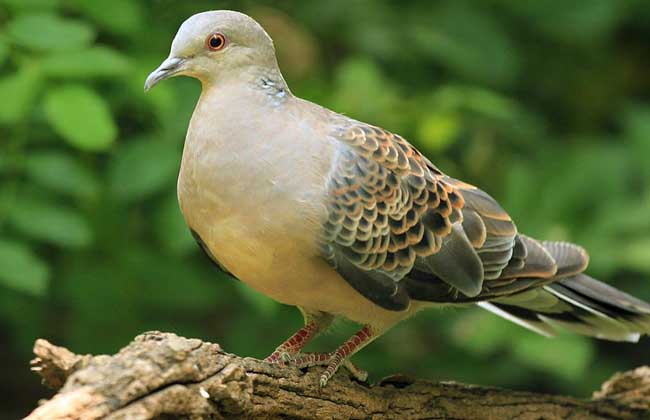
The Oriental turtle dove is a bird of the genus Streptopelia in the family Columbidae, with a total of 6 subspecies. Its body length is about 32 cm. The bill and claws are straight or slightly curved, the base of the bill is soft and covered with a cere, and the tip of the bill is swollen and horny. The neck and legs are both relatively short, and the tarsi are fully feathered. The dark scalloped plumage on the upper body has brown feather edges, the rump is gray, the tail feathers are nearly black, and the tail tip is light gray. The underparts are mostly pinkish, and the feet are red. It produces a high-frequency “pu-pu” sound when taking off. It moves in pairs or alone, mostly in open farming areas, villages and around houses, around temples, or near small ditches, foraging on the ground. Its food consists mostly of whole grains. It is distributed in the Himalayas, India, Northeast Asia, Japan, mainland China and Taiwan. Northern birds migrate south to winter.
Habits
The Oriental turtle dove often moves in pairs or small groups, sometimes perching in pairs in trees, or flying and foraging together in pairs. If the female bird is injured, the male bird, after being startled into flight, will fly back several times to circle and call above the original spot. When active on the ground, it is very lively, often advancing rapidly in small steps, foraging while walking, with its head swinging back and forth. In flight, the wings beat frequently, straight and fast. It sometimes also glides, especially when flying from a tree to the ground. Its call is low, sounding like 'ku-ku-ku' repeated many times.
Foraging
The Oriental turtle dove mainly eats the fruits, seeds, grass seeds, tender leaves and young shoots of various plants, and also eats crops such as rice, corn, sorghum, millet, soybean, mung bean, rapeseed and so on, and sometimes also eats insects such as lepidopteran larvae and beetles. Foraging mostly takes place on the ground under forests, at forest edges and in farmland.
Habitat
The Oriental turtle dove often inhabits low hills, plains and mountain broad-leaved forests, mixed forests, secondary forests, orchards and farmland, as well as bamboo groves near houses and trees.