What are the types of turtledoves? Introduction to common turtledove varieties
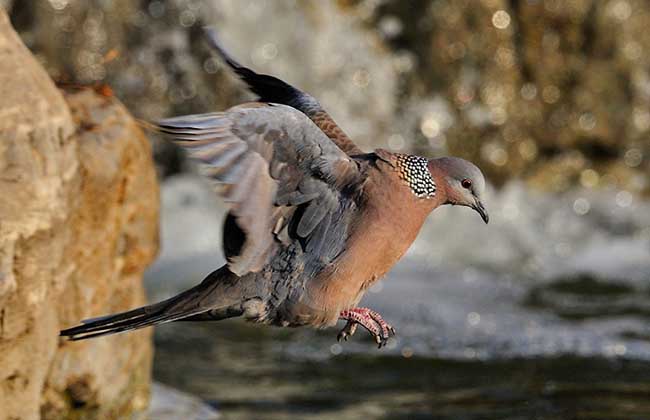
Do you know what types of turtledoves there are? The turtledove belongs to the genus Streptopelia in the family Columbidae, order Columbiformes, class Aves, and is a bird of Europe and North Africa. Common varieties in China include the red turtledove, the spotted dove, the oriental turtledove, and the artificially bred white turtledove. Let's take a look together below!
Red turtledove
The red turtledove, also known as the red dove and red jiazhu, is distributed in the Himalayas, India, China to Southeast Asia and the Philippines. In China, it is a resident bird of the open woodlands and relatively flat coastal woodlands and secondary vegetation conditions of South China and East China. It also extends across the southern and eastern Qinghai-Tibet Plateau to most areas of North China, East China and Hainan.
The red turtledove anxiously walks along the ground while searching for food. Its body length is about 30 cm. Its call is a deep Ceu-u-u-u-u repeated several times in succession, with the stress on the first syllable. During the breeding season, the call changes noticeably, becoming a four-note gugu (second tone) + gugu (fourth tone), as well as a two-note call with stress on the first tone. The small wine-red turtledove is called red; the front end of the black half-collar on the neck is white. The male has a grayish head, pinkish underparts, brownish-yellow wing coverts, nearly black primary flight feathers, and blue-gray tail feather patterns with white outer tail tips; the female is paler and darker, with a dark brown head and less red in the body plumage. The iris is brown, the bill is gray, and the feet are red.
Oriental turtledove
The oriental turtledove is a common species in China. It is medium-sized, with a body length of 27-35 cm. The two wings have no metallic feather color, and the 2nd and 3rd flight feathers are the longest. The feet are short and strong, and the tarsometatarsus is longer than the middle toe. The upper body plumage is mainly brown, and the head and neck are grayish brown tinged with wine color. The forehead and crown are gray or blue-gray, and it is found in almost all provinces and regions of China. In autumn and winter it moves to the plains and often roosts in flocks with spotted doves. It flies like a pigeon and often glides. Its call is monotonous and low. It is very vigilant. It feeds on sorghum, wheat seeds, rice grains and fruits, and sometimes also eats insect larvae; in winter it often eats the seeds and kernels of camphor trees. It builds its nest in trees, generally 3-7 m above the ground, made of twigs and simple in structure. Turtledoves are numerous and are game birds of economic value.
Spotted dove
The spotted dove, also known as "zhongban" and "zhujingban", belongs to the order Columbiformes and the family Columbidae. It is a familiar medium-sized (30 cm) pinkish-brown turtledove. Males and females are the same color, the tail is slightly long, the white at the front end of the outer tail feathers is very broad, the flight feathers are darker than the body plumage, and the body plumage is mostly grayish brown. Its obvious feature is the black patch on the sides of the neck covered with white spots. The upper back is brown, and the lower back to the rump is blue-gray. The tip of the tail is blue-gray, and the iris is orange-yellow. The bill is dark blackish brown. The feet are purplish red. Its call is a soft, pleasant "gu-gu-gu-gu-gu-gu" repeated over and over, with the last note emphasized. It is common and widely distributed in Southeast Asia. Through the Lesser Sunda Islands it has been introduced to other places as far as Australia.
In eastern China, Taiwan, China and the coastal provinces, it is a common resident bird and cage bird, commonly seen in open lowlands and villages throughout central, southwestern, southern and eastern China. The subspecies Tigrina occurs west of the Nujiang River in southwestern Yunnan. Vacillans occurs in the rest of Yunnan and southern Sichuan. Hainana occurs on Hainan Island. Formosana occurs in Taiwan. The nominate subspecies occurs in other areas within its distribution range. The spotted dove lives commensally with humans, inhabiting open sparse woodlands as well as around villages and rice fields, feeding on the ground, and favoring hard granular food such as small snails, camphor kernels and grain. It often stands in pairs on open roadsides. When disturbed, it slowly flaps its wings and flies close to the ground.
White turtledove (magic turtledove)
The white turtledove is also a common variety in China. It is an artificially bred albino variety of the Eurasian collared dove and is widely used in magic performances and kept as a pet.