An agricultural science and technology sower rooted in the mountain villages
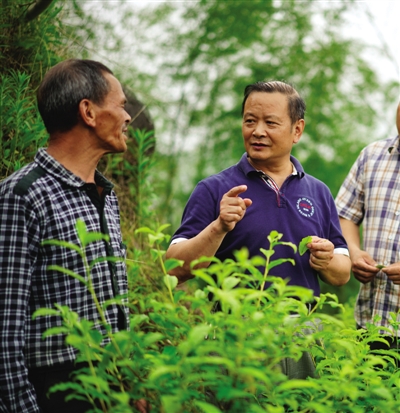
On June 15, Wang Ziqiang came to Taishun again. This time his task was to join a group of experts in investigating and solving the problems encountered in the development of Taishun's tea industry.
It is impossible to count how many times Wang Ziqiang has come to Taishun. Over 11 years, whether county leaders, township officials or mountain villagers, whenever they mention "Old Wang," the science and technology commissioner and professor from Zhejiang University, they all call him by a nickname: "the God of Wealth in science and technology."
Xia Keying, deputy director of the Taishun County Science and Technology Bureau, said that Wang Ziqiang is the most "special" of the commissioners, having stayed in Taishun the longest. From 2005 to now, he has continuously loaded up newly cultivated crop seeds and brought urgently needed technical teams to the mountains, traveling the road of science and technology assistance.
The farmers who are on brotherly terms with Wang Ziqiang say that Old Wang is truly the "God of Wealth in science and technology." He can work "green magic," and whatever variety passes through his hands will miraculously rise in value...
Zhang Hongguo, secretary of the Taishun County Party Committee, told reporters, "Money support, material support, but best of all is a science and technology commissioner." This saying circulating among the people in the Taishun mountains is exactly the earnest expectation the people have for science and technology commissioners like Wang Ziqiang. And through their own practice at the grassroots and their spirit of taking root in rural areas, science and technology commissioners have opened a "window of science and technology" for the mountain areas to escape poverty and become prosperous.
"Over the past 11 years, he has not only brought us new varieties, but also treated himself as a 'mountain person' and treated us as his own family"
--Wang Ziqiang in the eyes of the people
"This is purple potato from Taiwan, China, this is Japanese purple sweet potato, and over there is purple rice..." Pointing to the vibrant mountain fields before him, Peng Zuosheng, an agricultural technician in the Wanpai community of Shiyang Town, talked about them as if counting his family treasures. This plot is the experimental field for more than 160 crop varieties brought by Wang Ziqiang.
"Especially the 'chestnut sweet potato' -- not only is its starch yield high, but it is also full of sugar and has a sticky texture," Peng Zuosheng said. Using its starch to make sweet potato vermicelli, the price was 6 yuan per jin the year before last, and last year it already sold for 7.4 yuan. Many villagers rely on this to make a net profit of more than 2,000 yuan per mu. Speaking of these seeds, Peng Zuosheng gave a pile of "likes" to Wang Ziqiang.
In the spring of 2005, in the meeting room of the Wanpai Township government, Peng Zuosheng met Wang Ziqiang for the first time. This was a professor from Zhejiang University who had just returned from a temporary post at the Ningxia Science and Technology Department. After the brief introductory meeting ended, Wang Ziqiang grabbed Peng Zuosheng's hand: "Let's go, take a walk in the fields."
In the rice fields of Shangpai Village, Wang Ziqiang said nothing, rolled up his trouser legs and waded in. In one plot, he grabbed a handful of soil and kneaded it, then introduced the precautions for farmyard fertilization to a farmer who had stopped hoeing. On his first trip to Wanpai, Wang Ziqiang spent 10 days visiting all 5 administrative villages and 7 natural villages in Wanpai Township at that time.
Because Zhejiang University had teaching duties, Wang Ziqiang then returned to Hangzhou. Peng Zuosheng and some farmers still murmured to themselves: "In the previous two years, two science and technology commissioners came, and neither stayed long. Will this professor also be just a passerby?"
Unexpectedly, less than a month later, Wang Ziqiang came again. This time he carried large and small bags, bulging with newly cultivated seeds of vegetables, sweet potatoes, rice and so on.
At that time, getting from Hangzhou to Wanpai required a bus ride of more than 7 hours. Trip after trip, Wang Ziqiang brought newly cultivated seeds into the mountains and took the villagers' needs out with him. Later, Wang Ziqiang drove there himself, with the trunk and back seats full of seeds to give to farmers.
"What I brought this time are seed potatoes." "This is a new variety from an academic exchange conference in Southeast Asia, and it can be trial-planted in the village"... People went from their initial surprise to gradually taking it for granted, and the familiar term "Old Wang" also began to appear in the mouths of Wanpai people.
"Now, the village has 67 kidney bean varieties, 30 vegetable varieties, 8 rice varieties, 4 sweet potato varieties, 5 corn varieties, 3 potato varieties..." Peng Zuosheng said with emotion that Wang Ziqiang moved the laboratory to Wanpai time after time, and he himself had evidently become a "mountain person," while in his heart, Wanpai people were "his own family."
"What I studied is agronomy, and everything that grows in the fields is related to my profession," Wang Ziqiang said. In the mountains, one can feel the simplicity and honesty of the people, and of course, one can better use one's professional skills.
"He is our 'God of Wealth in science and technology.' Wherever he brings knowledge, the villagers there become rich"
--Wang Ziqiang in the eyes of business owners
"Chug chug chug" -- after the beginning of summer in the Wanpai tea garden, tea-picking machines broke the original silence. Wanpai, which had a foundation of large-scale tea planting for decades, previously found summer and autumn tea unwelcome among tea farmers because of high labor costs and low market prices. Now, a couple operating one tea-picking machine can produce nearly 2,000 jin of fresh leaves in a day.
It was "Old Wang" who liberated the productive forces.
Xie Xihe, now general manager of "Tailong Tea Manufacturing Co., Ltd.," contracted 1,200 mu of village tea gardens and an old tea processing factory as early as 2003.
But as labor costs grew higher and higher, the profits of the tea garden were severely squeezed, and the enterprise once fell into losses.
After some investigation, Wang Ziqiang suggested that Xie Xihe introduce mechanical picking and scientifically renovate the spacing of tea trees and the layout of paths in the tea garden to meet the requirements of mechanized operation. Soon, the model of carefully making famous high-quality tea and machine-harvesting summer and autumn tea was promoted in the enterprise and in Wanpai. At the same time, Wang Ziqiang also helped Xie Xihe select entirely new tea varieties, among which Zhongcha 108 could better avoid the early and late frosts in the mountain areas and quickly became one of the varieties promoted by mountain tea farmers.
With the injection of science and technology, the tea production mode in Wanpai was changed and the varieties were improved. Processed spring tea rapidly jumped from the original 70 to 80 yuan per jin to several hundred yuan per jin.
Li Yuanzhong, deputy mayor of Shiyang Town, told reporters that now, in addition to tea, industries such as the pollution-free sweet potato cultivation base and rice-field fish farming have formed a good complement to the tea industry, enabling farmers to increase their incomes. Last year, the per capita net income of Wanpai farmers ranked among the top among the 8 communities in Shiyang Town.
After Wang Ziqiang became "famous" in Wanpai and became head of the Taishun County science and technology commissioner liaison group, the "jobs" he took on also crossed regional boundaries.
One day in 2013, Xie Enjiu, general manager of the Tainong Vegetable and Fruit Cooperative, told Wang Ziqiang that he wanted to promote Taishun's excellent-tasting wild vegetables across the country, but was troubled by the lack of technology for rapid propagation of vegetable seedlings. After hearing this, Wang Ziqiang immediately recommended tissue culture technology to him. With his help, Xie Enjiu began preliminary experiments in tissue culture seedling cultivation: "Perhaps very soon, people all over the country will be able to eat wild vegetables produced in Taishun," Xie Enjiu said full of expectation.
In Siqian Town, Yan Lichao, head of the Taishun Baihua Bee Professional Cooperative, was worried because he could not figure out the methods for breeding queen bees. When Wang Ziqiang learned of this, he took the initiative to visit him, helped Yan Lichao pass QS certification, and also jointly developed a new type of beehive, increasing honey-collection efficiency by a full 4 times. In response to the difficulty of breeding queen bees, Old Wang invited Su Songkun, a bee-keeping expert from Zhejiang University, and ultimately succeeded in overcoming the problem. Now, in addition to Yan Lichao making considerable profits, more than 100 member farming households in the cooperative have also benefited greatly.
With Wanpai as his "old base area," Wang Ziqiang's footprints gradually spread across all the townships of Taishun.
"Taishun is poor, and its poverty lies in a lack of talent. Old Wang not only contributes his own technology, but also 'assembled' an expert team for us"
--Wang Ziqiang in the eyes of officials
Wang Ziqiang has professional expertise, but it is impossible for him to cover everything. Yet when encountering "cross-disciplinary" problems, he never said "no." Instead, each time he left the farmers with a promise: "Next time, I will invite other experts to solve this problem together."