Post-90s young man sells pigs with Internet+ approach, sells 700 in 4 months
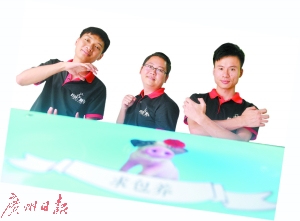
Zhuang Xubin, Guo Kai, Wu Deqiu (from left)
Not-so-skilled knife work.
Pigs' growth can be monitored in real time via mobile phone.
A year ago, Zhuang Xubin was still a "blue-collar" worker at a multinational company, working nine to five. Guo Kai, meanwhile, was already the owner of an online store with annual sales of four million yuan. A year later, the two quit their jobs to sell pigs together. In today's local pork market, which is veritably a red ocean, this group of young people, relying on Internet thinking, sold 700 pigs through crowdfunding in less than half a year and opened their first community brick-and-mortar store. Netizens can not only watch the entire growth process of their personally named "private pig" via video monitoring, but also earn a 9% annualized return.
The boss personally steps up to cut meat, orders via WeChat delivered on call
At 5 a.m., just as dawn was breaking, Zhuang Xubin rubbed his sleepy eyes and boarded a minivan with his partners, setting off for the Zhongnan wholesale market in Chancheng District to "haul pork."
Zhuang Xubin's pork comes from a partner pig farm. A pig weighing nearly 300 jin, after the slaughterhouse removes the offal and excess fat and other parts, leaves about 200 jin of "premium" cuts that can go on the shelves.
After the pork arrives at the store, under the "knife man's" cutting, it is divided into different parts, labeled and placed on the counter to await buyers. At 6 a.m., the stall in the Yicui Rose Garden residential community begins welcoming its first customers returning from morning exercise.
"Do you even know how to cut? It's all chopped to pieces." Regular customers in the community, when they find something unsatisfactory about the pork, will point it out to your face without restraint. The day's "part-time" knife man drew some "disdain" from the housewives. He studied food safety in university, and like the other staff, was a "novice" at butchering pork.
Wu Deqiu previously worked at an advertising company. After switching careers to "selling pork," whenever the store was busy or the knife man took leave, he would be pushed to the cutting block. "A good knife man, with one clean chop, can cut exactly the weight the customer wants." Wu Deqiu admitted that his skill was not yet up to par; with one chop, the weight he estimated would always be off by one or two liang.
When encountering a particular customer, he would then have to cut another piece, or make another slice. But the "value" of the trimmed-off scraps would drop significantly. When the store first opened, a housewife couldn't stand it and even had Wu Deqiu hand over the pork knife so she could step up herself.
At that moment, Zhuang Xubin was not idle either. He was busy recording pre-sale orders from the community residents' group on WeChat. Orders within 5 km would be delivered to doorsteps that morning. "These days the aunties are pretty good with WeChat too. Sometimes they send a message saying how much pork they want and which part, and we can deliver it."
On good business days, before 10 a.m., the pork at the stall would be mostly sold out. But selling pork also depends on "looking to the sky for a living." A while back, a heavy rainstorm lasted nearly most of the day, and the store's business was so quiet you could catch sparrows at the door. The staff, looking at each other, were unwilling to let the pork be bought up at low prices by restaurants, so they decided to split it and take it home to eat. "We ate it for a whole week. Fortunately, there are quite a lot of different ways to cook pork," Zhuang Xubin said with a laugh.
From giving sows B-ultrasounds to quitting his job to start a business, he believes "a small business can make a fortune"
At 6 p.m., after pulling down the stall's roller shutter, the 7 partners began reviewing the day's sales and conducting data analysis. The second floor of the 40-square-meter stall was their office, and the space seemed a bit cramped. To save costs, the painting of the office walls and other renovation work was all done by themselves.
On the small blackboard indoors were densely written work task assignments, displaying the workload of a startup company. Usually they could not go home until after 9 p.m.
"One choice really can change your life trajectory afterward." Zhuang Xubin said that at this time last year, he was still working at a large multinational enterprise group, living a nine-to-five life every day. Having studied food safety, after graduation he worked at a breeding base in Gaoyao, using instruments every day to give B-ultrasound checks to sows being bred.
"The smell of pig manure isn't the hardest thing to endure. The hardest part is not seeing more than a few people all day long." Zhuang Xubin said that when he was in university, he already wanted to start a business and found his own company. This post-90s young man from Chaoshan admitted frankly that he had the business genes of Chaoshan people in his bones, and longed to strive in a big city and gain a place for himself. In his hometown in Chaoshan, there is a saying: "A salary won't make you stand out, but a small business can make a fortune."
When he submitted his resignation, the company's person in charge even advised Zhuang Xubin that the road of entrepreneurship was not easy and gave him three months to think it over, saying that if he changed his mind he could still come back, but Zhuang Xubin politely declined the offer.
What actually made Zhuang Xubin determined to start a business was also the influence of his "partner" Guo Kai, a fellow alumnus also from Chaoshan. "The slow bird must start flying early." Guo Kai admitted frankly that in university he paid special attention to making plans. According to the goals Guo Kai set, besides studying, before graduation he had to earn his first pot of gold for entrepreneurship.
"Back then I tinkered with everything." Guo Kai said that in those days there were no takeout apps like now, and transportation at the school was inconvenient. He first found a catering company and asked to buy 900 meal sets at once, requesting a 1.5 yuan discount on each. Then he returned to the school and distributed takeout flyers to every dormitory. Every day after receiving orders by phone, he used Feixin to send them to the restaurant owner for meal preparation. After delivery to the school, he asked part-time students to deliver them to each dormitory. By dealing in these "small transactions," he earned 200,000 yuan by graduation, saving up a startup fund.
Internet-thinking crowdfunding pig farming cuts out middleman price differences
After graduating from Foshan University in 2010, when starting his second business, Guo Kai and several friends found a garment company in Zhangcha to do OEM production and opened their own brand store online. Two years later, the online store's annual sales exceeded 4 million yuan, with gross profit of about 30%.
Later, the practices of several bosses from the Nanhai Chamber of Commerce gave Guo Kai inspiration for starting another business. It turned out that in order to eat pork they could trust, several bosses had specially contracted a private farm in Jiangmen to raise pigs for themselves to eat. "In the homes of pig farmers, there are usually a few pigs kept for their own consumption, generally raised for at least a year." Because his daughter liked eating meat, and in order to eat with peace of mind, Guo Kai specifically looked into the breeding market. Farmers told him that pork generally sold on the market could be raised to 300 jin and sent to slaughter in just 8 months. To fatten them quickly, many pig farms also use antibiotics and growth-promoting feed along the way.
However, not every consumer can afford to contract their own private pig farm like the bosses. Can ordinary citizens also eat pork they can trust?
While working at the pig farm, Zhuang Xubin discovered that because pork prices fluctuate, farmers are often unwilling to invest when pork prices are at a low point. "If at this time a customer could pay in advance to reserve a pig, and after the farmer raises it, sell it to the customer at wholesale price, cutting out the middleman's price difference, wouldn't that achieve a win-win?" His idea coincided with Guo Kai's. "Now anything can be crowdfunded, so let's use Internet thinking to crowdfund pig farming." Several freshly graduated alumni all felt it was "worth doing."