Masked Palm Civet Farming Techniques, Market Prices, and Analysis of the SARS Connection
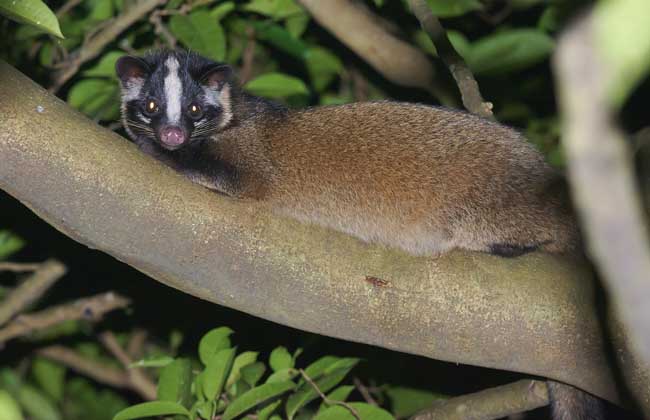
The Masked Palm Civet's Living Habits
The masked palm civet is a forest-edge mammal and a nocturnal animal. It likes to be active at dusk, at night, and before sunrise, and it is good at climbing. It is an omnivorous animal and is quite fond of eating juicy fruits; it mainly feeds on wild fruits and grains, and also eats twigs and leaves, and it even goes into orchards to eat fruit. It has scent glands near the anus, and when facing an enemy it releases a strange odor to drive it away.
The masked palm civet mainly inhabits forests, thickets, rock caves, tree holes, or earthen burrows, and can occasionally be found in cultivated land. It is distributed across Indochina, Indonesia, Myanmar, India, Bhutan, Nepal, and the vast areas of China south of North China, from the western suburbs of Beijing, Datong in Shanxi, the Qinling Mountains in Shaanxi, and western Sichuan in the north all the way to the southern Himalayas in Tibet, and in the south to Taiwan, Hainan Island, and the southern edge of Yunnan, among other regions.
The Farming Value of the Masked Palm Civet
1. The fat of the masked palm civet is a raw material in cosmetics production and can treat burns.
2. Masked palm civet meat is rich in nutrients and has a unique flavor; it is fatty but not greasy, fresh and tender and tasty, and through the ages it has always been a wild game meat loved by the people of China.
3. The fur of the masked palm civet is called qingyao fur and is one of China's major export furs; over the long term, due to excessive hunting, the wild population has declined sharply.
The Nutritional Value of the Masked Palm Civet
Every 100 grams of masked palm civet meat contains 435.90 kcal of calories, 3.92 g of protein, 30.36 g of fat, 41.99 g of carbohydrates, 5.30 g of dietary fiber, 35.30 mcg of vitamin A, 159.00 mcg of carotene, 0.09 mg of thiamine, 0.18 mg of riboflavin, 1.51 mg of niacin, 11.70 mg of vitamin C, 1508.36 mg of vitamin E, 65.30 mg of calcium, 131.45 mg of phosphorus, 2885.85 mg of sodium, 100.20 mg of magnesium, 5.66 mg of iron, 1.44 mg of zinc, 2.66 mcg of selenium, 1.00 mg of copper, 1.18 mg of manganese, 367.80 mg of potassium, 0.04 mg of vitamin B6, 0.14 mg of pantothenic acid, 22.50 mcg of folic acid, 85.50 mcg of biotin, and 27.90 mg of cholesterol.
1. The masked palm civet can provide the human body with rich nutrients such as protein, fat, carbohydrates, vitamins, and minerals, and has the effects of tonifying the middle and boosting qi, strengthening the spleen and benefiting the stomach, nourishing yin and moistening dryness, and strengthening the kidneys and preserving essence.
2. The masked palm civet is suitable for patients with conditions such as weak spleen and stomach, deficiency of both qi and blood, poor appetite, weakness of the limbs, lung-heat cough, dry cough, impotence, and frequent urination.
3. Healthy people who eat it are full of energy and become stronger with fewer illnesses.
Building the Masked Palm Civet Enclosure
1. The masked palm civet hides by day and comes out at night, likes to be active inside the enclosure, and is social, and it has no special requirements for the civet enclosure. The masked palm civet also has no strict requirements for periodic changes in sunlight, and the main forms of housing are cage rearing, group rearing, and a combination of cage rearing and group rearing.
2. The cages are made of galvanized iron mesh, and small chambers and dark chambers are built inside the cages with bricks. Perches should be set up inside the cages for the masked palm civets to climb, jump, and rest on. Their range of activity is relatively small, so the environment should be kept dry and quiet. The inner chamber should preferably have a cement floor, which makes washing easier.
3. Because the masked palm civet is good at climbing, perches, tree stumps, and the like can be set up indoors and outdoors for the animals to climb, so that they can move about and rest; the room should also have a top net or top cover, with mesh openings no larger than 5 sq cm, to prevent the animals from escaping and to ensure safety.
4. In summer, prevent exposure to the sun and rain; in winter, prevent draft, especially at night. Straw curtains or cotton curtains can be used as cover, and the temperature of their living environment should generally be kept at 25-30°C. Drinking water must be clean and fresh; do not let them drink water that has been sun-heated in summer or frozen in winter, and change the water frequently.
Is SARS Related to the Masked Palm Civet?
On May 11, 2003, researchers in Shenzhen and Hong Kong, China isolated a SARS-like virus from masked palm civet specimens, and Beijing, Guangzhou, and other places successively placed farmed masked palm civets under temporary sealed storage and management.
In August 2003, China's State Forestry Administration determined the first list of terrestrial wild animals that could be commercially farmed and utilized, and the masked palm civet, which had been the subject of so much hype, would have its "SARS culprit" label removed and become a dish on people's tables.
In 2013, Yuen Kwok-yung, a professor of infectious diseases at the University of Hong Kong, China's medical school, said that the natural host of the SARS virus is a bat called the "Chinese horseshoe bat," and that the masked palm civet is only an intermediate host, not the natural host; only then was the masked palm civet cleared of its 10-year injustice.