Complete Picture Gallery of Centipede Species, High-Definition Charts to Help You Identify Common Varieties
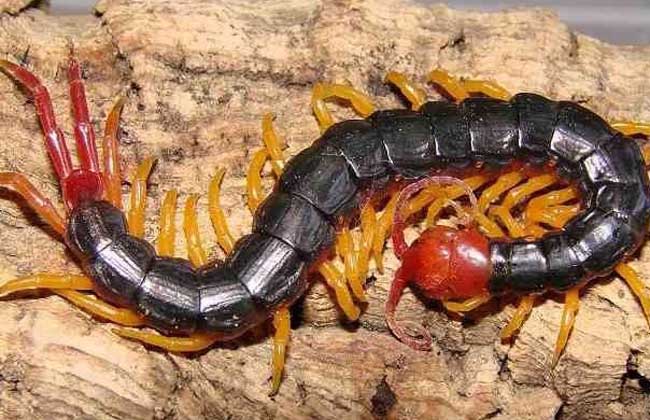
Centipedes are carnivorous animals, a collective term for terrestrial arthropods of the order Scolopendromorpha and family Scolopendridae, originating in the Silurian Period, with 2,800 species still surviving today. Like arthropods in general, they are known for having many segmented limbs. Common centipedes include three types: red-headed, blue-headed, and black-headed. They have venom glands that secrete venom and can themselves be used as medicine. Let us now take a look at the complete picture gallery of centipede species!
Red-headed centipede
The red-headed centipede has a flat, elongated body with a golden-yellow head and whip-like antennae. The dorsal side of its trunk is dark green, and the ventral side is yellow-brown. It is made up of many segments, each with a pair of legs. China produces 10 million red-headed centipedes annually, which sell well both domestically and abroad, mainly in Jingzhou, Suizhou, Yichang, Xiaogan, Yunyang and other cities and prefectures in Hubei, as well as in some counties of Laohekou, Xiangfan, Jingmen, Zaoyang and other cities.
Blue-headed centipede
The blue-headed centipede has a blue back and legs, with a pale blue abdomen. It is small in size, about one-half the length of the red-headed centipede. It is often found in damp wall corners, under bricks, under rotting leaves, and in old, damp houses. It is more commonly seen in summer and has a fairly broad diet, especially favoring various insects.
Black-headed centipede
The black-headed centipede has a black back and legs, with a pale yellow abdomen. It is even smaller than the blue-headed centipede and prefers damp, dark places. It often inhabits under rotten wood and in stone crevices and on overgrown, damp thatch grass. It is distributed in Jiangsu, Zhejiang, Anhui, Henan, Hubei, Hunan, Guangdong, Guangxi, Shaanxi, Sichuan and other places.
Many-spined centipede
The many-spined centipede can reach a body length of 160 mm, with 18 antennal segments, the basal 6 segments smooth and hairless, and most tergites lacking ridges. Tergites 2 to 19 have incomplete parallel longitudinal sutures. The tips of the coxopleural processes have 3 small spines, with no dorsal spines or lateral spines. The 20th and 21st pairs of walking legs lack tarsal spines. On the last pair of walking legs, the prefemur has 2 small spines on the outer side and 2 small spines on the inner side of the ventral surface, and 2 small spines on the inner side of the dorsal surface, while the tip of the apical spine has 3 small spines. Adult males have no gonopods on either side of the ventral plate of the anterior genital segment.
Lesser-spined centipede
The lesser-spined centipede is a similar species to the many-spined centipede, also known as the golden-headed centipede. Its body length is 110-130 mm. It prefers damp, dark places and mostly feeds on other arthropods. It is mainly distributed in China and Japan and is commonly seen in the middle and lower reaches of the Yangtze River. The lesser-spined centipede is a traditional Chinese medicinal material and has the functions of calming wind and relieving spasms, reducing swelling and detoxifying.