What types of leeches are there? A detailed introduction to common species
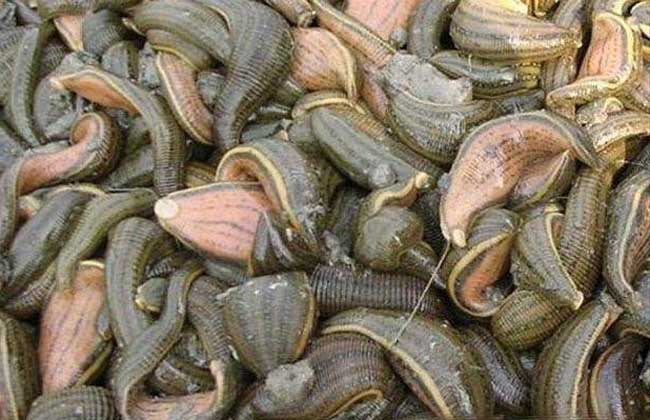
Leeches live in rice paddies, ditches, shallow polluted ponds and other places, are fond of sucking the blood of humans and livestock, move very agilely, can swim in a wavelike manner, and can also move like an inchworm. They become active whenever spring warms, June to October is their egg-laying period, and in winter they often lie dormant in the wet mud near the shore, neither eating nor moving, with strong survival ability. Now let us take a look at what types of leeches there are!
Japanese medical leech
The Japanese medical leech, also called the medicinal leech, has a narrow, elongated and slightly flat body, roughly cylindrical, with a body length of 3-5 cm and a width of 4-5 mm (fixed), and the back is green with black, with 5 yellow longitudinal lines. The ventral surface is flat, grayish green, without mottled markings. The number of body rings is 103. The clitellum is not prominent, occupying 15 rings. The male genital pore is between the 31st and 32nd ring grooves. The female pore is between the 36th and 37th ring grooves. There are 5 pairs of eyes, arranged in an arc. There is a front sucker on the ventral surface at the front end of the body. The esophagus has 6 longitudinal folds, and there are 3 jaws, semicircular, with well-developed jaw teeth. There is a rear sucker on the ventral surface at the rear end, bowl-shaped, facing the ventral surface, with the anus on its dorsal side.
The Japanese medical leech lives in paddy fields and swamps, sucks the blood of humans and livestock, moves agilely, can swim in a wavelike manner and move like an inchworm, becomes active when spring is warm, June to October is the egg-laying period, and lies dormant in winter. Its regenerative ability is very strong; if it is cut and kept, a new body can regenerate from the cut part. It is distributed throughout the country.
Whitmania pigra
Whitmania pigra has a large body, slightly spindle-shaped, flat, 6-13 cm long and 0.8-2 cm wide. The back is usually dark green, with 6 longitudinal lines composed of fine yellow-black spots, and the dorsal midline is darker. The ventral surface is pale yellow, mixed with many irregular tea-green spots. The number of body rings is 107. The clitellum is obvious, occupying 15 rings. The male genital pore is between the 33rd and 34th ring grooves. The female pore is between the 38th and 39th ring grooves. The eyes are the same as those of the Japanese medical leech. The front sucker is small, and the jaw teeth are not well developed.
Whitmania pigra lives in paddy fields, rivers and lakes and marshes. It does not suck blood, but feeds on plankton in the water, small insects, larvae of mollusks, and humus on the mud surface. It is distributed in most areas of the country.
Tea-colored leech
The tea-colored leech, also called niubie, is slightly smaller than Whitmania pigra, willow-leaf shaped, flat, with a brown-green back and 5 longitudinal lines composed of fine green-black spots. The ventral surface is light yellow, very flat, scattered with irregular dark green spots. The rest is similar to Whitmania pigra. It is distributed in most areas of the country.