Dragon fruit price crash: Jiang Yilu and Lin Mengzi breed new varieties hoping to replace the old market
Following reports of price crashes in bananas and pineapples, outsiders speculate that dragon fruit, now entering its production season, will be the next "victim." In recent years, dragon fruit prices have been good, and many farmers rushed to plant it, leaving prices perpetually on the brink of collapse. "If you don't build your own customer base, I wouldn't recommend growing it," advise Jiang Yilu and Lin Mengzi, a husband-and-wife team who have long studied dragon fruit.
Both Jiang Yilu and Lin Mengzi once studied in the doctoral program at the Department of Horticulture and Landscape Architecture at National Taiwan University. More than four years ago, they returned to Neimen, Kaohsiung, China to actually grow dragon fruit, applying their past academic knowledge to field cultivation. Being on the front lines of cultivation, they are all the more attuned to farmers rushing to plant. "The vast majority of farmers see dragon fruit making money and jump in, even though market expectations clearly point to falling prices."
Having foreseen the price crash crisis, the two warned nearby farmers not to grow dragon fruit, but were instead questioned as angling for their own dragon fruit profits, and even mocked. "When we first started saying not to plant, that was the most pitiful time, because dragon fruit prices hadn't crashed yet. We talked about it for two years and farmers scolded us for two years. Every time we went to drink tea, we got teased."
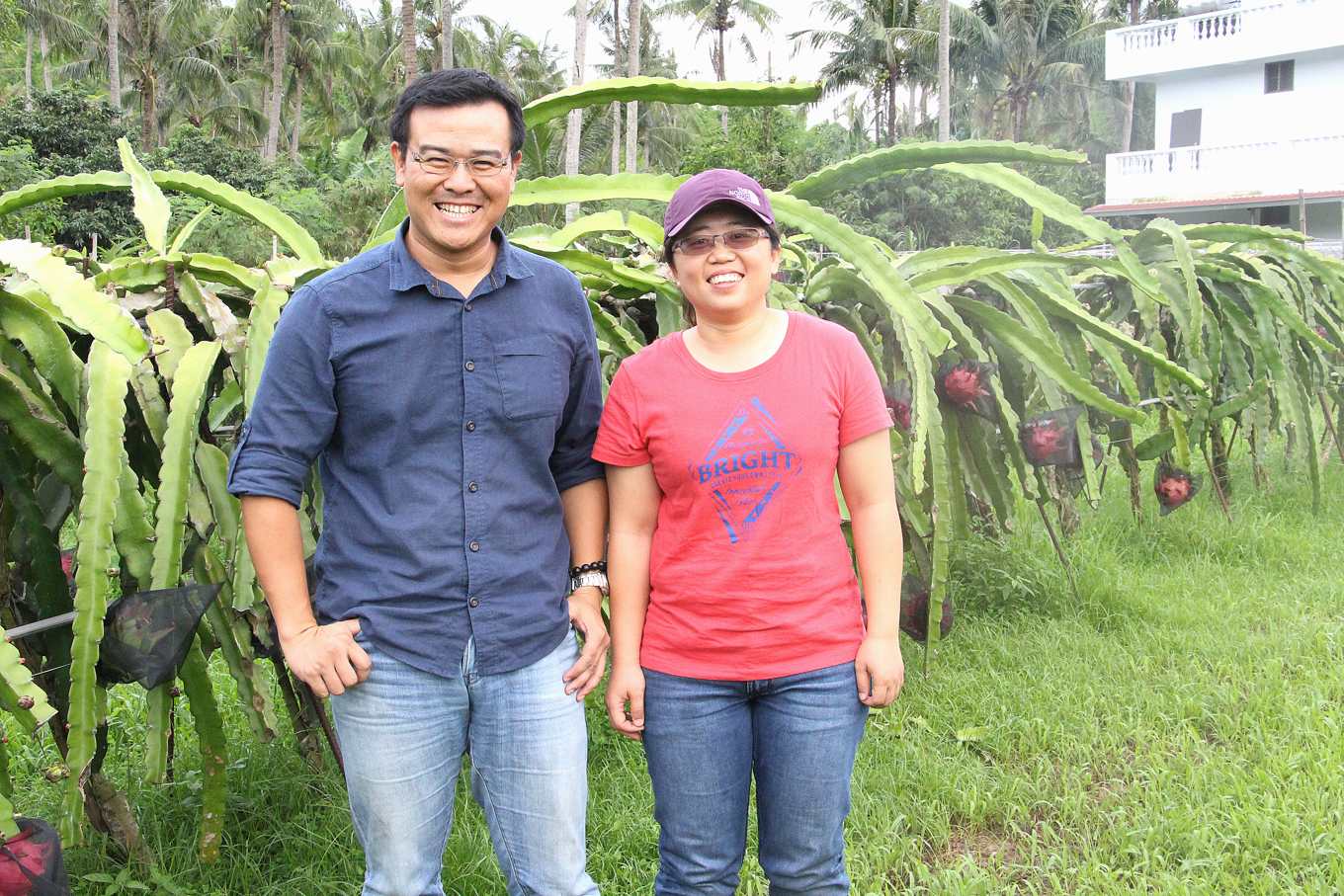
The couple works in great harmony, carrying out breeding to create a new market for dragon fruit
Visiting the orchard the two operate, the grounds are still somewhat muddy because of heavy rain a few days earlier. Jiang Yilu says that if days of heavy rain cause flooding in the field, the branches rot easily, which may further lead to disease. "So when you first design the field plots, drainage has to be done well."
The interview had just touched on the need for orchards to value cleanliness, yet at the actual orchard some branch debris still hadn't been cleared away. Jiang Yilu jokes, "So every time we walk the field ourselves, the two of us argue." Though they may "argue," their rapport is excellent throughout the conversation, playing off each other and filling in the key points the other left out.
One buries himself in the field planting, one stands in the lecture hall teaching, each in their proper place yet inseparable. Lin Mengzi knows his passion for teaching; when she talks about school matters, she speaks as clearly as if she were the one involved. Jiang Yilu understands her rural life; he never misses any situation in the orchard.
The two have studied dragon fruit hand in hand all along, and have watched the dragon fruit industry evolve, from the earliest poorer varieties to the improved Dahong and Fugui Hong with good flavor, sweetness and quality. Facing farmers rushing in to plant and a chaotic market, Jiang Yilu believes, "To break out in the dragon fruit market, we must rely on new varieties; perhaps they can gradually replace the current cultivation area and create a new market." At present the two keep working on breeding, including yellow dragon fruit and bicolor dragon fruit. Though there are no clear results yet, they are still sowing seeds for the future new dragon fruit market.