How much is leech per jin? Market price analysis
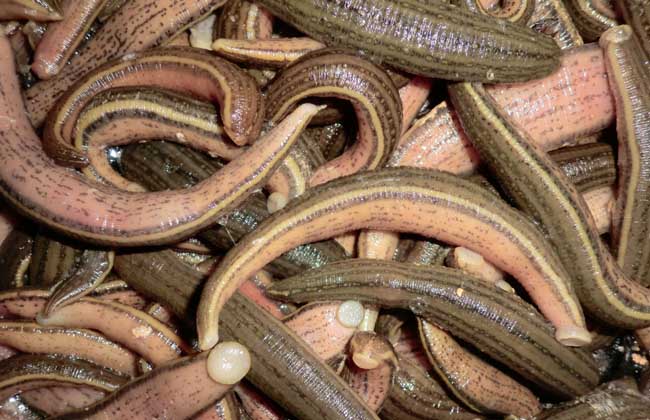
The leech is a traditional special medicinal aquatic animal in China. As a medicine it has effects such as treating stroke, high blood pressure, clearing blood stasis, amenorrhea, and bruises and injuries. Historically it was mainly caught in the wild. Due to the abuse of pesticides and chemical fertilizers in recent years and the pollution of the environment by the “three wastes” of industry and agriculture, wild natural resources have sharply declined, and its market demand potential is huge. Let us take a look below at how much leech costs per jin!
How much is leech per jin?
Leech not only has a very high medicinal value, but also has a wide range of applications, and market supply is also very tight. Its price trend has been rising year by year. At present, the processed clear-water leech is 600-650 yuan per jin, salt-water leech is about 450-500 yuan per jin, and the market price of alum-water leech is about 430-450 yuan per jin. At the same time, the market price of leech is expected to remain firm in the later period.
Historical prices of leech
At present, the market demand for leech is increasing year by year, wild leech resources are being depleted year by year, stocks in various places are running short in supply, and the supply-demand gap is as high as more than 50%. These factors are the main reasons for the consecutive sharp rises in leech prices. A survey of 17 professional Chinese medicinal herb markets across the country showed that since 2000, leech prices have risen sharply year after year, rising from 150 yuan in 2002 to 160 yuan in 2003, 170 yuan in 2004, 180 yuan in 2005, 190 yuan in 2006, 200 yuan in 2007, and 230 yuan in 2008. From 2009 to 2011, leech prices soared continuously, rising to 380 yuan in 2009, then soaring to 740 yuan in 2010, and by 2011 had soared to 800-820 yuan.
Factors behind leech prices
1. Serious river pollution: Leeches grow in rivers, lakes, streams, ditches and paddy fields. Because river pollution is serious, and paddy fields have been heavily treated with pesticides and chemical fertilizers year after year, leeches find it difficult to reproduce and grow, and large numbers die. Some production areas have become nearly extinct, and production is reduced by more than 30% each year because of this.
2. Changes in the growth environment: In order to develop the local economy, the main leech production areas have, year after year and on a large scale, carried out mining, road building, factory building, house building, land clearing for tree planting, and the development of industrial parks and tourist areas, among other human activities, severely damaging the environment on which leeches depend for survival and leaving leeches with no place to live. At present, groups of leeches are rarely seen in the rivers and lakes of the main production areas.
3. Draining the pond to catch the fish everywhere: Leech prices have risen year after year, and 1 kilogram of dried leech can sell for several hundred yuan. The income from catching leeches greatly exceeds that from producing grain and vegetables. High profits have stimulated the enthusiasm of people in production areas to catch leeches, and whenever the new production season arrives they rush in all at once, catching without restraint. Regardless of size, all leeches are caught by "draining the pond to catch the fish," which has affected leech reproduction.
4. Greatly increased usage: China's elderly population is growing, and the number of people suffering from cardiovascular and cerebrovascular diseases is rising year by year. The number of new drugs, special drugs and Chinese patent medicines produced with leech as the main raw material is increasing day by day, and the required leech raw material has already exceeded that of the 1980s-1990s by dozens of times.
5. Lagging artificial breeding: Artificial breeding has been carried out for 10 years, but the technical difficulties have never been overcome. Leeches grow slowly and have a high mortality rate. Many production areas have abandoned breeding one after another, and commercial leeches are not seen on the market anywhere.
Varieties of medicinal leech
1. Whitmania pigra: Whitmania pigra is currently the main breeding variety in China. It mainly feeds on animal blood, and also feeds on plankton and mollusk larvae in the water. Its main characteristics are a large body, fast growth, high reproduction rate, and easy catching. It is currently the main variety promoted for breeding.
2. Whitmania acranulata: Whitmania acranulata is also known as the tea-colored leech, willow-leaf leech, and so on. Whitmania acranulata has 1 yellow longitudinal band on each side of its body, a grayish-yellow ventral surface, and 1 band on each side edge formed by gathered dark brown spots. It feeds on aquatic earthworms and insect larvae. Its underdeveloped jaws can pierce the skin but cannot suck blood.
3. Hirudo nipponia: Hirudo nipponia has a narrow and long body, slightly cylindrical, and somewhat flattened dorsoventrally. It mainly sucks the blood of humans and livestock, and in nature mainly feeds on the blood of fish and other animals. It is not easy to raise artificially on a large scale. In medicine it is mostly used as a live specimen and is not used to process medicines. There is a large demand for medicinal leeches abroad, but they must be live.
4. Whitmania laevis: Whitmania laevis has a body slightly spindle-shaped, gradually tapering toward the front, with the mouth opening in front of its posterior margin. Its body is relatively small, and its living habits are similar to those of Whitmania pigra. It often feeds on snails (river snails, pond snails) and insect larvae, among others. Its reproduction rate is small and its yield is low, so it is not suitable for large-scale artificial breeding.
5. Poecilobdella javanica: Poecilobdella javanica has a body length of 100-160 mm, with the largest specimen at 225 mm, a maximum body width of 10-19 mm, and a posterior sucker diameter of 10-19 mm. Its living habits and medicinal functions are similar to those of Whitmania pigra, and it has a large body, high yield and is easy to raise, so Poecilobdella javanica can also be used as an excellent variety for artificial breeding and large-scale farming.