Leech Farming Techniques, Pictures, and Detailed Explanation of Effects and Functions
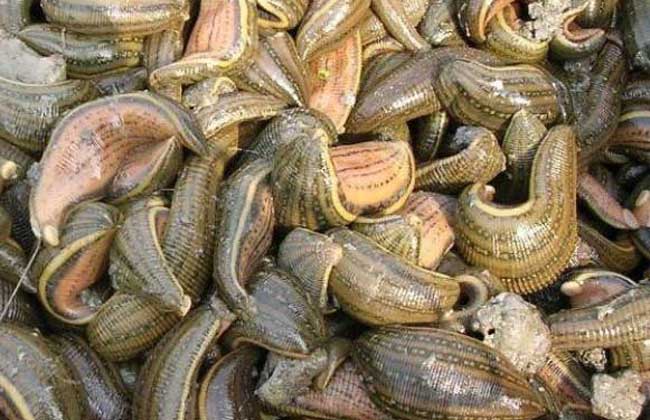
Living Habits of Leeches
1. Leeches are cold-blooded annelids and can grow and reproduce in both northern and southern China. They mainly live in freshwater reservoirs, ditches, paddy fields, lakes and marshes, and are most abundant in ponds rich in organic matter or in small unpolluted rivers.
2. The suitable growth temperature is 10-40°C. In northern regions, when the temperature is below 3°C, they enter a dormant hibernation period in the soil, and in March-April of the following year, when the temperature rises above about 8°C, they emerge from dormancy and become active.
3. Leeches are omnivorous animals and mainly live by sucking the blood or body fluids of animals. They often feed mainly on plankton, insects, and mollusks in the water. Under artificial conditions, they are fed various animal internal organs, cooked egg yolk, compound feed, plant residues, freshwater snails and shellfish, miscellaneous fish, earthworms, etc.
Effects and Functions of Leeches
[Nature and Flavor] Salty, bitter, neutral, mildly toxic.
[Meridian Entry] Enters the liver meridian.
[Effects] Breaks blood stasis, expels blood stasis, and unblocks menstruation. Treats blood accumulation, abdominal masses, accumulations and gatherings, women's amenorrhea, dry blood forming consumptive disease, traumatic injuries, eye pain, and corneal opacities.
[Indications] Used for amenorrhea, abdominal masses, and traumatic injuries.
[Usage] Oral administration: in pills or powders, 0.5-4 qian. External use: place on the affected area to suck; or drip the soaking liquid.
1. To treat women's difficult menstruation, and also to treat men with full and urgent bladder and blood stasis: 30 leeches (prepared), 30 gadflies (remove wings and legs, prepared), 20 peach kernels (remove skin and tips), 3 liang rhubarb (soaked in wine). Grind the above four ingredients into powder, boil with 5 sheng of water, reduce to 3 sheng, remove the dregs, and take 1 sheng warm. (Dangdang Decoction from Jingui Yaolue)
2. To treat blood stasis in a woman's abdomen, unfavorable menstruation, intermittent flow, and fullness and urgency in the heart and abdomen: 3 liang peach kernels (soaked in water, remove skin, tips and twin kernels, stir-fried with bran until slightly yellow), 40 gadflies (stir-fried until slightly yellow, remove wings and legs), 40 leeches (stir-fried until slightly yellow), 3 liang Sichuan rhubarb (cut into pieces and slightly stir-fried). Grind the above medicines and sift into powder, mix with refined honey and pound over a hundred times, and make pills the size of firmiana seeds. Take 15 pills each time on an empty stomach with warm wine. (Taoren Pill from Shenghui Fang)
3. To treat absent menstruation, or postpartum lochia, with pain in the umbilical and abdominal region: 4 liang prepared rehmannia, 50 each of gadflies (remove heads, stir-fry wings), leeches (stir-fried with glutinous rice until yellow, remove the glutinous rice), and peach kernels (remove skin and tips). Grind the above into powder, make honey pills the size of firmiana seeds. Take 5 or 7 pills each time on an empty stomach with warm wine. (Dihuang Tongjing Pill from Furen Liangfang)
4. To treat incessant bleeding from abnormal uterine discharge: leeches are processed and sifted, taken with wine about 1 qian, twice a day; once the bad blood is dispelled, recovery occurs. (Qianjin Fang)
5. To treat fractures: leeches are dried over a new tile, made into fine powder, mixed with hot wine and taken 1 qian; after the time of a meal, the pain may ease, and after one more dose, the pain stops. Then apply fracture medicine and secure it with a splint. (Jingyan Fang)
6. To treat metal wounds, injuries from blows, falls from heights, compression by wood or stone, internal damage with blood stasis, heart and abdominal pain, inability to urinate or defecate, and near death from qi exhaustion: 0.5 liang red leeches (stir-fried with lime over slow fire until scorched yellow), 2 liang rhubarb, 2 liang black pharbitis seed. Grind each into fine powder. Take 3 qian each time, mixed with hot wine. After the time it takes to walk four or five li, take another 2 qian of pharbitis seed powder mixed with hot wine to promote it. The viscera must discharge the bad blood, in clumps or pieces; once the bad blood is gone, recovery occurs. (Duoming Powder from Jisheng Fang)
Nutritional Value of Leeches
Leeches are invertebrate soft-bodied animals without a skeletal structure, and the whole body can be utilized. Their main components are protein, polypeptides, trace elements, and fatty acids.
1. Protein: The amino acid content in dried leech powder is as high as 62%, which is 2.7 times the 23.3% protein content of muscle; among these 17 amino acids, glutamic acid, aspartic acid, lysine, and leucine are relatively high in content, and they play a very important role in the health benefits of leeches. Among the 17 amino acids contained in leeches, 7 are essential amino acids for the human body, with a content of 1535mg/100g dry weight, accounting for 72% of the total amino acids.
2. Polypeptides: Blood-sucking leeches contain low-molecular-weight polypeptides composed of multiple amino acids, which are the main active ingredients through which blood-sucking leeches exert medicinal and health benefits.
3. Trace elements: Poecilobdella manillensis contains 8 elements: calcium, chromium, copper, iron, magnesium, manganese, vanadium, and zinc, among which vanadium, manganese, copper, iron, and zinc are essential trace elements for the human body. The contents of zinc and iron are relatively high, at 1.4mg/g and 1.36mg/g respectively. The zinc content is 8 times higher than the zinc content in soybeans and 2 times higher than the content in pig liver. This shows that Poecilobdella manillensis has a very strong ability to enrich zinc. In nature, zinc content is relatively low, yet it is an important element for maintaining normal human physiological activities, and the human body cannot produce it itself and can only rely on external supply. Research also shows that zinc is widely involved in basic biochemical processes such as protein enzymes, carbohydrates, nucleic acids, and fat metabolism, and it is known that the activity of more than 300 enzymes is related to zinc. In addition, zinc can improve human immunity and has anticancer functions. As people age, the content of trace elements in the body gradually decreases, especially zinc, causing damage to enzyme proteins and accelerating the aging process and the occurrence of diseases. Therefore, in order to maintain an appropriate concentration of trace elements in the body, it is necessary to consume foods rich in trace elements.
4. Fatty acids: Poecilobdella manillensis contains 16 fatty acid components, among which saturated fatty acids account for 63.34% and unsaturated fatty acids account for 34.05%. Research has found that monounsaturated fatty acids, while lowering total cholesterol and harmful cholesterol, do not lower beneficial cholesterol. In addition, monounsaturated fatty acids have special physicochemical characteristics and physiological functions, with effects such as regulating human lipid metabolism and treating and preventing cardiovascular and cerebrovascular diseases.
Breeding Techniques for Leeches
1. Construction of breeding ponds: The pond area should preferably be about 30 sq m, and it is advisable to build a square of 5 m × 5 m or 6 m × 6 m. Around the pond, a 1-1.5 m platform should be set along the pond wall, with water surface in the middle, a water depth of 50 cm, and the platform 2 cm above the water surface, with the platform surface kept moist. The soil used for the platform should be loose sandy soil with high humus content, convenient for leeches to burrow. Yellow clay must not be used. An overflow outlet should be set level with the platform surface to prevent rainwater from flooding the platform and causing breeding failure. Generally, there are two types: small breeding ponds and large breeding ponds:
① Construction of small breeding ponds: Generally, a pond ditch 3 m wide and 1 m deep is built, with no limit on length. Several small ponds can also be built with shared hard edges, with a pond ridge 40 cm wide, and each pond provided with inlet and outlet openings. In the middle of the pond, there must be a 50—100 cm wide spawning platform, with the platform and the water surface on the same level, and a 20 cm thick layer of humus soil piled on the platform. This serves as a place for leeches to spawn and reproduce. The water level should preferably be 50—60 cm.
② Construction of large breeding ponds: The construction of large breeding ponds generally follows the actual geographical environment to build ponds of different specifications. If the water source is inconvenient, a layer of plastic film can also be laid on the bottom of the pond. An appropriate amount of river mud should be placed on the pond bottom to increase the organic matter content of the water. Some aquatic plants can be planted in the water to purify the water quality and increase the oxygen content in the water. It is best to bury a ring of nylon mesh (0.5—0.6 m high) on the pond bank to block natural enemies such as frogs and snakes from entering the breeding pond. To prevent excessively high water temperature and too strong light in summer, trees such as weeping willows can be planted on the pond bank for shade.