Key Points of Sika Deer Farming Technology and a Detailed Guide to Feeding and Management Methods
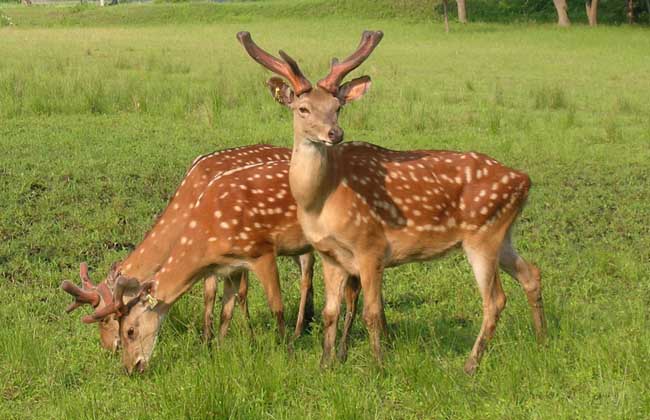
The sika deer is a medium-sized deer, with a body length of 140-170 cm, a shoulder height of 85-100 cm, and an adult weight of 100-150 kg; females are relatively smaller. The deer has antlers, generally with four tines. There is a dark brown dorsal line down the center of the back. The tail is short, black on the upper side and white on the underside. The summer coat is brownish yellow, covered with distinct white spots shaped like plum blossoms, which is why it is called “sika deer.” The rump patch is white. It lives at the edges of forests or in mountain grassland areas. Its habitat changes with the seasons. Males usually live alone and join the herd during the rutting and mating season. It is active at dawn and dusk, feeding on green grass and leaves, and is fond of licking salt and alkali. Each litter has 1 fawn, and the fawn has white spots on its body. It is mainly distributed in China, Japan and Russia.
Living Habits of the Sika Deer
The sika deer lives at forest edges and in mountain grassland areas, not in dense forests or thickets, as this is conducive to running quickly. Its daytime and nighttime habitats differ noticeably. During the day it mostly chooses sunny slopes with relatively deep, dense thatch grass and places where its body color is basically similar, so that it can detect enemies earlier and escape quickly; at night it rests on the middle or upper-middle part of slopes, with no fixed slope aspect, though sunny slopes are still the majority, and the thatch grass where it rests is relatively short and sparse.
Gregariousness: Under natural conditions, sika deer are gregarious, in groups ranging from a dozen or so to several dozen. In cold winter, their gregariousness is greater than in other seasons, and the gregariousness of artificially penned sika deer herds has still not changed. The lead deer in the herd often influences the movement of the whole herd; to avoid harm, many deer will run in the direction and along the route taken by the lead deer or a few deer. If an individual deer is occasionally kept separately because of illness or other reasons, it appears timid and uneasy, pacing back and forth in the enclosure and even refusing to eat or drink. Foreign deer are very likely to be attacked by some deer in the group. People make use of this gregariousness of sika deer to domesticate them, graze them and control the entire herd.
Sika deer spend most of their time in group activities, and the size of the group varies with the seasons, natural enemies and human factors, usually 3-5 deer and sometimes more than 20. In spring and summer, the group is mainly composed of females and fawns, while males mostly live alone and join the herd during the rutting and mating season. Mating begins from August to October each year. When a female is in estrus, she makes a distinctive courtship call that lasts about a month or so, while a male makes a “baa-baa” call like an old sheep when courting.
Foraging Habits of the Sika Deer
Sika deer are active at dawn and dusk, and their living area changes with the seasons. In spring they are mostly on semi-shaded slopes, feeding on the tender branches and leaves of trees and shrubs such as oak, chestnut, lespedeza, wild hawthorn and garden burnet, as well as newly sprouted herbaceous plants. In summer and autumn they move to the forest edge on shaded slopes, mainly feeding on vines and herbaceous plants such as kudzu, fleeceflower root, changium and strawberry. In winter they prefer warm sunny slopes, feeding on ripe fruits, seeds and various mosses and lichens, occasionally coming down the mountain to feed on crops such as rapeseed and wheat, and they also often go to saline-alkali land to lick salt and alkali.
Its temperament is alert and its movements are agile; hearing and smell are well developed, while vision is slightly weaker, and it is timid and easily startled. Because its limbs are slender and its hooves are narrow and pointed, it runs swiftly and has a strong jumping ability, being especially good at climbing steep slopes. Those successive long leaps are light, quick and agile, with a graceful and unrestrained posture, allowing it to move freely through thickets, appearing and disappearing at times.
Reproductive Patterns of the Sika Deer
Male sika deer compete for mating rights through “antler duels,” and this “antler dueling” is a very common phenomenon among deer. A robust male can usually have more than 10 females. In one breeding season, a female can come into estrus multiple times, with an estrous cycle of 5 days, and once pregnant she no longer comes into estrus. The gestation period is about 230 days, and birthing occurs from May to June of the following year. Generally only 1 fawn is born per litter, with a few having 2. The newborn fawn's body hair is yellowish brown, also with white spots, and it can stand up within a few hours and can run with the female the next day. When the female forages, she first looks around outside the forest, and only after making sure there is no danger does she bring the fawn out; if she detects danger, she gives an alarm call and takes the fawn to flee into the dense forest. The lactation period is 2-3 months, and after 4 months the fawn can grow to about 10 kg. Sexual maturity occurs at 1.5-3 years, and the lifespan is about 20 years.
Feeding and Management of Newborn Fawns
During the female deer's delivery, a designated person should be on duty to guard her. After the fawn is born, the mucus on its body should be wiped dry, or the female should be allowed to lick it dry. If the fawn is found to be in a state of apparent death, it should be held upside down and its chest tapped, its head swung so that the amniotic fluid and mucus in the mouth and nose flow out, wiped clean with gauze, and its forelimbs moved, with a cardiotonic injected if necessary. After birth, the fawn should promptly receive colostrum, and can be nursed naturally or artificially. Natural nursing is generally done by the female herself, and there is also the method of raising fawns together and returning them to the female herd at fixed times for nursing, which can be chosen according to circumstances. Artificial nursing must also allow the fawn to receive colostrum; female deer colostrum or dairy cow colostrum can be used, and fresh milk, fresh eggs, cod liver oil, salt and glucose can also be mixed into an artificial milk. The milk for artificial nursing must be boiled for disinfection, and feeding must be done at fixed times and in fixed amounts. After the fawn has received colostrum, work such as disinfecting the umbilical cord, clipping the ear number, weighing and measuring body measurements should be done well, and then the female and fawn should be sent to the maternity pen for females with fawns. The maternity pen for females with fawns should be equipped with a fawn protection railing, allowing the fawn to rest in a dry and clean environment and preventing the fawn from being trampled to death by other females.
Feeding and Management of Nursing Fawns