What do sika deer antlers look like? A detailed explanation of antler shape characteristics
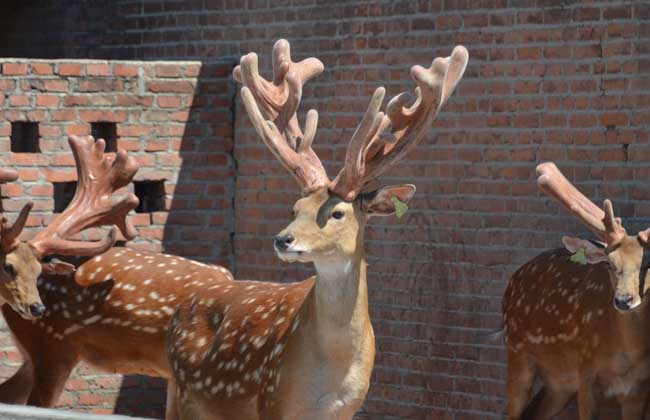
The sika deer is a medium-sized deer, with a body length of 140-170 cm, a shoulder height of 85-100 cm, and an adult weight of 100-150 kg. Females are smaller, males have antlers, usually with four tines. They live in groups most of the time, and the size of the group varies with the seasons, natural enemies, and human factors, usually 3-5 individuals and up to more than 20 at most. Now let us take a look at what sika deer antlers look like!
What do sika deer antlers look like?
Sika deer antlers look like gnarled, interlacing tree branches. Female sika deer have no antlers, while males have a pair of magnificent solid antlers on their heads. Each antler has 4 tines in total. The brow tine and the main beam form an obtuse angle and extend forward near the base. The second tine is relatively far from the brow tine and positioned higher, so it is often mistaken as absent. The main beam splits again into two small branches at its end. The main beam generally curves to both sides, forming a slightly semicircular arc. The brow tine extends horizontally forward and upward, and the antler tips curve slightly inward and are very sharp.
The habitat environment of sika deer
Sika deer live at forest edges and in mountainous grassland areas, not in dense forests or thickets, which helps them run quickly. Their habitats during the day and at night differ noticeably. During the day, they mostly choose sunny slopes with relatively deep, dense thatch grass and places where the habitat color is basically similar to their body color. At night, they rest in the middle or upper-middle part of slopes, with varying slope aspects, though sunny slopes are still the most common. The thatch grass in resting places is relatively low and sparse, so they can detect danger earlier and flee quickly.
What food do sika deer eat?
Sika deer are active at dawn and dusk, and their living areas change with the seasons. In spring, they are mostly on semi-shady slopes, feeding on the tender branches and leaves of trees and shrubs such as oak, chestnut, lespedeza, wild hawthorn, and garden burnet, as well as newly sprouted herbaceous plants. In summer and autumn, they move to forest edge areas on shady slopes, mainly feeding on vines and herbaceous plants such as kudzu, fleeceflower root, changium, and strawberries. In winter, they prefer warm sunny slopes, feeding on ripe fruits, seeds, and various mosses and lichens, occasionally coming down the mountain to feed on crops such as rapeseed and wheat, and they also often go to saline-alkali land to lick salt and alkali.
The reproductive habits of sika deer
During the breeding period, male sika deer significantly reduce their food intake and become rough and fierce in temperament. In order to compete for mates, they often engage in antler clashes, and the two antlers on their heads become weapons used to attack each other. This kind of "antler clash" is a very common phenomenon among deer. A strong male can usually have more than 10 females. In one breeding season, a female can come into estrus multiple times, with an estrous cycle of 5 days, and once pregnant she no longer comes into estrus. The gestation period is about 230 days, and birth occurs in May-June of the following year. Generally, only 1 fawn is born per litter, with a few cases of 2 fawns. The body hair of the newborn fawn is yellowish brown, also with white spots. It can stand up within a few hours and can run with the female on the second day. When the female forages, she first looks around outside the forest, and only after making sure there is no danger does she bring the fawn out. If she detects danger, she will make a startled cry and take the fawn into the dense forest. The lactation period is 2-3 months, and after 4 months the fawn can grow to about 10 kg. They reach sexual maturity at 1.5-3 years old, and their lifespan is about 20 years.
The current population status of sika deer
Historically, sika deer were overhunted and captured, and the wild population is extremely small. Wild sika deer are already a highly endangered animal in China, with a total number of less than 1,000. The North China subspecies and Shanxi subspecies have become extinct. The South China subspecies has about 200 individuals on the border of Anhui, Zhejiang, and Jiangxi, and fewer than 100 in Guangxi. The Sichuan subspecies has about 500 in northern Sichuan and southern Gansu. The Northeast subspecies may already be extinct. The Taiwan subspecies was originally extinct, but later domesticated populations were rewilded and released, and there are now about 200. It has become extinct in South Korea and Vietnam, and may already be extinct in North Korea. There are about 9,000 in eastern Russia, while Japan has about 300,000. Japanese sika deer were once on the brink of extinction, but good protection and the extinction of the Japanese wolf led to population recovery. Now, because there are no natural enemies to control them, the excessive number of sika deer has caused damage to forests and farmland.