Sika Deer Pictures: A Gallery to Admire This Beautiful Cervid
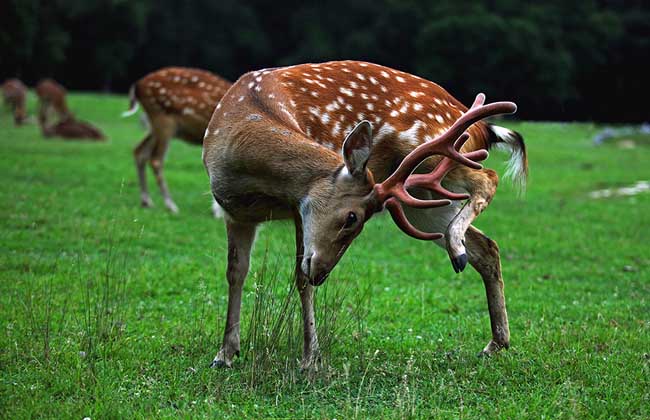
The sika deer is covered in striking white spots shaped like plum blossoms, which is why it is called the “sika deer”. It has a white rump patch and lives at forest edges or in mountain grassland areas. Its habitat changes with the seasons. Males usually live alone, but join herds during the rutting and mating season. It is active at dawn and dusk, feeds on green grass and leaves, and loves licking salt and mineral licks. It gives birth to 1 fawn per litter, and the fawn has white spots on its body. It is mainly distributed in China, Japan and Russia.
The sika deer is a medium-sized deer, with a body length of 125-145 cm, a tail length of 12-13 cm, and a body weight of 85-110 kg. The head is slightly round, the face is relatively long, the nose tip is bare, the eyes are large and round, the infraorbital gland is slit-shaped, the lachrymal pit is obvious, and the ears are long and upright. The neck is long. The limbs are slender, the main hooves are narrow and pointed, and the side hooves are small. The tail is relatively short.
The coat color of the sika deer changes with the seasons. In summer, the body hair is brownish yellow or chestnut red, with no underfur, and many irregularly arranged white spots are set along both sides of the spine and the lower edge of the flanks, resembling plum blossoms, which is how it got its name. In winter, the body hair is smoky brown, the white spots are not obvious, and it resembles the color of withered thatch grass. The neck and the back of the ears are grayish brown, a black dorsal line runs from the tips of the ears to the base of the tail, the belly is white, and there is a white patch on the rump surrounded by a ring of black hair. The upper side of the tail is black, and the underside is white.
Female sika deer have no antlers. The male has a pair of majestic solid antlers on its head, with 4 tines in total. The brow tine and the main beam form an obtuse angle, extending forward near the base. The next tine and the brow tine are relatively far apart and positioned higher, and it is often mistakenly thought that there is no next tine. The main beam splits again into two small branches at its end. The main beam generally curves to both sides, forming a slight semicircular arc, the brow tine is held crosswise forward and upward, and the tips of the antlers curve slightly inward and are very sharp.